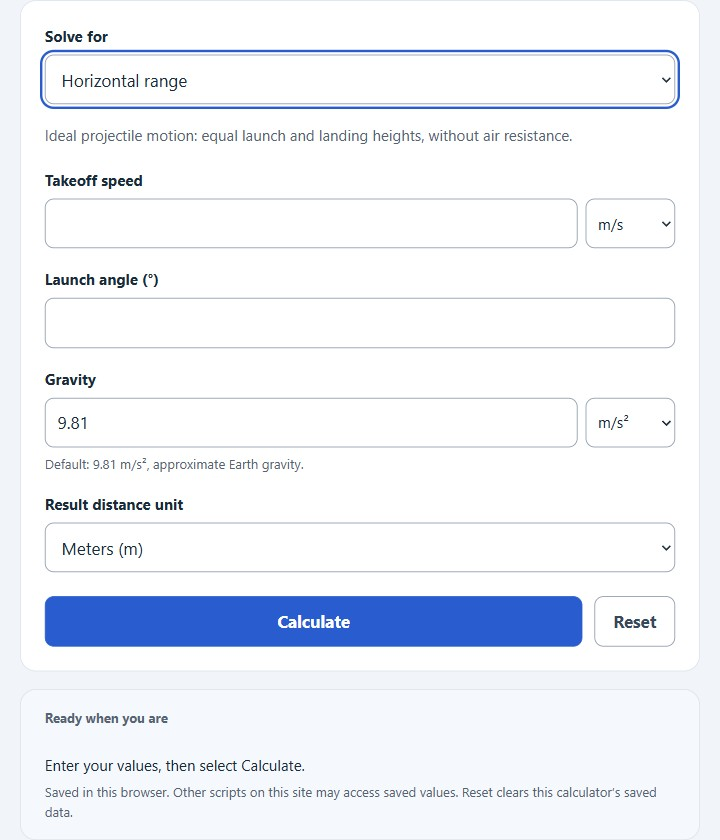
Select horizontal range, takeoff speed, launch angle, or gravity, then enter the required values. This ideal model assumes equal launch and landing heights and no air resistance. It is not for vehicle operation or stunt planning.
Related Calculators
- Air Friction Calculator
- Coefficient of Friction to Acceleration Calculator
- Bullet Travel Time Calculator
- Kinetic Energy to Force Calculator
- All Physics Calculators
Car Jump Distance Formula
The calculator uses the ideal projectile range equation. It assumes the car launches and lands at the same height, with no air resistance, no lift, no drag, and no rotation effects.
- R = jump distance, also called horizontal range
- v = initial velocity at takeoff
- theta = launch angle above the horizontal
- g = acceleration due to gravity
- sin = sine function, using the angle in degrees after conversion inside the calculator
To find jump distance, the calculator squares the launch speed, multiplies by the sine of twice the launch angle, then divides by gravity.
To find initial velocity, it rearranges the range equation and takes the square root.
To find launch angle, it solves for the angle using inverse sine. It reports the lower and complementary higher-angle solutions when distinct. At maximum range, both solutions are 45°.
To find gravity, it rearranges the range equation to solve for the acceleration needed to produce the entered distance, speed, and angle.
Common Gravity and Speed Reference Values
Use these values to check that your inputs are in the expected range.
| Quantity | Metric value | US customary value |
|---|---|---|
| Earth gravity | 9.81 m/s² | 32.17 ft/s² |
| 1 mph | 0.44704 m/s | 1.46667 ft/s |
| 30 mph | 13.4112 m/s | 44 ft/s |
| 60 mph | 26.8224 m/s | 88 ft/s |
| Launch angle | Effect in ideal range formula |
|---|---|
| 0° | No ideal vertical launch component, so range is 0 in this model. |
| 30° | Gives the same ideal range as 60° for the same speed. |
| 45° | Maximum ideal range when launch and landing heights are equal. |
| 60° | Gives the same ideal range as 30° for the same speed, but with a higher arc. |
| 90° | Straight up in the ideal model, so horizontal range is 0. |
Example Problems
Example 1: Find jump distance
A car leaves a ramp at 25 m/s with a launch angle of 20°. Use Earth gravity, 9.81 m/s².
The ideal jump distance is 40.9523 meters.
Example 2: Find initial velocity
A car needs to jump 100 ft at a 25° launch angle. Use Earth gravity, 32.17 ft/s².
The required ideal takeoff speed is 64.8035 ft/s, which is about 44.18 mph.
FAQ
Why does a 45° launch angle give the longest jump?
For equal launch and landing height, the range formula depends on sin(2*theta). The largest possible sine value is 1, which happens when 2*theta = 90°. That means theta = 45°. Real cars may not behave this way because air resistance, ramp shape, vehicle attitude, and suspension movement affect the jump.
How do I choose what to calculate?
Choose the quantity in Solve for. Only the inputs needed for that calculation are shown. Gravity defaults to 9.81 m/s² when it is an input; change it when appropriate. Zero values and angles of 0° or 90° can make an inverse calculation impossible or nonunique; the calculator explains those cases.
Can this be used for real car stunt planning?
This gives an ideal physics estimate only. Real vehicle jumps include drag, lift, ramp curvature, tire contact, suspension rebound, vehicle pitch, landing height difference, and safety margins. Do not use this result by itself for stunt design or vehicle operation.