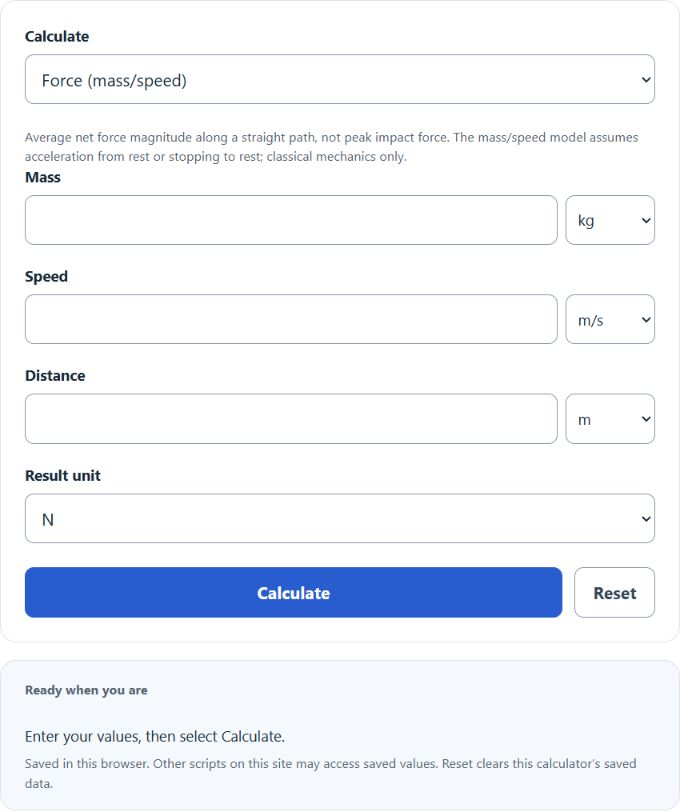
Calculate mass, velocity, distance, or force in kinetic energy equations, or find energy from force and distance with common unit conversions.
- All Physics Calculators
- Mechanics and Physics Unit Converters
- All Force Calculators
- Energy To Force Calculator
- Speed to Force Calculator
- Average Kinetic Energy Calculator
Kinetic Energy to Force Formula
The following equation is used to calculate the force from kinetic energy.
- Where F is the average net force magnitude along the path (N)
- m is the mass (kg)
- v is the speed (m/s), with acceleration from rest or stopping to rest assumed
- d is the distance (m)
To calculate average net force magnitude along a straight path, divide the magnitude of the kinetic energy change by the positive distance. The formula above assumes that one endpoint is at rest; it does not give peak impact force.
| Mass (kg) | Velocity (m/s) | Distance (m) | Force (N) |
|---|---|---|---|
| 1 | 1 | 1 | 0.500 |
| 1 | 2 | 1 | 2.000 |
| 1 | 3 | 1 | 4.500 |
| 1 | 5 | 1 | 12.500 |
| 2 | 1 | 1 | 1.000 |
| 2 | 2 | 1 | 4.000 |
| 2 | 3 | 1 | 9.000 |
| 2 | 5 | 1 | 25.000 |
| 5 | 1 | 1 | 2.500 |
| 5 | 2 | 1 | 10.000 |
| 5 | 3 | 1 | 22.500 |
| 5 | 5 | 1 | 62.500 |
| 10 | 1 | 1 | 5.000 |
| 10 | 2 | 1 | 20.000 |
| 10 | 3 | 1 | 45.000 |
| 10 | 5 | 1 | 125.000 |
| 20 | 1 | 1 | 10.000 |
| 20 | 2 | 1 | 40.000 |
| 20 | 3 | 1 | 90.000 |
| 20 | 5 | 1 | 250.000 |
| *SI units. Formula: F = (m × v²) / (2 × d). All rows assume distance d = 1 m for clarity. | |||
Can kinetic energy be converted to force?
A kinetic energy change and a distance can determine the average net force component along a straight path. Net work equals the change in kinetic energy; for this model, the average force magnitude is |ΔK| / d. Total kinetic energy alone is sufficient only when the other endpoint is at rest.
How to convert kinetic energy to force?
Example Problem:
The following example outlines the steps and information needed to calculate force from kinetic energy.
First, determine the mass. For this problem, the mass is calculated to be 25 kg.
Next, determine the velocity. The velocity of the object is 10 m/s.
Next, determine the distance. Assume the object stops from 10 m/s to rest over a straight 100 m path.
Finally, calculate the force using the formula above:
F = 1/2*m*v^2 / d
F = 1/2*25*10^2 / 100
F = 12.5 N (average net stopping force magnitude)
FAQ
What is kinetic energy and how is it different from potential energy?
Kinetic energy is the energy that an object possesses due to its motion. It is calculated based on the mass and velocity of the object. Potential energy, on the other hand, is the energy stored in an object due to its position, condition, or composition. For example, an object at a certain height above the ground has gravitational potential energy.
Why is the distance over which the force acts important in converting kinetic energy to force?
The distance over which the force acts is crucial because it directly affects the amount of force applied. According to the work-energy principle, work done (force times distance) is equal to the change in kinetic energy. Therefore, knowing the distance allows for the calculation of the force required to achieve a certain change in kinetic energy.
Can the formula for converting kinetic energy to force be used for any type of motion?
The formula F = 1/2*m*v^2 / d gives the average net force magnitude along a straight stopping path, or acceleration from rest. The force may vary; this is a distance average, not a peak force. For two nonzero endpoint speeds use |ΔK| = 1/2*m*|vf^2 – vi^2|. General curved or rotational motion requires the appropriate work integral.