Calculate carbon-fiber part weight for plates, tubes, and fabric layups with mixed units, editable density, ply count, resin ratio, and waste quantities.
- All Construction Calculators
- All Weight Calculators
- Tungsten Weight Calculator
- Titanium Weight Calculator
Carbon Fiber Weight Formulas
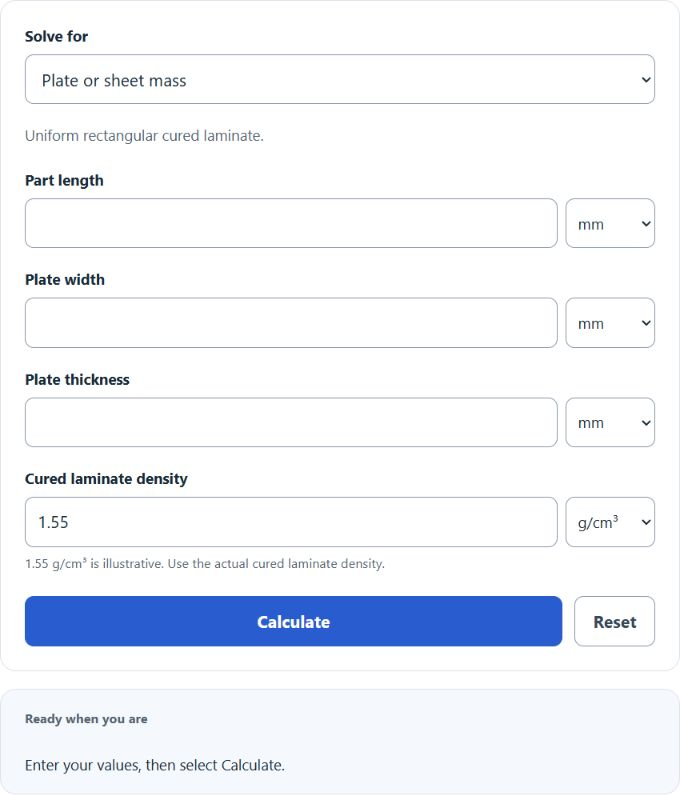
The calculator supports rectangular plates/sheets, round hollow tubes, fabric layup materials, and maximum layup area from a finished mass budget. The additional shape formulas below are reference formulas rather than selectable modes.
For a layup, dry fiber mass = area × fabric areal mass × plies; finished laminate mass = dry fiber mass × (1 + resin-to-fiber mass ratio). Maximum area = finished mass budget ÷ [fabric areal mass × plies × (1 + resin ratio)]. Purchase allowance applies only to material purchases, not finished-part mass. The plies count must be a positive whole number.
Carbon Fiber Flat Sheet / Rectangular Bar Weight Formula = L * W * T * d
Carbon Fiber Round Bar Weight Formula = π * (D^2/4) * L * d
Carbon Fiber Square / Rectangular Hollow Tube Weight Formula = [W*H - (W-2T)*(H-2T)] * L * d
Carbon Fiber Round Hollow Tube Weight Formula = π * (R^2-r^2) * L * d
Carbon Fiber Square Angle (equal-leg) Weight Formula = (2*W*T - T^2) * L * d
Carbon Fiber T Bar Weight Formula = [W*T1 + (H - T1)*T2] * L * d
Carbon Fiber C Channel Weight Formula = (2*W*T1 + H*T2) * L * d
Variables used in these equations:
- L is the length
- W is the width (or flange width, depending on the shape)
- H is the height (for hollow tubes, H is the outer height; for the C-channel formula, H is the inner web height between flanges)
- d is the density
- D is the diameter
- T is the thickness / wall thickness
- R is the outer radius
- r is the inner radius
- T1 is the flange thickness (width direction) for T-bars/C-channels
- T2 is the web thickness (height direction) for T-bars/C-channels
Choose the unit next to each input. The calculator converts each value internally, so dimensions and density do not need matching displayed unit systems. Lengths accept mm, cm, m or inches; density accepts g/cm³, kg/m³ or lb/in³. Layup modes also convert area, dry fabric areal mass and the finished mass budget. Results estimate mass in grams, kilograms, pounds and ounces.
What is the density of carbon fiber?
Use the density of the actual cured laminate. The calculator’s 1.55 g/cm³ default and its 1.45–1.65 g/cm³ sensitivity comparison are illustrative assumptions. Product values vary: Toray’s listed T700S laminate has a stated density of 1.60 g/cm³, while Toray T300 bare fiber is 1.76 g/cm³. Bare-fiber density is not a substitute for cured-laminate density.