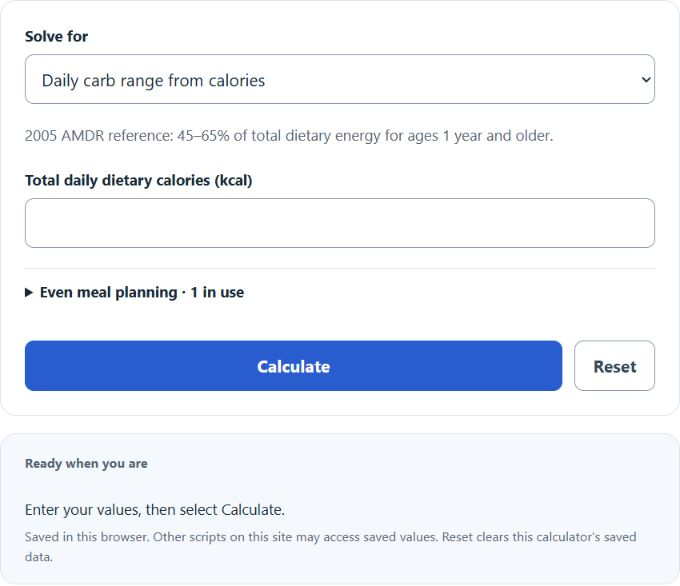
Calculate daily carbohydrate grams from calories using the 45–65% AMDR, set a custom carb percentage, or find what share of calories comes from entered carbs.
- All Health and Medical Calculators
- Macros Calculator
- Body Fat Calculator
- Ideal Weight Calculator
- Net Carbs Calculator
- Grams of Fat to Calories Calculator
Daily Carbs Formula
This calculator converts an entered daily calorie amount into carbohydrate grams. It does not estimate calorie needs from body weight, height, age or activity.
Reference range (g/day) = daily kcal × 0.45 ÷ 4 to daily kcal × 0.65 ÷ 4.
Custom grams/day = daily kcal × (percentage ÷ 100) ÷ 4.
Carbohydrate calorie share (%) = grams/day × 4 ÷ daily kcal × 100.
The general Atwater factor of approximately 4 kcal per gram provides this simplified conversion. The optional meal count divides the daily amount evenly among 1–12 whole eating occasions; it does not prescribe a meal pattern. If carbohydrate energy exceeds total entered calories, check the inputs.
Daily Carbs Definition
The 2005 carbohydrate AMDR reference is 45–65% of dietary energy for ages one year and older. At 2,000 kcal/day this corresponds to 225–325 g/day. A custom 55% share gives 275 g/day; 250 g/day at 2,000 kcal represents 50% of calories. The custom 0–100% input range is a mathematical domain, not a recommended diet range.
The carbohydrate RDA is a separate reference: 130 g/day for nonpregnant, nonlactating people age one and older, 175 g/day during pregnancy and 210 g/day during lactation. Infants have separate adequate-intake values. The calculator does not clamp percentage results to the RDA. Total carbohydrate differs from added sugar and net carbs.
Method notes: These are healthy-population references, not individualized prescriptions. The National Academies’ 2024 review recommended replacing the AMDR framework in future DRI reviews and allowed interim use with its limitations. Medical conditions, medications, pregnancy, lactation and athletic training can require individualized advice. References: National Academies AMDR review and carbohydrate dietary reference values.