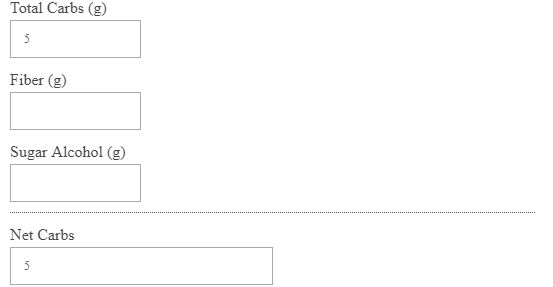
Calculate net carbs from total carbs, fiber, and sugar alcohols, plus adjusted carbs, portion totals, and recipe carbs per serving.
Note: “Net carbs” is an informal estimate and not a standardized nutrition-label value. This tool is for educational use only and not medical advice. If you have diabetes, are pregnant, or take glucose-lowering medication, follow the carbohydrate-counting approach recommended by your clinician/care team (often total carbohydrate) and do not rely on this tool for medication dosing; nutrition-label rules and fiber/allulose/sugar-alcohol reporting can vary by country and product.
- All Food and Cooking Calculators
- Ideal Body Weight Calculator
- Body Fat Calculator
- Carbs Calculator (Carbohydrates per Day)
- %DV Calculator (Percent Daily Value)
Net Carbs Formula
A common way to estimate net carbs (especially when using U.S./Canada-style nutrition labels where “Total Carbohydrate” includes fiber and sugar alcohols) is:
- Where TC is the total carbs
- F is the total fiber
- SA is the amount of sugar alcohols you subtract (this may be 0%–100% of listed sugar alcohols depending on type and your method)
To estimate net carbs, subtract dietary fiber and then subtract the portion of sugar alcohols you are treating as “non-impact.” Note: “net carbs” is not an official nutrition-label number and methods vary; some sugar alcohols can still contribute calories and may raise blood glucose for some people (especially at higher doses). Also, in some countries, “carbohydrate” on the label already excludes fiber, so you generally would not subtract fiber again.
How to Calculate Net Carbs
Calculating net carbohydrates is a key process in many modern diets, including the Atkins and keto diets. “Net carbs” is an informal estimate meant to approximate the carbohydrates most likely to be absorbed and potentially raise blood glucose.
What's the point of calculating net carbs?
Well, there could be several reasons. One, you could be on either a ketogenic diet (also known as keto) or an Atkins type of diet, where you are required to stay below a certain number of carbs per day. Two, you could be an athlete that tracks your macros. (Macros is short for macronutrients which generally include fats, carbohydrates, and proteins.) Three, you could have diabetes or another health condition where it’s important to manage carbohydrate intake and monitor blood sugar levels. Or maybe you are just a health nerd that likes to track your food.
Whatever the reason, one motivation for tracking net carbs (instead of total carbs) is that most dietary fiber is not digested in the small intestine, and many sugar alcohols are only partially absorbed. Because of that, they often have a smaller effect on blood glucose than sugars and starches—but the effect varies by the specific ingredient, the amount consumed, and the person. Many sugar alcohols also provide some calories (often less than sugar’s ~4 kcal/g, but not always zero).
That’s not to say fiber isn’t important. Adequate fiber intake supports regular bowel movements and gut health. While some fiber passes through largely intact, some types can be fermented by gut bacteria into short-chain fatty acids, which can have metabolic effects and can contribute a small amount of energy.
One last note on net carbs, specifically sugar alcohols: sugar alcohols (also called polyols) are used as sweeteners and bulking agents and can cause gastrointestinal symptoms (like gas, bloating, or diarrhea) in some people, especially in larger amounts. Their effects on blood glucose and overall health can vary by type and dose, so it can be helpful to read nutrition labels carefully and discuss dietary changes with a qualified healthcare professional if you have a medical condition.