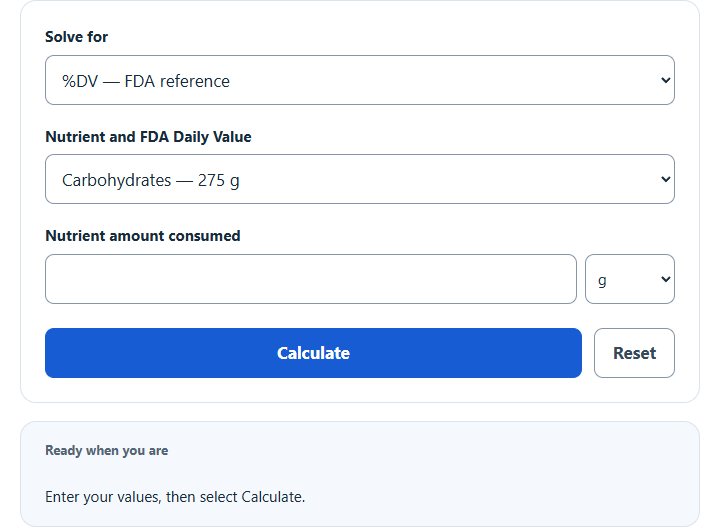
Calculate %DV from total nutrient amount and FDA or custom Daily Value, or find the amount needed for a target %DV in g, mg, or mcg.
- All Food and Cooking Calculators
- AMDR Calculator
- Macro Calculator
- Net Carbs Calculator
- Percentage of Calories Calculator
- Carbs Calculator
- Protein Calculator
- Calorie Calculator
Calculator Functions
| Function | What it does | What it requires |
|---|---|---|
| %DV — FDA reference | Finds the percent of the FDA Daily Value that an amount of a nutrient supplies | Requires the nutrient and the amount consumed in g, mg or mcg |
| Nutrient amount — FDA reference | Converts a %DV into the amount of the nutrient it stands for | Requires the nutrient, the target percentage and a result unit |
| Percentage — custom reference | Finds an amount as a percentage of any reference amount, such as a personal daily target | Requires the custom reference amount and the amount consumed, each in g, mg or mcg |
| Nutrient amount — custom reference | Converts a percentage of a custom reference into an amount | Requires the custom reference amount, the target percentage and a result unit |
The two FDA functions cover 16 nutrients, listed with their Daily Values in the table below. Amounts can be entered in grams, milligrams or micrograms and are converted to the unit of the Daily Value before dividing (1 g = 1,000 mg = 1,000,000 mcg).
%DV Formula
| %DV | Percent Daily Value (%) |
| A | Amount of the nutrient consumed, in the same unit as DV |
| DV | Daily Value of the nutrient, the reference amount used on Nutrition Facts labels |
The FDA describes %DV as the share of a nutrient’s Daily Value that one serving supplies: a serving with 30 mcg of a nutrient whose Daily Value is 300 mcg has a %DV of 10% [1].
%DV — FDA reference
The formula applies directly, with DV taken from the table. 300 g of carbohydrates is 300 ÷ 275 × 100 = 109.0909% of the Daily Value, and 460 mg of sodium is 460 ÷ 2,300 × 100 = 20%.
| Nutrient | FDA Daily Value |
|---|---|
| Carbohydrates | 275 g |
| Total fat | 78 g |
| Saturated fat | 20 g |
| Cholesterol | 300 mg |
| Protein | 50 g |
| Sodium | 2,300 mg |
| Dietary fiber | 28 g |
| Added sugars | 50 g |
| Vitamin C | 90 mg |
| Vitamin D | 20 mcg |
| Vitamin B6 | 1.7 mg |
| Zinc | 11 mg |
| Calcium | 1,300 mg |
| Iron | 18 mg |
| Potassium | 4,700 mg |
| Vitamin A | 900 mcg RAE |
These are the Daily Values in the FDA reference guide as of November 12, 2026 (the FDA page was last updated March 5, 2024) [1]. The guide lists 19 more vitamins and minerals; for those, use a custom reference.
Nutrient amount — FDA reference
This turns a label percentage back into an amount. 4% DV of potassium is 4 ÷ 100 × 4,700 mg = 188 mg, or 0.188 g, and 25% DV of calcium is 325 mg.
Percentage — custom reference
The main formula is used with a reference amount of any size in place of the FDA Daily Value. Against a personal protein target of 120 g, 45 g of protein is 45 ÷ 120 × 100 = 37.5%.
Nutrient amount — custom reference
The amount formula is used with the custom reference in place of DV. 25% of a 1,500 mg sodium limit is 25 ÷ 100 × 1,500 = 375 mg.
How to Calculate % Daily Value
Take the amount of the nutrient in the serving, or the total eaten, and put it in the same unit as the nutrient’s Daily Value. Divide the amount by the Daily Value and multiply by 100. A serving with 12 g of dietary fiber supplies 12 ÷ 28 × 100 = 42.86% of the Daily Value. Nutrition Facts labels print the figure rounded to the nearest whole percent, so that serving would show 43% [2]. As a general guide, 5% DV or less per serving is low and 20% DV or more is high [1].
Limits of This Estimate
- The Daily Values here are the labeling references for adults and children 4 years and older, and those for carbohydrates, fat, saturated fat, fiber, protein and added sugars are based on a 2,000 calorie diet [2]. They are not personal nutrition targets. Infants, children 1 through 3, and pregnant or lactating women have different label values [2].
- The result is an unrounded percentage, not a label declaration. A label rounds %DV to the nearest whole percent, and a protein %DV on a label is based on the protein amount corrected for protein quality [2]; this calculator compares mass only.
- The FDA guide has a Daily Value for added sugars and none for total sugars [1], so total sugars cannot be given a %DV.
- A custom reference is an arithmetic comparison. It is not an FDA Daily Value or a medical recommendation; for individual advice, consult a clinician or registered dietitian.
Sources
- U.S. Food and Drug Administration, Daily Value on the Nutrition and Supplement Facts Labels: how %DV is worked out, the Daily Value of each nutrient, and the 5% and 20% guide
- Code of Federal Regulations, 21 CFR 101.9, Nutrition labeling of food: the age groups and 2,000 calorie basis of the Daily Values, rounding to the nearest whole percent, and the protein quality correction