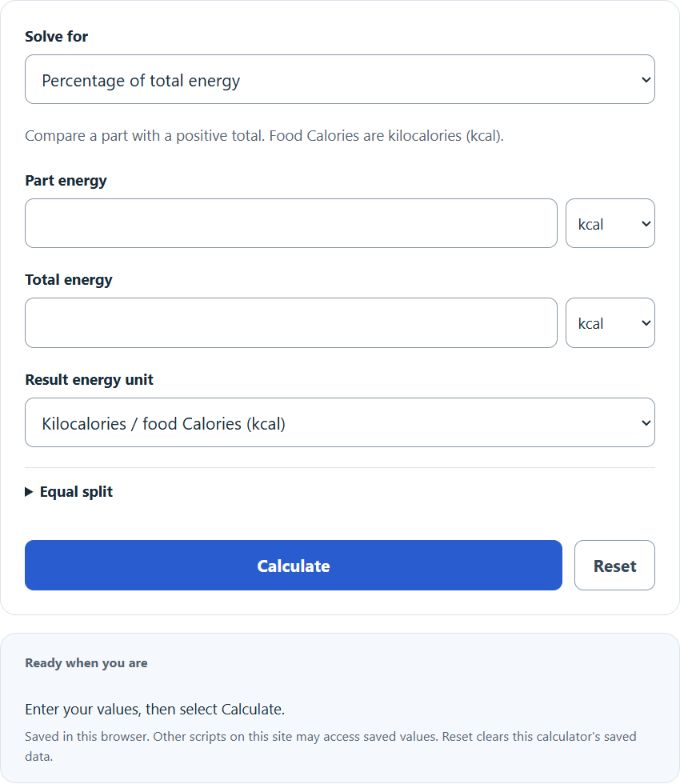
Calculate what percentage one calorie amount contributes to a total, reverse-solve calories or total intake, and break down protein, carbs, fat, and alcohol.
- All Food and Cooking Calculators
- BMR Calculator
- Calorie Calculator
- Calorie Target Calculator
- Macro Calculator
- AMDR Calculator
- Carbs Calculator
- Weight Loss Calculator
Percentage of Calories Formula
The calculator compares part and total energy, solves either energy from a percentage, or estimates energy and shares from macro grams. Its general factors are 4 kcal/g for protein and carbohydrate, 9 kcal/g for fat, and 7 kcal/g for ethanol. Food labels can differ because of food-specific factors, fiber, sugar alcohols, and rounding.
- Total Calories: The positive energy total for the same quantity or time period as the part. Food Calories are kilocalories (kcal).
- Macro Percent: The percent of calories assigned to protein, carbohydrate, fat, or alcohol.
- Macro Calories: Calories supplied by one macro.
- Macro Grams: The entered gram amount, or a gram amount calculated manually in Example 1.
- Calories Per Gram: General energy factors of 4 kcal/g for protein and carbohydrate, 9 kcal/g for fat, and 7 kcal/g for ethanol; ethanol grams are not the total mass of an alcoholic drink.
Energy from a percentage multiplies a positive total by the entered percentage. Example 1 then converts the calories into grams manually using a general energy factor; the calculator has no percent-to-grams control.
Energy and shares from macro grams estimates energy from protein, carbohydrate, fat, and ethanol grams. Each share uses the sum of those four estimated energy amounts as its denominator, including ethanol. This mode does not use a separately entered known total.
Percentage of total energy compares a part with a positive total. Total energy from a percentage reverses that relationship; zero energy at 0% has no unique positive total. These modes compare entered energy rather than estimating personal calorie needs.
Blank macro gram fields count as zero; at least one must be positive. Required energy and percentage fields are not filled automatically. Optional meals or servings divide the part energy equally, or divide all estimated energy in macro mode.
Calorie Factors and Illustrative Macro Splits
Use these factors to check the arithmetic below. All listed splits are illustrative, not dietary recommendations or universal balanced ranges. For adult context (ages 19 and older), AMDR reference ranges are 10-35% protein, 45-65% carbohydrate, and 20-35% fat; individual needs vary. The 30/40/30 example has carbohydrate below that adult reference range.
| Nutrient | Calories per gram | Used for |
|---|---|---|
| Protein | 4 kcal/g | Protein calorie and gram targets |
| Carbohydrate | 4 kcal/g | General carbohydrate energy estimate; no automatic fiber subtraction |
| Fat | 9 kcal/g | Fat calorie and gram targets |
| Alcohol | 7 kcal/g | Energy estimate from grams of ethanol |
| Split | Protein | Carbs | Fat | Alcohol |
|---|---|---|---|---|
| Example 30/40/30 | 30% | 40% | 30% | 0% |
| Higher carb | 25% | 50% | 25% | 0% |
| Lower carb | 30% | 20% | 50% | 0% |
| Keto style | 25% | 5% | 70% | 0% |
| Includes alcohol | 20% | 50% | 25% | 5% |
Examples
Example 1: Convert calorie percentages to grams
You have a 2,000 kcal target and use a 30% protein, 40% carbohydrate, 30% fat, and 0% alcohol split.
- Protein calories = 2,000 × 30% = 600 kcal. Protein grams = 600 ÷ 4 = 150 g.
- Carb calories = 2,000 × 40% = 800 kcal. Carb grams = 800 ÷ 4 = 200 g.
- Fat calories = 2,000 × 30% = 600 kcal. Fat grams = 600 ÷ 9 = 66.7 g.
Example 2: Convert grams to percentages
You enter 120 g protein, 200 g carbs, 67 g fat, and 0 g alcohol. You do not enter a known total calorie value.
- Protein calories = 120 × 4 = 480 kcal.
- Carb calories = 200 × 4 = 800 kcal.
- Fat calories = 67 × 9 = 603 kcal.
- Total macro calories = 480 + 800 + 603 = 1,883 kcal.
- Protein = 480 ÷ 1,883 × 100 = 25.5%.
- Carbs = 800 ÷ 1,883 × 100 = 42.5%.
- Fat = 603 ÷ 1,883 × 100 = 32.0%.
FAQ
Why do fat grams look lower than carb or protein grams?
Fat has more calories per gram. One gram of fat has 9 calories, while protein and carbohydrate each have 4 calories per gram. For the same calorie percentage, fat will produce fewer grams.
Should you use total carbs or net carbs?
The calculator applies its general 4 kcal/g factor to the carbohydrate grams you enter. It does not subtract fiber or adjust sugar alcohols, and its estimate may differ from a food label. Check which carbohydrate definition your source uses rather than assuming this model reproduces label energy.
Why do macro calories not always match total calories?
General energy factors, food-specific factors, fiber, sugar alcohols, and label rounding can produce different totals. The macro mode divides by its own four-source estimated total; it has no known-total denominator or separate untracked-calories control. Its shares sum mathematically to 100%, although independently rounded displayed shares may differ slightly.