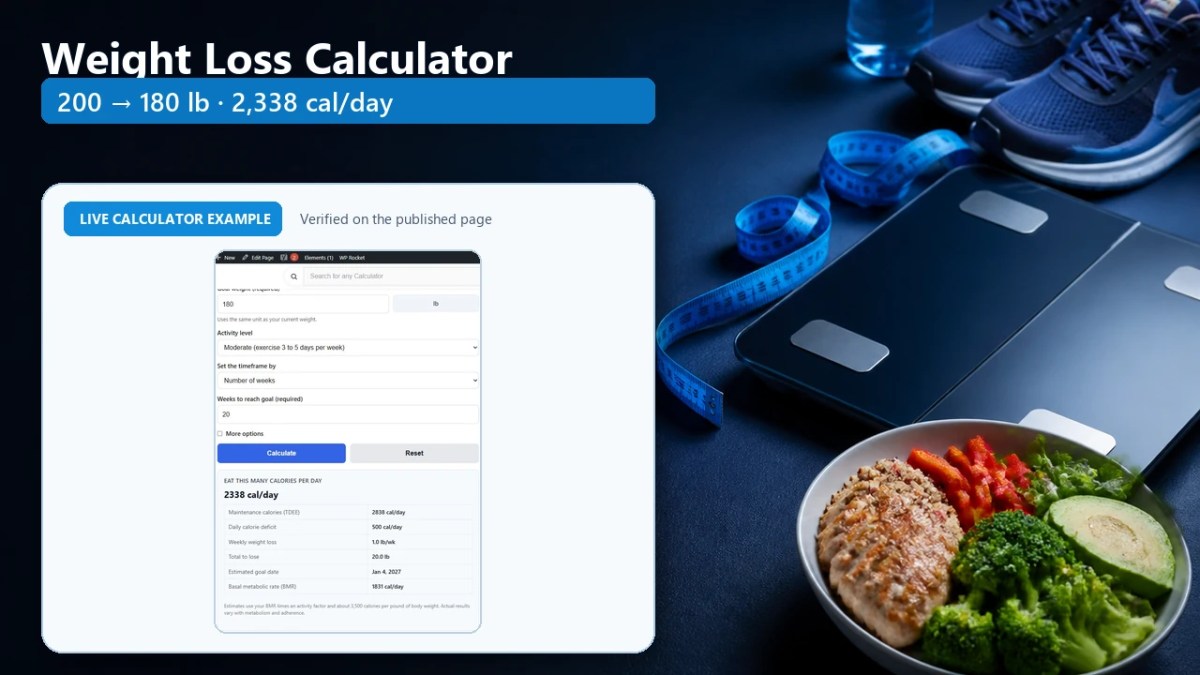
Estimate daily calories for weight loss or maintenance based on your weight, height, age, gender, activity level, and weekly weight goal.
Important: This calculator provides an educational estimate and is not medical advice. Do not use for children/teens, pregnancy or breastfeeding, or if you have a history of eating disorders or a medical condition/medications that affect weight. For personalized targets (and for rapid weight loss), consult a licensed healthcare professional and review public-health guidance (for example, CDC/NIH recommendations).
- All Health and Medical Calculators
- Calorie Calculator
- Body Fat Calculator
- Weight Loss Percentage Calculator
- METS (Metabolic Equivalent) Calculator
- Calorie Target Calculator
- Matched Weekday Weight Comparison Calculator
Watch the full explainer with transcript and worked examples.
How This Weight Loss Calculator Works
This calculator estimates how many calories you can eat each day to maintain weight or lose weight at a chosen weekly rate. It uses your body data to estimate resting calorie needs, adjusts for activity, and then applies a calorie deficit based on your goal.
Core Formula
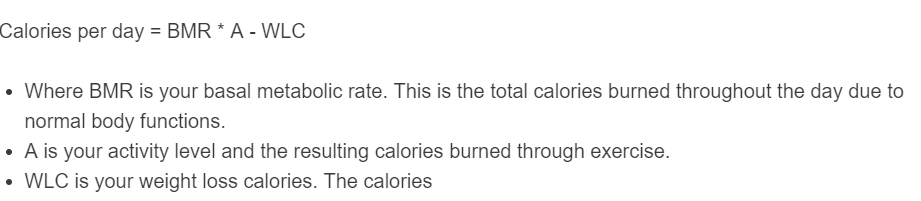
The calculation follows this structure:
BMR is your estimated basal metabolic rate, AF is your activity factor, and TDEE is your total daily energy expenditure.
What Each Input Changes
| Input | Why It Matters | Practical Tip |
|---|---|---|
| Weight | Heavier bodies usually burn more calories at rest and during movement. | Use current body weight, not goal weight. |
| Height | Taller individuals often have higher baseline calorie needs. | Enter height carefully; small errors change the estimate. |
| Age | Estimated calorie needs generally decline with age. | Use full years for the most accurate estimate. |
| Gender | Body composition differences affect calorie estimation. | Select the option used by the calculator formula. |
| Activity Level | Activity adjusts resting calorie needs upward to estimate daily burn. | Choose based on your normal week, not your best week. |
| Weight Goal | Your target rate determines the calorie deficit applied. | More aggressive goals are harder to sustain. |
Goal Rate and Approximate Daily Deficit
| Goal | Approx. Daily Deficit | Typical Use |
|---|---|---|
| Maintain weight | 0 calories/day | Holding current weight steady |
| Lose 0.5 lb/week | ~250 calories/day | Small, easier-to-maintain deficit |
| Lose 1.0 lb/week | ~500 calories/day | Common moderate target |
| Lose 1.5 lb/week | ~750 calories/day | More aggressive, needs strong adherence |
| Lose 2.0 lb/week | ~1000 calories/day | Very aggressive; not suitable for everyone |
How to Use the Result
- If the calculator gives maintenance calories: eat near that level to hold weight steady.
- If it gives a fat-loss target: treat it as a starting estimate, not an exact guarantee.
- Track trends weekly: compare 7-day average body weight instead of single weigh-ins.
- Recalculate after progress: calorie needs usually decrease as body weight decreases.
- Adjust slowly: if progress stalls for 2 to 3 consistent weeks, review intake accuracy and activity before cutting calories further.
Activity Level Selection Guide
| Calculator Option | Usually Means |
|---|---|
| Not Active | Mostly sedentary day, little planned exercise |
| 1-2 hours of exercise/week | Light activity with a small amount of structured training |
| 3-5 hours of exercise/week | Moderate routine with regular training most weeks |
| 6-10 hours of exercise/week | High training volume or very active lifestyle |
Why Actual Weight Loss May Differ
| Reason | What Happens |
|---|---|
| Water retention | Scale weight can stay flat even while body fat decreases. |
| Inaccurate food tracking | Portions, oils, snacks, and drinks are often undercounted. |
| Activity overestimation | Choosing too high an activity level raises calorie targets too much. |
| Weekend inconsistency | Large weekend surpluses can erase weekday deficits. |
| Body adaptation | Calorie needs may drop slightly as weight and activity change. |
Quick Planning Reference
If you know how much weight you want to lose, you can estimate the timeline with your chosen weekly rate:
Example: a 12 lb target at 1 lb per week is about 12 weeks, assuming consistent adherence and stable conditions.
Important Notes
- This calculator is best used as an educational estimate.
- Daily calorie needs are not fixed; they change with body weight, activity, sleep, stress, and adherence.
- Extremely low calorie targets can reduce energy, training performance, and long-term consistency.
- This type of estimate is not appropriate for children, teens, pregnancy, breastfeeding, eating disorders, or medical situations that affect weight regulation.
FAQ
Is losing 1 to 2 pounds per week reasonable?
For many adults, yes. It is often used as a practical balance between speed and sustainability.
Should I eat back exercise calories?
If your activity level already reflects your normal training, the calculator has already accounted for it in the estimate.
When should I recalculate?
Recalculate whenever your body weight, routine, or training volume changes meaningfully.
Why did my result change after switching units?
Minor rounding differences can appear when converting between pounds/kilograms or inches/centimeters.