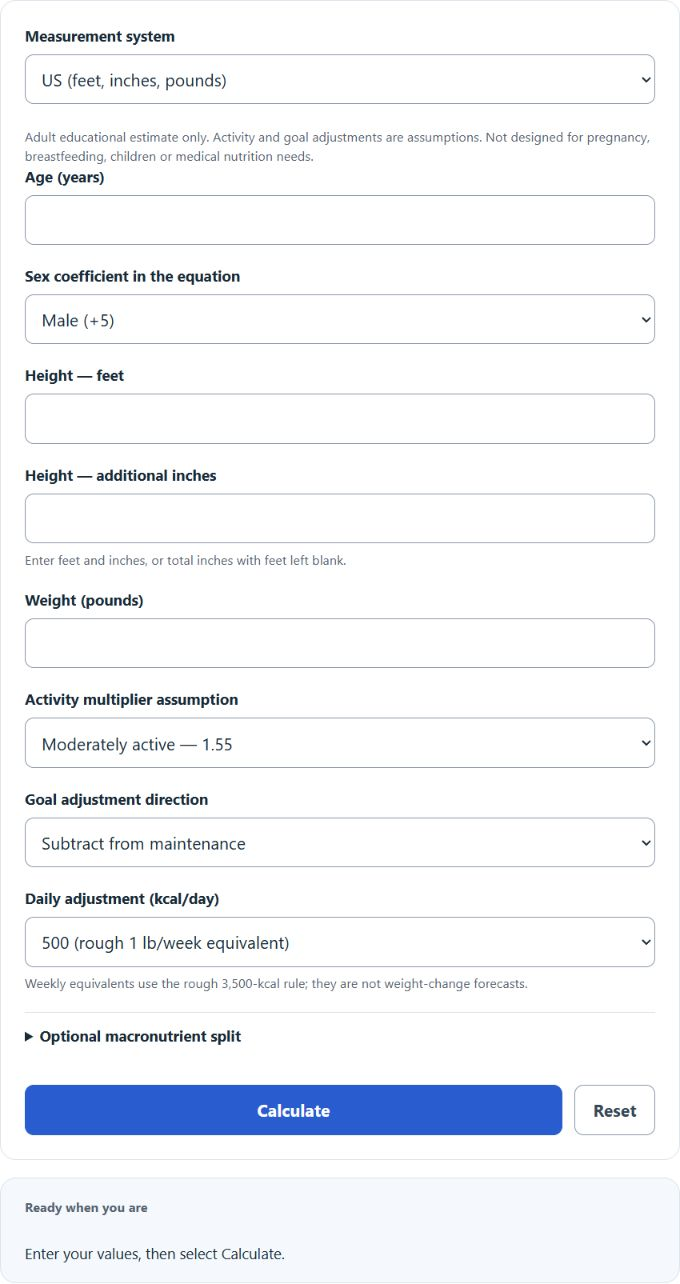
Estimate an adult daily calorie target from a resting-energy equation, an activity assumption and a chosen daily adjustment. The result and optional macro splits are educational estimates, not personal intake prescriptions.
Disclaimer: This calculator provides a general estimate and is not medical advice. Calorie needs vary by individual. If you are under 18, pregnant/breastfeeding, have a medical condition (such as diabetes, heart/kidney disease), take medications that affect appetite/weight, or have a history of eating disorders, consult a clinician or registered dietitian before changing your intake.
- All Health and Medical Calculators
- Weight Loss Calculator
- Weight Loss Percentage Calculator
- Maintenance Calories Calculator
- Calorie Calculator
- BMR Calculator
Calorie Target Calculator
The following formula is used to calculate a calorie target:
- Where C is the target calories (estimated daily intake)
- TDEE is the estimated total daily energy expenditure (based on BMR multiplied by an activity factor)
- GA is the goal adjustment in calories per day (negative for weight loss, positive for weight gain)
To learn more about BMR and daily calorie needs, visit the calculators linked above.
In this case, the formula estimates the target amount of calories you can eat to work toward weight loss, gain, or maintenance goals.
What is a calorie target?
A calorie target is a planned daily energy intake. This calculator estimates one arithmetically; the result does not establish nutritional adequacy, individual safety or a guaranteed weight change.
These goals can include weight loss, gain, maintenance and sports performance. An appropriate plan depends on individual needs, health and nutrition; an equation alone cannot ensure the result is suitable.
How to calculate a calorie target?
The following example is a step-by-step solution on how to estimate how many calories a person should target per day based on their goals.
First, determine the person’s individual height, weight, age, and sex metrics. For this example, the person has the following characteristics:
Weight = 200 lbs
Height = 72 inches (6 ft)
Age = 25 years old
Sex = Male
Next, calculate the BMR of the individual using the Mifflin–St Jeor equation (an estimate):
Weight in kg = 200 ÷ 2.20462 ≈ 90.72 kg
Height in cm = 72 × 2.54 = 182.88 cm
BMR = (10 × 90.72) + (6.25 × 182.88) − (5 × 25) + 5 ≈ 1930 calories/day
Next, estimate total daily energy expenditure (TDEE) using an activity factor. In this case, the person is moderately active (activity factor ≈ 1.55):
TDEE = 1930 × 1.55 ≈ 2992 calories/day
Next, choose an illustrative daily adjustment. In this example, GA = −500 kcal/day. The rough 3,500-kcal-per-pound rule does not predict exact weekly weight change, because energy expenditure and body composition change over time. See NIH dynamic weight-change research.
Finally, calculate the calorie target using the formula above:
C = TDEE + GA
C = 2992 + (−500)
C ≈ 2492 calories per day
FAQ
What factors influence the Basal Metabolic Rate (BMR)?
BMR is influenced by several factors including age, sex, weight, height, and overall genetic composition. Muscle mass also plays a significant role, as individuals with more muscle mass typically have a higher BMR.
How does physical activity level impact calorie needs?
Physical activity level significantly impacts calorie needs by increasing the number of calories your body burns per day. The more active you are, the higher your calorie needs will be to maintain or achieve your weight goals.
Can weight loss goals affect your calorie target significantly?
Yes, weight loss goals can significantly affect your calorie target. To lose weight, you need to create a calorie deficit, which means eating fewer calories than your body burns. The size of the deficit will influence the rate of weight loss.
Why is it important to accurately calculate a calorie target?
Accurately calculating a calorie target is crucial for achieving specific fitness and health goals, such as weight loss, muscle gain, or maintenance. An equation provides a starting estimate; it cannot ensure nutritional adequacy or that an intake avoids underfeeding or overfeeding.