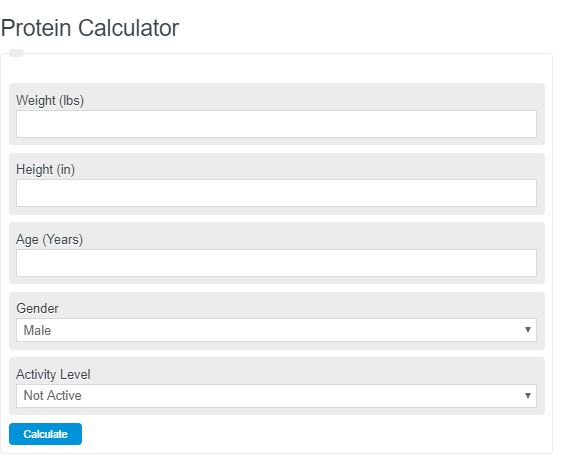
Estimate daily protein in grams from body weight and activity or training range, with per-meal targets, calories, unit conversion, and reverse planning.
Disclaimer: This tool provides an educational estimate only and is not medical advice. If you have kidney or liver disease, are pregnant/breastfeeding, are under 18, have diabetes, or follow a medically prescribed diet, talk with a clinician or registered dietitian before changing your protein intake.
- All Health and Medical Calculators
- Bulking Calculator
- Carbs Calculator
- Macro Calculator
- Grams of Fat to Calories Calculator
Protein Intake Formula
This calculator primarily estimates your daily protein target from body weight using a grams-per-kilogram (g/kg) range based on activity level. It can also show an optional calories-based comparison (using your entered calories or an estimated TDEE).
P = Wkg × r
Optional calories comparison: Pcal = (Protein% × Calorieskcal) / 4
Optional TDEE estimate (Mifflin–St Jeor): BMR = 10Wkg + 6.25Hcm − 5a + S; TDEE = BMR × m
TDEE estimate source: Academy of Nutrition and Dietetics: Mifflin–St. Jeor Equations
- Where P is the daily protein target (grams/day)
- Wkg is your body weight in kilograms (kg)
- r is the protein factor in g/kg based on activity level (this calculator uses a common activity-based range of 0.8 to 2.2 g/kg; individual needs vary)
- Optional calories comparison: Protein% varies by activity level (15%–30% in this calculator) and the calculator uses 4 kcal per gram of protein
- Optional TDEE estimate: a is age (years), Hcm is height (cm), S = +5 (male) or −161 (female), and m is an activity multiplier
For the optional calories-based comparison, the calculator uses a protein calorie percentage that increases with activity level (15%–30%) and assumes 4 kcal per gram of protein. This is a rough comparison only; the main estimate is based on grams per kilogram of body weight.
Protein, just like fats and carbs, has its own unique properties that make it important for health. One key role of dietary protein is supplying amino acids needed to repair and build body tissues, including muscle. Resistance training can cause microscopic muscle damage, and recovery and adaptation rely in part on adequate protein intake. Protein can also help with satiety (feeling full), which may support appetite control.