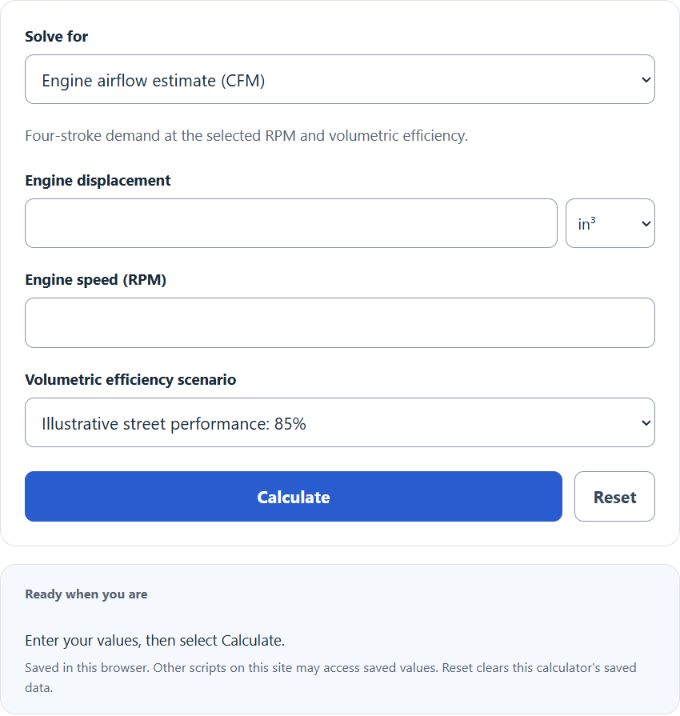
Calculate the carburetor CFM your engine needs from displacement, max RPM, and volumetric efficiency, plus the max RPM or engine size a given carb supports.
Carburetor CFM Formula
CFM = (CID * RPM * VE) / 3456
- CFM is the airflow the carburetor must supply, in cubic feet per minute
- CID is the engine displacement in cubic inches (the calculator also accepts liters and cc)
- RPM is the maximum engine speed you actually run to, in revolutions per minute
- VE is the volumetric efficiency as a decimal, for example 0.85 for 85%
The constant 3456 comes from converting cubic inches to cubic feet (1728 cubic inches per cubic foot) and from the fact that a four-stroke engine fills all of its cylinders once every two crankshaft revolutions (1728 x 2 = 3456).
The calculator can also rearrange this formula to solve backward. If you already own a carburetor, it finds the RPM corresponding to the entered airflow rating and assumed VE:
RPM = (CFM * 3456) / (CID * VE)
Or the equivalent engine displacement at the entered rating, RPM and VE:
CID = (CFM * 3456) / (RPM * VE)
If you select a 2-barrel carburetor, the calculator first divides its rating by the square root of 2 (approximately 1.414) before using it in these formulas. 2-barrel carbs are flow-rated at a test pressure of 3.0 inches of mercury while 4-barrel carbs are rated at 1.5 inches, so a 2-barrel number is not directly comparable until it is converted.
Volumetric Efficiency Values and Common Carburetor Sizes
Volumetric efficiency is the percentage of its theoretical air volume the engine actually pulls in at wide-open throttle. The first table provides illustrative scenarios; use measured or defensible VE at the selected RPM.
| Engine build | Illustrative volumetric efficiency |
|---|---|
| Stock engine, factory cam and heads | 70% to 80% |
| Rebuilt or mild street performance build | 80% to 90% |
| Serious race engine, ported heads, big cam | 95% to 100% |
| Highly tuned race engine with intake tuned for ram effect | 100% to 110% |
The second table shows the required airflow for common V8 combinations, an illustrative 4-barrel size comparison, and the equivalent 2-barrel rating. The 2-barrel column matters when comparing against 2-barrel carbs such as the Holley 350 or 500, whose ratings are taken at 3.0 inHg and read about 1.414 times higher than a 4-barrel rating for the same real airflow.
| Engine and use | Max RPM / VE | Required CFM | Common 4-bbl choice | 2-bbl equivalent rating |
|---|---|---|---|---|
| 283 stock small block | 5,500 / 80% | 360 | 390 CFM | 510 CFM |
| 302 street build | 6,000 / 85% | 446 | 500 CFM | 630 CFM |
| 350 street build | 6,000 / 85% | 516 | 570 or 600 CFM | 730 CFM |
| 383 stroker, hot street | 6,500 / 90% | 648 | 650 CFM | 917 CFM |
| 454 big block, hot street | 6,000 / 90% | 709 | 750 CFM | 1,003 CFM |
Example Problems
Example 1: sizing a carburetor. You have a 350 cubic inch small block with a mild performance build that you shift at 6,500 RPM. Using 85% volumetric efficiency:
CFM = (350 x 6,500 x 0.85) / 3456 = 559.5 CFM
The calculator’s illustrative list next contains 570 CFM; 600 CFM is another catalog example. Confirm the engine, manifold, secondaries, rating standard and manufacturer guidance rather than buying solely from this estimate.
Example 2: checking a carb you already own. You have a 750 CFM 4-barrel and want to know the highest RPM it can feed on that same 350 with a stronger 90% VE build:
RPM = (750 x 3456) / (350 x 0.90) = 8,229 RPM
This is the RPM corresponding to the assumed airflow and VE. It is not a mechanical speed limit or a hard airflow ceiling: a carburetor can flow more than its rating at a greater pressure drop.
Frequently Asked Questions
Should I round up or down from the calculated CFM?
Compare nearby catalog ratings and manufacturer selection guidance; this estimate alone does not prescribe a size. A slightly small carburetor keeps air velocity through the venturis high, which gives crisp throttle response and good drivability. A carburetor that is far too large slows the air down, weakens the fuel-metering signal, and causes bogging and poor low-speed manners. If you are between sizes on a street car, a vacuum secondary carburetor is the safer choice because the secondaries only open as engine demand rises.
Why does a 2-barrel carburetor have a higher CFM number than an equivalent 4-barrel?
The two types are tested at different pressure drops. 2-barrel carbs are rated at 3.0 inches of mercury and 4-barrel carbs at 1.5 inches. Airflow scales with the square root of the pressure drop, and the square root of 2 is about 1.414, so a 500 CFM 2-barrel actually flows about 354 CFM at the 4-barrel test standard. This calculator uses the approximate square-root pressure conversion when you select the 2-barrel option; it is not a measured product specification.
Does volumetric efficiency stay the same at every RPM?
No. Volumetric efficiency changes with engine speed and typically peaks near the torque peak, where intake tuning helps the cylinders fill best. The single VE number used for carburetor sizing represents the engine near its power peak at wide-open throttle, which is the condition that demands maximum airflow. That is why the formula pairs VE with maximum RPM rather than an average operating speed.