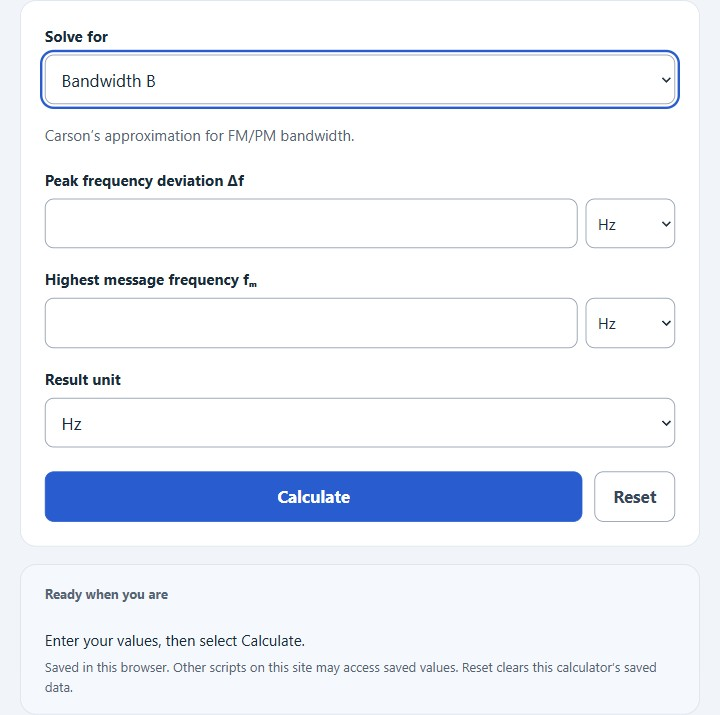
Calculate bandwidth with Carson’s Rule by entering peak frequency deviation and message frequency, or solve for either missing value.
Related Calculators
- dB Per Decade Calculator
- Radio Distance Calculator
- Effective Permittivity Calculator
- Cavity Resonance Calculator
- All Physics Calculators
Carson’s Rule Formula
Carson’s rule estimates the occupied bandwidth of an FM or PM signal using the peak frequency deviation and the highest baseband message frequency.
Rearranged formulas used when you enter bandwidth and one other value:
- B = estimated bandwidth of the modulated signal
- Δf = peak frequency deviation
- fm = maximum baseband message frequency
Choose the quantity to solve, then enter the other two values. For bandwidth, the calculator uses B ≈ 2(Δf + fm). For peak deviation it uses Δf = (B / 2) – fm; for highest message frequency it uses fm = (B / 2) – Δf. Inputs are converted to hertz before the answer is converted to the selected result unit. These are estimates under Carson’s approximation, not spectrum measurements or regulatory limits.
Common Frequency Unit Conversions
Use these conversions to check whether your inputs are in the same scale before applying Carson’s rule.
| Unit | Equivalent in Hz | Example |
|---|---|---|
| Hz | 1 Hz | 5,000 Hz = 5,000 Hz |
| kHz | 1,000 Hz | 5 kHz = 5,000 Hz |
| MHz | 1,000,000 Hz | 2 MHz = 2,000,000 Hz |
| GHz | 1,000,000,000 Hz | 1 GHz = 1,000,000,000 Hz |
Typical Carson’s Rule Inputs and Results
| Peak Deviation Δf | Message Frequency fm | Estimated Bandwidth B |
|---|---|---|
| 5 kHz | 3 kHz | 16 kHz |
| 25 kHz | 15 kHz | 80 kHz |
| 75 kHz | 15 kHz | 180 kHz |
Example Problems
Example 1: Calculate bandwidth
You have a peak frequency deviation of 75 kHz and a maximum baseband message frequency of 15 kHz.
The estimated bandwidth is 180 kHz.
Example 2: Calculate peak frequency deviation
You have a bandwidth of 80 kHz and a maximum baseband message frequency of 15 kHz.
The peak frequency deviation is 25 kHz.
FAQ
What does Carson’s rule estimate?
Carson’s rule estimates the approximate bandwidth needed to transmit a frequency-modulated or phase-modulated signal. It includes the effect of both the peak frequency deviation and the highest frequency in the baseband message.
Why is bandwidth multiplied by 2 in Carson’s rule?
The factor of 2 accounts for the upper and lower sidebands around the carrier. The occupied bandwidth extends on both sides of the carrier frequency, so the sum of peak deviation and message frequency is doubled.
Can the calculated deviation or message frequency be negative?
No. If solving for Δf or fm, the bandwidth must be large enough. For example, when solving for Δf, B / 2 must be greater than or equal to fm. A negative result means the entered values are not physically valid for Carson’s rule.