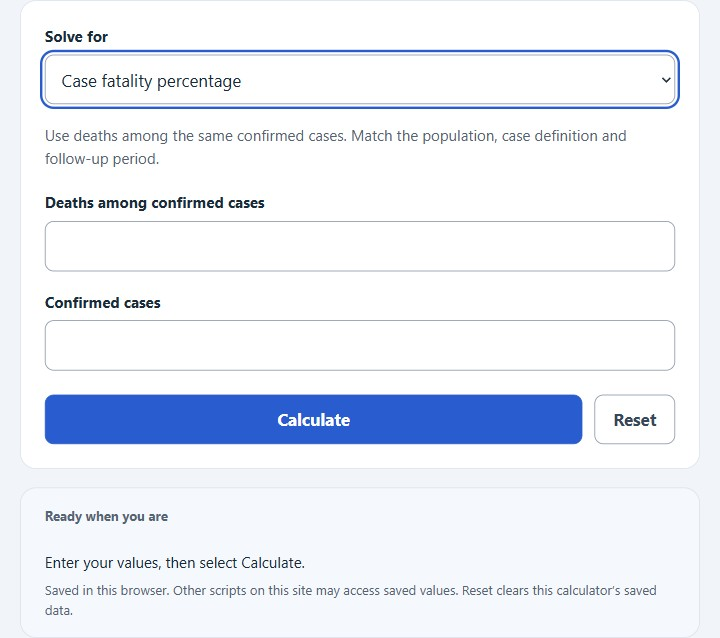
Calculate case fatality rate from deaths and confirmed cases, solve for missing deaths or cases, and compare two CFR percentages as a ratio.
Case Fatality Rate Formula
The case fatality rate (CFR) is calculated using the following formula:
Variables:
- CFR is the case fatality rate, expressed as a percentage
- D is the total number of deaths attributed to a specific disease in a defined period
- C is the total number of confirmed (diagnosed) cases of that disease in the same period
The numerator (D) must be a subset of the denominator (C). Every death counted must belong to the pool of confirmed cases. This constraint distinguishes the CFR from the crude mortality rate, where the denominator is the entire population at risk rather than diagnosed individuals alone.
What Is the Case Fatality Rate?
The case fatality rate is a measure of disease severity used in epidemiology. It quantifies the proportion of diagnosed individuals who die from a given disease within a specified timeframe. Unlike a mortality rate, which divides deaths by the total population at risk, the CFR restricts its denominator to people who have already been diagnosed. This makes it a measure of lethality among known cases rather than a measure of population-level death risk.
CFR is most useful for acute infectious diseases where the interval between diagnosis and outcome (recovery or death) is relatively short. For chronic diseases such as diabetes or heart failure, case fatality becomes harder to define because the window between diagnosis and death can span decades, and intervening causes of death complicate attribution.
CFR vs. IFR vs. Mortality Rate
Three mortality metrics are commonly confused. Each uses a different denominator, which changes the interpretation.
| Metric | Numerator | Denominator | Measures |
|---|---|---|---|
| Case Fatality Rate (CFR) | Deaths from disease | Confirmed/diagnosed cases | Lethality among diagnosed patients |
| Infection Fatality Rate (IFR) | Deaths from disease | All infected (including undiagnosed and asymptomatic) | Lethality among all infections |
| Crude Mortality Rate | Deaths from disease | Total population at risk | Population-level death risk |
For the same population and death numerator, adding undiagnosed infections to the denominator makes IFR no larger than CFR. Estimates from different studies, time periods or death definitions need not satisfy that ordering. Early-pandemic WHO guidance discussed IFR estimates near 0.5 to 1%; those historical estimates are not a current universal risk for COVID-19.
Case Fatality Rates by Disease
The following table gives historical or context-specific examples, not calculator defaults or individual risk predictions. Values depend on diagnosis, outcome follow-up, treatment, vaccination, population and period. COVID-19 and seasonal influenza do not have a single universal CFR. Consult current disease-specific public-health evidence before interpreting a comparison.
| Disease | Approximate CFR | Notes |
|---|---|---|
| Rabies (untreated) | >99% | Nearly 100% fatal once symptomatic; post-exposure prophylaxis is effective if given early |
| Ebola virus disease | 25 to 90% | Varies by outbreak and species; 2014 West Africa outbreak averaged roughly 40% |
| MERS-CoV | ~36% (WHO, November 2022) | High CFR partly due to detection bias toward severe hospitalized cases |
| Smallpox (Variola major) | ~30% | Eradicated in 1980; Variola minor had a CFR of about 1% |
| Yellow fever (severe) | Up to ~50% in severe cases | This is a severe-case measure; it does not describe all infections |
| Cholera (untreated) | 30 to 50% in untreated cases | With oral rehydration therapy, CFR drops below 1% |
| SARS-CoV-1 (2003) | ~11% | 8,096 cases globally; rapid containment limited total case count |
| COVID-19 (all strains) | Varies by population and period | Naive CFR varied by variant and healthcare capacity; IFR substantially lower |
| Influenza (seasonal) | Varies by population and period | 1918 pandemic CFR was roughly 2 to 3%; varies by strain and age |
| Measles (industrialized) | 0.1 to 0.3% | In low-income settings without vaccination, CFR can reach 3 to 6% |
| Plague (pneumonic, untreated) | ~100% | Bubonic plague 30 to 60% untreated; antibiotics reduce it to under 10% |
Biases That Distort CFR Estimates
A raw CFR figure should never be taken at face value without understanding the biases embedded in its calculation. Four systematic biases are especially common.
Ascertainment bias inflates CFR when only the most severe cases are tested and diagnosed. During early COVID-19, testing was reserved for hospitalized patients in many countries, so mild and asymptomatic infections were excluded from the denominator. This made the virus appear deadlier than subsequent seroprevalence data later confirmed.
Time-lag bias suppresses CFR early in an epidemic. The naive formula (cumulative deaths divided by cumulative cases at a single point) counts unresolved cases in the denominator. Because death takes time, many of those cases will eventually die but are counted as alive at the moment of calculation. Adjusting for the interval between symptom onset and death corrects for this.
Reporting and attribution bias affects both numerator and denominator. Under-reporting of deaths (common in settings with limited autopsy or death certificate infrastructure) lowers the numerator. Meanwhile, deaths caused by comorbidities may be misattributed to the disease, raising the numerator. These opposing pressures can partially cancel out, but not reliably.
Population composition effects arise when the age, comorbidity profile, or healthcare access of the diagnosed population differs from the general infected population. A CFR calculated from a young, healthy cohort will understate the lethality experienced by elderly or immunocompromised groups, and vice versa. Age-stratified CFRs are more informative than aggregate figures for public health decision-making.
Case Fatality Ratio vs. Case Fatality Rate
Case fatality ratio (CFR) is the proportion of diagnosed cases who die from the disease. It is often called a case fatality rate, although it has no person-time denominator. Comparing two CFRs is a separate calculation: 15% divided by 3% is 5, so the entered CFR for Group A is five times the entered CFR for Group B. Comparisons require compatible case definitions, populations and follow-up; they do not establish individual prognosis or a treatment effect. Select Case fatality percentage for deaths divided by cases, or Compare two CFR percentages for A divided by B. The inverse modes report unrounded implied quantities and a nearest whole count.
Practical Applications of CFR
Public health authorities use the CFR to triage resource allocation during outbreaks. A disease with a high CFR but low transmissibility (such as Ebola) demands intensive case isolation and contact tracing, while a disease with a lower CFR but extremely high transmissibility (such as influenza) may cause more total deaths and require mass vaccination campaigns instead. The CFR also serves as a benchmark to evaluate clinical interventions. A change from 10% to 4% is a 60% relative reduction in the observed CFR, but that change alone does not establish treatment efficacy: differences in case detection, population and follow-up may explain it. Regulatory agencies and hospital systems track these shifts to make formulary and protocol decisions.