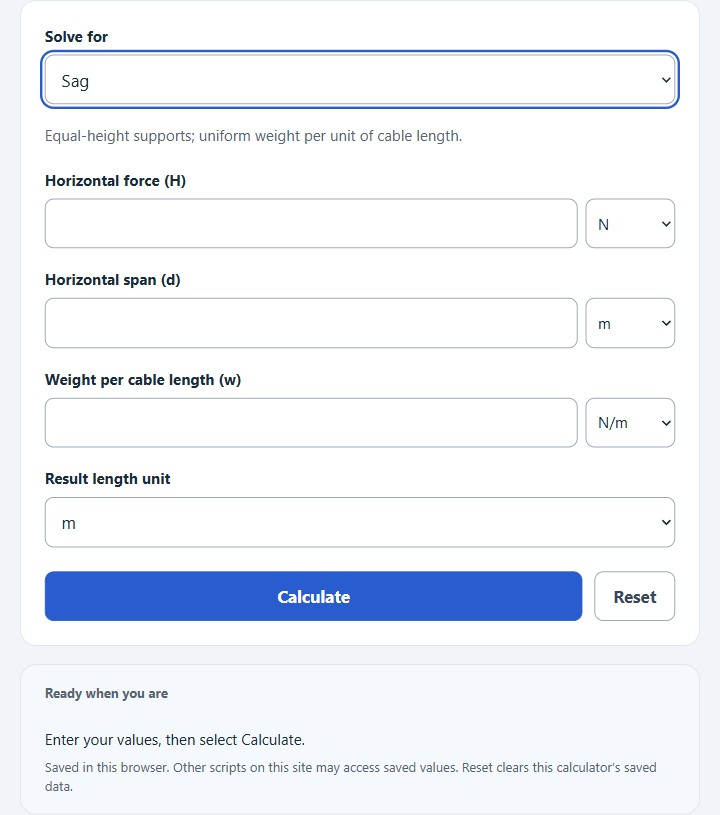
Choose sag, horizontal force, horizontal span, or weight per cable length, then enter the other three values. The ideal catenary model assumes equal-height supports and uniform weight per actual cable length.
Related Calculators
- Arc Height (sagitta) Calculator
- Arc Length Calculator
- Cartesian To Parametric Calculator
- Diagonal Distance Calculator
- All Math and Numbers Calculators
Catenary Sag Formula
The exact catenary sag calculation for equal-height supports uses the catenary parameter a, defined as horizontal force divided by weight per unit length.
To calculate distance when sag is known, the inverse form is:
To calculate horizontal force or weight per unit length, the calculator first solves the sag equation numerically for a, then uses one of these formulas:
- S = sag, the vertical drop from the supports to the lowest point of the cable
- H = horizontal force or horizontal component of tension
- w = weight (force) per unit of actual cable length, not per horizontal span
- d = horizontal distance between equal-height supports
- a = catenary parameter, equal to H / w
- cosh = hyperbolic cosine
- acosh = inverse hyperbolic cosine
Select the value to solve for, enter the other three values and choose the result unit. All four quantities must be greater than zero.
- Solve for sag: it calculates a = H / w, then applies the exact sag formula.
- Solve for horizontal span: it calculates a = H / w, then applies the inverse distance formula.
- Solve for horizontal force: it solves the exact sag equation for a, then calculates H = wa.
- Solve for weight per cable length: it solves the exact sag equation for a, then calculates w = H / a.
Common Units and Conversions
The calculation is performed internally in base metric units: newtons, meters, and newtons per meter.
| Quantity | Supported units | Base unit used |
|---|---|---|
| Horizontal force | N, kN, lbf | N |
| Distance | m, km, ft, in | m |
| Weight per unit length | N/m, kN/m, lbf/ft, ozf/in | N/m |
| Sag | m, km, ft, in | m |
Sag Ratio Reference
The sag ratio S / d is a quick way to judge whether sag is small compared with the span.
| Sag ratio S / d | Typical interpretation |
|---|---|
| Less than 0.02 | Very shallow sag. Parabolic estimates are often close, but the exact catenary still gives the more precise value. |
| 0.02 to 0.10 | Moderate sag. Exact catenary calculation is preferred. |
| Greater than 0.10 | Large sag. The exact catenary model is important because simple approximations can drift noticeably. |
Example Calculations
Example 1: Calculate sag
Suppose the horizontal force is 10,000 N, the span distance is 100 m, and the weight per unit length is 20 N/m.
The sag is approximately 2.5021 m.
Example 2: Calculate distance
Suppose the horizontal force is 5 kN, the weight per unit length is 10 N/m, and the sag is 1 m.
First convert 5 kN to 5,000 N.
The span distance is approximately 63.2350 m.
FAQ
What does “exact” mean in this catenary sag calculator?
“Exact” means the calculation uses the catenary equation with hyperbolic cosine instead of the simpler parabolic sag approximation. The exact catenary is especially useful when sag is not very small compared with the span. Numerical evaluation is approximate and answers are rounded. The model assumes an ideal flexible cable under uniform self-weight; it does not establish structural safety or include wind, ice, elasticity or concentrated loads.
Does this work for supports at different heights?
No. The formulas used here assume both supports are at the same height and the lowest point is centered between them. If the supports are at different elevations, the catenary shape is still valid, but the equations require additional height-difference terms.
Why does increasing horizontal force reduce sag?
Increasing horizontal force increases the catenary parameter a = H / w. A larger a makes the curve flatter over the same span, so the sag decreases. Increasing weight per unit length has the opposite effect because it lowers a.