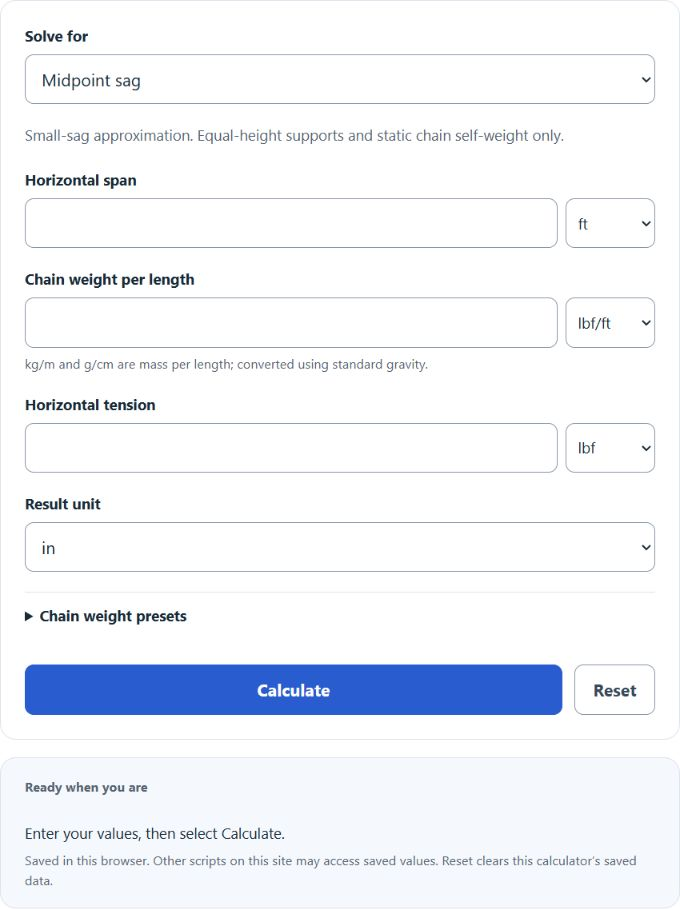
Estimate midpoint sag from horizontal span, chain weight per length, and horizontal tension, or estimate horizontal tension for a sag limit. The small-sag model assumes equal-height rigid supports and static self-weight; it does not check chain or anchor strength.
- All Automotive Calculators
- Chain Drive Tension Calculator
- Pulley Torque Calculator
- Sprocket Speed Calculator
- Belt Tension Frequency Calculator
- Sprocket Ratio Calculator
- Tension to Torque Calculator
Chain Sag Formula
The calculator uses the common parabolic sag approximation for a chain hanging between two supports at the same height. It is most accurate when the sag is small compared with the span.
- s = chain sag at the midpoint
- w = chain weight force per unit length
- L = span between supports
- T = horizontal tension in the chain
For the tension mode, the same formula is rearranged to solve for the tension needed to keep the sag at or below a chosen value:
- T = estimated horizontal tension
- w = chain weight force per unit length
- L = span between supports
- s = maximum allowed midpoint sag
Choose Midpoint sag to enter horizontal span, chain weight per length, and horizontal tension. Choose Horizontal tension to enter span, weight per length, and the desired sag limit. Results are approximate. Tension uses lbf, N, or kgf, not mass units. Mass densities in kg/m or g/cm are converted to weight force using standard gravity, 9.80665 m/s².
Typical Chain Weights and Sag Interpretation
The proof-coil references below are published weights for Perfection Chain low-carbon-steel Grade 30. Other chains require their actual manufacturer weight; nominal diameter does not determine a universal weight. These weights are not working load limits, and this product is not for overhead lifting. See the manufacturer specification.
| Chain type | Typical weight | Common use |
|---|---|---|
| #10 jack chain | Use actual product weight | Light hanging loads |
| 1/8 inch proof coil chain | 0.19 lb/ft | Small utility chain |
| 1/4 inch proof coil chain | 0.65 lb/ft | General-purpose chain |
| 3/8 inch proof coil chain | 1.40 lb/ft | Heavier utility chain |
| 1/2 inch proof coil chain | 2.37 lb/ft | Heavy hanging or barrier chain |
| Sag as percent of span | How it usually looks |
|---|---|
| Less than 2% | Very taut, almost straight |
| 2% to 5% | Light visible droop |
| 5% to 10% | Noticeable curved shape |
| More than 10% | Deep sag; use an exact catenary assessment |
Chain Sag Examples
Example 1: Find the sag
A chain spans 20 ft between supports. The chain weighs 1.5 lb/ft, and the horizontal tension is 50 lbf.
Convert to calculator formula units:
- L = 20 ft = 240 in
- w = 1.5 lbf/ft = 0.125 lbf/in
- T = 50 lbf
The estimated midpoint sag is 18 in, or 1.5 ft, which is 7.5% of the span. This is a parabolic approximation.
Example 2: Find the tension needed
A 1/4 inch proof coil chain weighs about 0.65 lb/ft. It spans 12 ft, and you want no more than 4 in of sag.
- L = 12 ft = 144 in
- w = 0.65 lbf/ft = 0.0541667 lbf/in
- s = 4 in
The model estimates 35.1 lbf of horizontal tension for 4 in sag. The actual catenary and larger support tension must be assessed separately; this is not a safe-load guarantee.
Chain Sag FAQ
Is this the exact catenary formula?
No. This calculator uses the parabolic approximation, which is simpler and works well for many light-to-moderate sag cases. A real hanging chain forms a catenary curve. If the sag is large compared with the span, the exact catenary result can differ from this estimate.
Why does sag increase so quickly when the span gets longer?
Sag depends on the square of the span. If you double the span and keep the same chain weight and tension, the sag becomes about four times larger. Shortening the span is often one of the most effective ways to reduce sag.
Does the tension result include a safety factor?
No. The result estimates the horizontal component for the sag limit; the resultant tension at a support is larger. It does not include a safety factor, shock loading, wind, movement, support strength, anchor strength, or the working load limit of the chain. For load-bearing or safety-critical use, check the rated hardware and apply the proper safety factor.