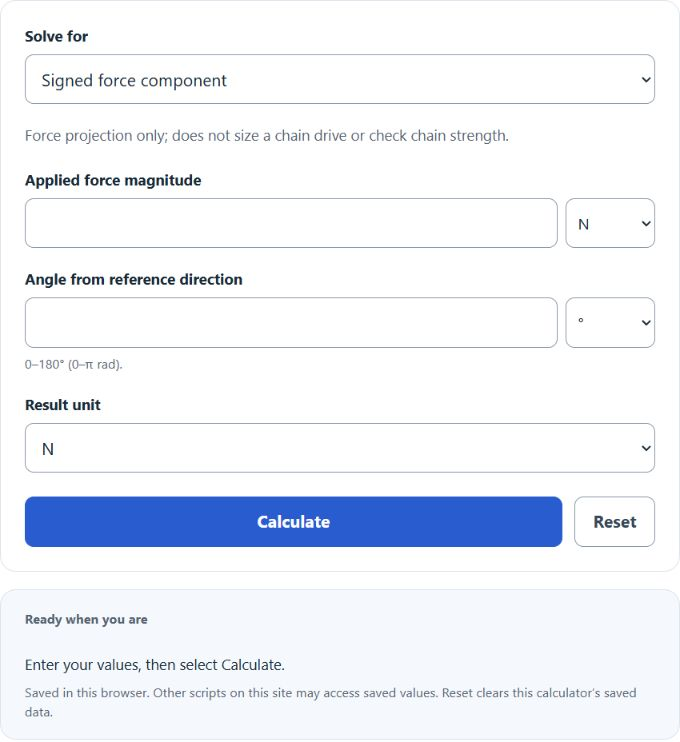
Choose a solve mode to calculate a signed force component, applied force magnitude, or angle from a chosen chain direction using N, lbf, degrees, or radians. This force-component model does not size a chain drive or check chain strength.
Related Calculators
- Sprocket Ratio Calculator
- Chain Wear (Stretch) Calculator
- Output Shaft Speed Calculator
- Bearing Load Calculator
- Torque Loss Calculator
- All Automotive Calculators
Chain Drive Tension Formula
The calculator projects an applied force onto a chosen positive chain direction. F is a nonnegative force magnitude, θ ranges from 0° to 180°, and T is a signed component. A negative T points opposite the reference direction; it is not a negative chain tensile-load magnitude. The component is F multiplied by cos(θ).
- T = signed force component along the chosen chain direction
- F = applied force magnitude
- θ = angle between the applied force and the chain direction
To solve for applied force when the tension component and angle are known, the calculator rearranges the formula:
To solve for the angle when the applied force and tension component are known, it uses the inverse cosine:
The calculator accepts force in newtons or pounds-force and angle in degrees or radians. Internally, force values are converted to newtons, and angles are converted to radians for the cosine calculation. The result is then converted back to the unit you selected.
- Calculate tension component: enter applied force and angle.
- Calculate applied force: enter tension component and angle.
- Calculate angle: enter applied force and tension component.
Angle Effect on Chain Direction Tension
The cosine term controls how much of the applied force acts along the chain. From 0° to 90°, the positive component decreases to zero. Beyond 90°, the signed component is negative and points opposite the chosen direction.
| Angle from Chain Direction | cos(θ) | Tension Component as % of Applied Force |
|---|---|---|
| 0° | 1.000 | 100.0% |
| 15° | 0.966 | 96.6% |
| 30° | 0.866 | 86.6% |
| 45° | 0.707 | 70.7% |
| 60° | 0.500 | 50.0% |
| 90° | 0.000 | 0.0% |
Force Unit Conversions Used
| Conversion | Value |
|---|---|
| 1 lbf to newtons | 4.448221615 N |
| 1 newton to lbf | 0.224808944 lbf |
| 1 radian to degrees | 57.2957795° |
| 1 degree to radians | 0.0174533 rad |
Example Calculations
Example 1: Calculate the tension component
You apply a force of 500 N at an angle of 30° to the chain direction.
The tension component along the chain is about 433.01 N.
Example 2: Calculate the applied force
The required tension component along the chain is 200 lbf, and the force is applied at 45°.
The applied force magnitude is about 282.84 lbf.
FAQs
What does tension component along the chain mean?
It is the signed projection of the applied force onto a chosen chain direction. A positive component points along that direction; a negative component points opposite it. It does not establish the tensile load, allowable load, or strength of a chain drive.
Why does the angle matter so much?
The calculator multiplies the applied force by cos(θ). At 0°, cos(θ) is 1, so all of the force acts along the chain. At 60°, only half of the force acts along the chain. At 90°, none of the force acts along the chain direction.
Why can some angle or force combinations be invalid?
For a nonzero force, the signed ratio T/F must lie between -1 and 1, and inverse cosine returns an angle from 0° to 180°. With zero force, a nonzero component is impossible and a zero component leaves the angle undetermined. At 90°, every force has a zero component, so force cannot be inferred. A component with the wrong sign for the chosen angle has no nonnegative force solution.