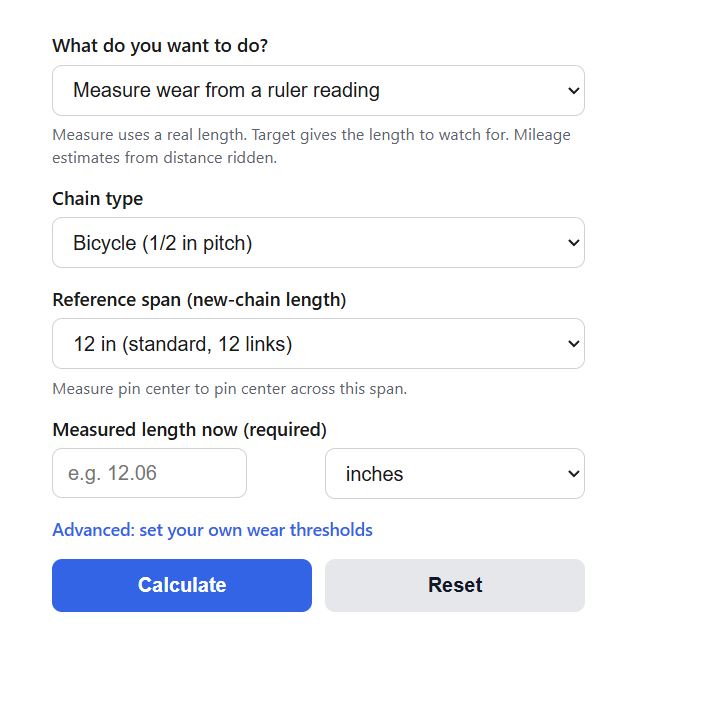
Calculate chain wear (stretch) as an elongation percentage from a ruler reading, find the replace-soon and replace-now lengths, and check bicycle, motorcycle, or roller chains.
Chain Wear Formula
Chain wear is measured as elongation: how much longer a span of chain has grown compared to a new one. The calculator compares your measured length against the nominal (new) length of the same span:
Wear % = (M - N) / N * 100
The nominal length is the pitch multiplied by the number of pitches (links) you measure across:
N = pitch * pitches
To turn a wear limit back into a target length, so you know the exact reading to watch for on a ruler, it rearranges the same relationship:
L_limit = N * (1 + W / 100)
In mileage mode, which applies to bicycle chains, it estimates wear from distance ridden and a maintenance rate instead of a measurement:
W = c * miles / 1000
Variables:
- M is the measured length of the span now
- N is the nominal (new-chain) length of that same span
- pitch is the distance between two pins (0.5 in for bicycle chain, 0.625 in for common motorcycle chain, or the ANSI size for roller chain)
- pitches is the number of links you span with the ruler
- W is the wear, expressed as a percentage of the nominal length
- c is the estimated wear rate per 1,000 miles (0.25 clean, 0.40 average, 0.60 neglected)
The tool has three functions. In measure mode you enter a real ruler reading and it returns the wear percentage plus the exact replace-soon and replace-now lengths for your chain. In target mode it skips the measurement and just gives you those go and no-go lengths, so you can check the chain later with a ruler alone. In mileage mode it estimates how worn a bike chain probably is from the miles on it and tells you roughly how many more miles remain before the next limit. The pins and bushings wear at each joint, which increases the effective pitch, so a small percentage spread across the whole chain is enough to make it skip on the sprocket teeth.
Wear Limits and Ruler Readings
The first table converts each wear level into the exact length a standard 12 inch bicycle span will read, which is the number a ruler or chain checker is really testing for. A new chain measures exactly 12 inches from pin center to pin center across 12 links.
| Wear | 12 in span reads | Added length | What it means |
|---|---|---|---|
| 0% (new) | 12.000 in | 0 mm | Reference length |
| 0.5% | 12.060 in (about 12 1/16 in) | 1.5 mm | Replace on 11 to 13 speed drivetrains |
| 0.75% | 12.090 in (about 12 3/32 in) | 2.3 mm | Replace on 6 to 10 speed and single speed |
| 1.0% | 12.120 in (about 12 1/8 in) | 3.0 mm | Worn out, inspect the cassette and chainrings too |
The second table shows the replacement limit by chain type, because bicycle and industrial chains are held to very different standards. Precision and fixed center drives are replaced far earlier than the general 3% figure often quoted for roller chain.
| Chain type | Replace at | Notes |
|---|---|---|
| Bicycle, 11 to 13 speed | 0.5% | Narrow chains protect expensive cassettes when swapped early |
| Bicycle, 6 to 10 speed | 0.75% | Past 1.0% the cassette is usually worn as well |
| Motorcycle drive chain | 1.0 to 1.5% | Follow the length limit in the service manual when given |
| Industrial roller, precision | 1.5% | Fixed center drives and chains running in parallel |
| Industrial roller, general | 3% | On large sprockets the limit is 200 / N, where N is the tooth count |
The 200 / N rule sets the point where a worn chain rides so high on a large sprocket that it can jump or skip. For a 70 tooth sprocket that works out to about 2.9%, which is why the general roller chain limit sits near 3% but drops for drives with smaller sprockets or tighter tolerances.
Example Problems
Example 1: Measuring a bike chain.
You line a ruler along a 12 inch section of your road chain and the far pin sits at 12.06 inches. Using the formula, Wear % = (12.06 – 12) / 12 * 100 = 0.5%. On an 11 speed drivetrain that is the replace point, so a new chain now saves the cassette from wearing to match.
Example 2: Setting a target length on roller chain.
You run ANSI 80 chain, which has a 1 inch pitch, and you measure across 12 pitches for a nominal length of 12 inches. For a precision drive the 1.5% limit is L = 12 * (1 + 1.5 / 100) = 12.18 inches, and the general 3% limit is 12 * 1.03 = 12.36 inches. Replace the chain once that 12 pitch span reaches 12.18 inches on a fixed center drive.
Frequently Asked Questions
Is chain wear the same as chain stretch?
They describe the same symptom but the name stretch is misleading. The side plates do not lengthen. Instead the pins and the bushings they turn against wear away a tiny amount at every joint, so each link sits slightly looser and the effective pitch grows. Added up across a whole chain, that small change is what a wear gauge reads as elongation.
How many links should I measure?
For a bicycle chain, measure 12 inches from the center of one pin to the center of another, which spans 12 links on a half inch chain. For roller chain, measure across at least 12 pitches, or use a 12 inch span for sizes up to No. 60 and a 24 inch span for larger chain. Spanning more links averages out small errors, so a longer measurement is more reliable than checking one or two links.
What wear percentage means it is time to replace?
On modern 11 to 13 speed bikes, replace at 0.5%. On 6 to 10 speed and single speed drivetrains you can wait until 0.75%, and by 1.0% the chain is worn out and the cassette likely needs replacing too. Industrial roller chain is usually replaced near 1.5% on precision drives and up to 3% in general service, with the 200 / N rule setting the limit on drives with large sprockets.