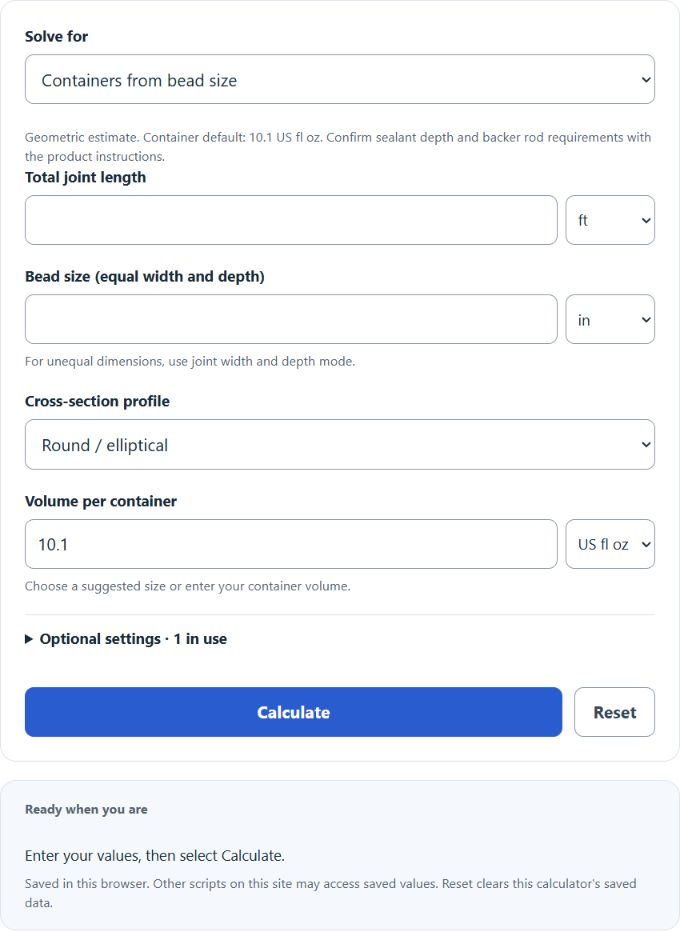
Calculate how many tubes of caulk you need from the total joint length and bead size, size a joint by its width and depth, or find the linear feet a set number of tubes will cover, with waste and cost.
Caulk Coverage Formula
The calculator works from how much caulk a container holds and how much a bead uses per foot. First it finds the cross-section of the bead, then the linear feet one container covers:
A = k * W * D
C = V / (A * 12)
To find how many containers a run needs, divide the run length by the coverage per container and add waste:
Tubes = (L / C) * (1 + w)
When you enter a joint by its width and depth instead, it works from total volume:
Tubes = (A * L * 12 / V) * (1 + w)
Variables:
- A is the bead or joint cross-section, in square inches
- k is the profile factor: 0.785 for a round bead, 0.5 for a V bead, and 1.0 for a square or full fill
- W and D are the bead width and depth, in inches
- V is the container volume, in cubic inches (a 10.1 fl oz cartridge holds about 18.2 cubic inches)
- C is the coverage of one container, in linear feet
- L is the total run length, in feet
- w is the waste allowance as a decimal (10 percent is 0.10), and the tube count is rounded up to a whole container
The bead size sets the cross-section, so it has the largest effect on coverage: doubling both bead width and depth cuts coverage to about a quarter. The profile factor accounts for bead shape, since a round bead uses less caulk than a square fill of the same width and depth. The container size scales the result directly, and the waste allowance covers the caulk lost to tooling, blowouts, and awkward corners. In coverage mode, containers multiplied by per-container coverage gives theoretical length; dividing by (1 + waste/100) gives usable coverage. Set waste to zero for theoretical coverage.
Caulk Coverage and Bead Size Charts
The first chart shows how far one standard 10.1 fl oz cartridge goes with a round bead at common sizes. Coverage falls quickly as the bead grows.
| Round bead size | Coverage per 10.1 oz tube | Common use |
|---|---|---|
| 1/8 in | about 124 ft | fine trim, molding |
| 3/16 in | about 55 ft | small trim gaps |
| 1/4 in | about 31 ft | windows, tubs, general |
| 3/8 in | about 14 ft | siding, exterior joints |
| 1/2 in | about 8 ft | wide or expansion gaps |
The second chart pairs each job with a starting bead size and the joint depth to aim for. Depth depends on the sealant and application. For example, Sika Backer Rod guidance uses a 2:1 width-to-depth ratio with a 1/4 inch minimum and 1/2 inch maximum depth; other products can differ. Follow the selected sealant’s current instructions. A foam backer rod sets that depth, keeps caulk off the back of the joint so it can stretch, and cuts how much caulk you use.
| Application | Starting bead | Joint depth and backer rod |
|---|---|---|
| Interior trim, baseboard | 1/8 in | shallow fill, no backer rod |
| Window and door perimeter | 1/4 in | depth up to 1/4 in |
| Tub and shower | 1/4 in | fill on a clean, dry surface |
| Siding and exterior trim | 3/8 in | depth about half the width |
| Expansion or control joint | 1/2 in or more | Follow product depth and backer-rod requirements |
Example Problems
Example 1: Tubes for a length of trim.
You have 60 linear feet of gaps to seal with a 1/4 inch round bead, using 10.1 oz cartridges and a 10 percent waste allowance. A 1/4 inch round bead covers about 30.9 feet per tube, so:
Tubes = (60 / 30.9) * 1.10 = 2.14, which rounds up to 3 cartridges.
Example 2: Tubes for a deep joint, with and without backer rod.
An expansion joint is 1/2 inch wide, 1/2 inch deep, and 20 feet long, filled fully with 10.1 oz cartridges and 10 percent waste. The cross-section is 1.0 * 0.5 * 0.5 = 0.25 square inches, so the volume is 0.25 * 240 * 1.10 = 66 cubic inches. Divided by 18.2 cubic inches per tube that is 3.6, or 4 cartridges. Add a backer rod to bring the caulk depth to 1/4 inch and the volume drops to 33 cubic inches, or 2 cartridges.
Frequently Asked Questions
How many linear feet does a tube of caulk cover?
A standard 10.1 fl oz cartridge covers about 31 feet with a 1/4 inch round bead. Coverage swings widely with bead size: roughly 124 feet at a 1/8 inch bead and only about 8 feet at a 1/2 inch bead. Enter your bead size in the calculator to get a geometric estimate for your container.
How many tubes of caulk do I need?
Divide the total length you need to seal by the coverage per tube for your bead size, then add about 10 percent for waste and round up to a whole container. For a joint you are filling completely, work from width times depth times length instead, and divide that volume by the volume in one container.
When do I need a backer rod?
Use backer rod when required by the sealant manufacturer to control depth and prevent adhesion to the back of the joint. The required width, depth and backing depend on the product and application. The calculator’s reduced-depth example is an illustration, not a universal installation recommendation.