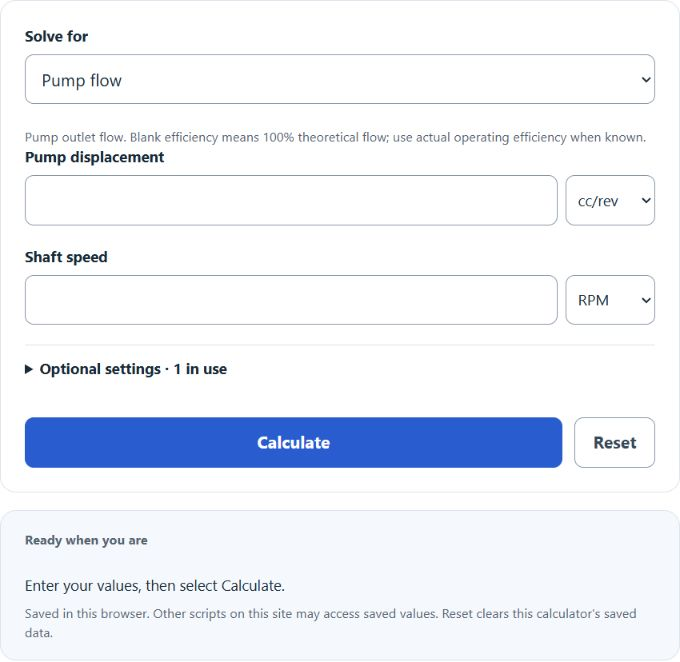
Convert cc/rev to L/min or calculate the missing displacement, RPM, or flow rate when you know any two of the three values for quick sizing.
- mL Per Hour Calculator
- m3/h to cfm Converter
- in^3 to Fluid Ounces Conversion Calculator
- Units/Hr To mL/Hr Calculator
- All Unit Converters
cc/rev to LPM Formula
The following formula is used to calculate the ideal flow rate in liters per minute from a displacement in cubic centimeters per revolution and a shaft speed in revolutions per minute.
Variables:
- LPM is the flow rate in liters per minute
- CCR is the displacement in cubic centimeters per revolution (cc/rev)
- RPM is the rotational speed in revolutions per minute
For theoretical flow, multiply pump displacement per revolution by shaft speed and divide by 1000. For delivered pump outlet flow, multiply this result by volumetric efficiency as a decimal: L/min = cc/rev × RPM × (efficiency/100) / 1000. When solving for displacement or RPM, divide the ideal inverse result by (efficiency/100). Blank efficiency in the calculator means 100%. Hydraulic motor inlet flow uses a different efficiency relationship.
The inverse forms of the equation are also useful:
- CCR = (LPM × 1000) / RPM
- RPM = (LPM × 1000) / CCR
What is a cc/rev to LPM Conversion?
A cc/rev to LPM conversion translates the volumetric displacement of a pump or motor into an ideal flow rate based on shaft speed. The cc/rev value tells you how much fluid volume is moved during each revolution, while L/min tells you how much volume passes in one minute. By combining the displacement with RPM, you can estimate the resulting ideal flow quickly and consistently.
This conversion is commonly used when reviewing hydraulic pump specifications, comparing equipment sizes, or estimating expected system flow. In actual operation, slip and inefficiencies may reduce real-world flow somewhat below the ideal value, but the formula remains a very useful first approximation.
How to Calculate cc/rev to LPM?
The following steps outline how to calculate liters per minute from cubic centimeters per revolution.
- First, determine the displacement of the pump or motor in cc/rev.
- Next, determine the shaft speed in RPM.
- Multiply the displacement by the RPM value.
- Divide the result by 1000 to convert the answer into liters per minute.
- Check your answer with the calculator above.
Example Problem:
Use the following variables as an example problem to test your knowledge.
Displacement (CCR) = 12 cc/rev
Rotational Speed (RPM) = 1800
Flow Rate (LPM) = (12 × 1800) / 1000 = 21.6 L/min
cc/rev to LPM Conversion Table
The table below shows example flow rates for a 10 cc/rev displacement at several common shaft speeds.
| Displacement (cc/rev) | Speed (RPM) | Flow (L/min) |
|---|---|---|
| 10 | 500 | 5 |
| 10 | 1000 | 10 |
| 10 | 1500 | 15 |
| 10 | 1800 | 18 |
| 10 | 2000 | 20 |
| 10 | 2500 | 25 |
| 10 | 3000 | 30 |
Because the relationship is linear, doubling the RPM doubles the flow, and doubling the displacement also doubles the flow. That makes cc/rev to LPM conversion one of the simplest and most practical calculations for hydraulic sizing and quick flow estimation.