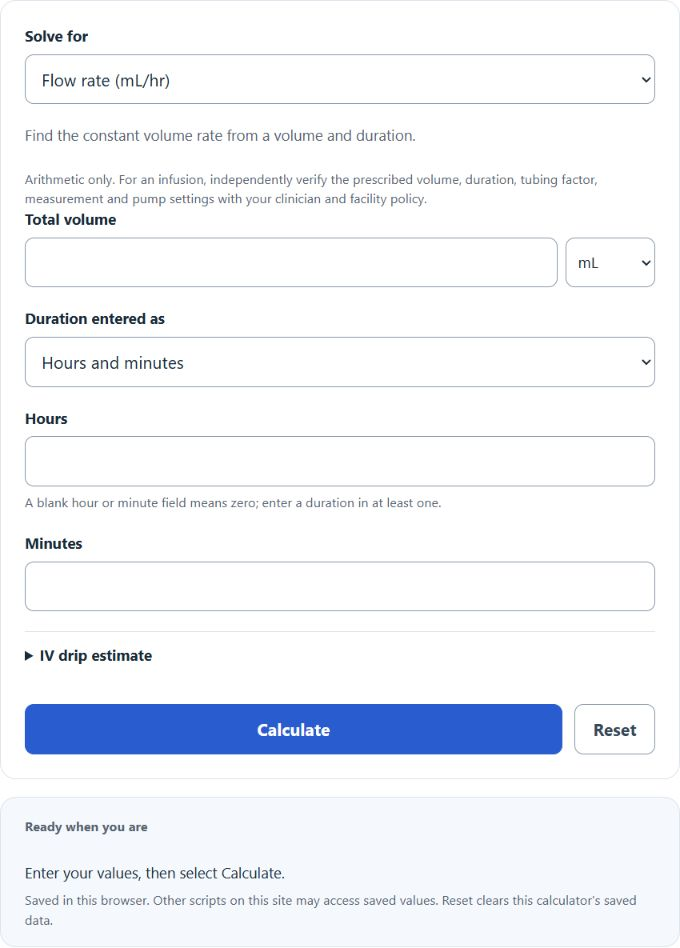
Calculate mL per hour from total volume and time, or find the volume delivered or time required at a set rate, with an optional IV drip rate in gtt/min.
- All Unit Converters
- mL/hr To gtt/min Calculator
- ml/hr to mcg/kg/min Calculator
- mL Per Minute Calculator
- ml to mg
Calculator Functions
| Function | What it does | What it requires |
|---|---|---|
| Flow rate (mL/hr) | Finds the constant rate in mL per hour that delivers a volume in a set time | Requires the total volume and the duration |
| Total volume | Finds the volume delivered at a constant rate over a set time | Requires the flow rate and the duration |
| Time required | Finds how long a volume takes at a constant rate | Requires the total volume and the flow rate |
Volume can be entered in mL, cc, L or US fl oz, and the rate in mL/hr or mL/min. The duration is entered as hours and minutes, decimal hours or minutes. An optional IV drip estimate adds drops per minute for a tubing drop factor of 10, 15, 20 or 60 gtt/mL, or a custom factor.
mL Per Hour Formulas
| R | Flow rate (mL/hr) |
| V | Total volume (mL) |
| T | Duration (hr). Minutes are divided by 60 first |
Flow rate (mL/hr)
The volume is divided by the time in hours [1]. A volume of 500 mL over 5 hours is 500 ÷ 5 = 100 mL/hr. For a time in minutes, 94 mL over 45 minutes is 94 ÷ 0.75 = 125.33 mL/hr. The result also shows the rate in mL/min and L/hr and the volume that rate would deliver in 24 hours. Volumes in other units are converted with 1 L = 1,000 mL, 1 cc = 1 mL and 1 US fl oz = 29.5735 mL [2].
Total volume
A rate of 33 mL/hr for 30 minutes delivers 33 × 0.5 = 16.5 mL. A rate entered in mL/min is multiplied by 60 first, so 2 mL/min for 1 hour is 120 mL.
Time required
A 1,000 mL bag at 150 mL/hr takes 1,000 ÷ 150 = 6.667 hours, shown as 6 h 40 min and 400 minutes. A rate of zero is rejected.
IV drip estimate
DF is the tubing drop factor in drops per mL, printed on the tubing package. Macrodrip sets are 10, 15 or 20 gtt/mL and microdrip sets are 60 gtt/mL, where the drops per minute equal the mL per hour [1]. At 100 mL/hr through 20 gtt/mL tubing the estimate is 100 × 20 ÷ 60 = 33.3 gtt/min, and at 250 mL/hr through 15 gtt/mL tubing it is 62.5 gtt/min. The result also gives the nearest whole drop, 33 and 63 in these cases, for comparison.
Limits of This Estimate
- The rate is assumed constant from start to finish. Pauses, rate changes, priming volume and pump accuracy are not included.
- For an infusion, the arithmetic alone does not show that a rate is safe. The order, the concentration, the device setting and the facility procedure each need to be verified independently.
- The whole-drop figure is a rounding of the estimate and changes the delivered volume slightly. It is not a prescribed setting, and the drop factor must be the one on the tubing in use.
Sources
- Lippincott NursingCenter, Drug Calculations: How to Calculate Drops Per Minute: hourly rate as volume divided by hours, drops per minute from the drop factor, and the common drop factors
- NIST, Guide for the Use of the International System of Units (SP 811), Appendix B.8: US fluid ounce to milliliter factor