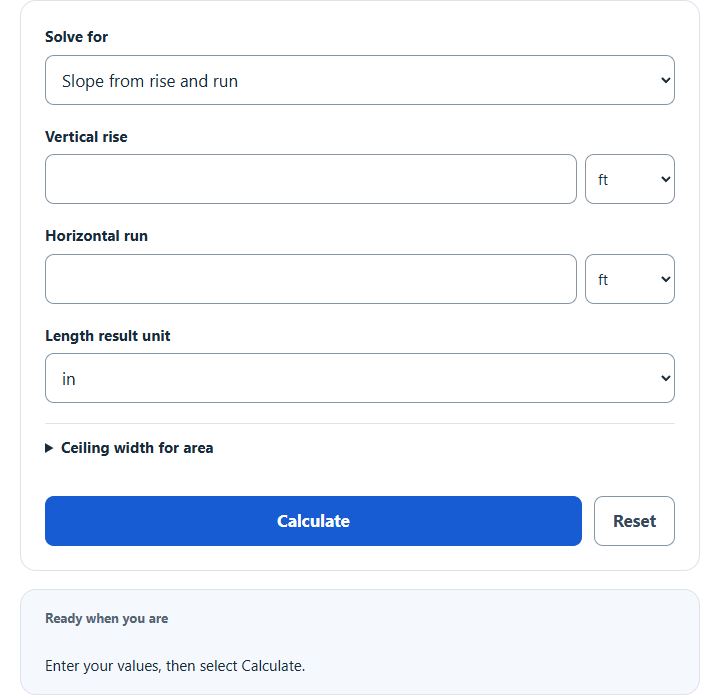
Calculate a ceiling’s slope angle, pitch and percent from its rise and run, or find headroom, a missing rise or run from a pitch, or sloped ceiling area.
- All Slope Calculators
- Gutter Slope Calculator
- All Construction Calculators
- Length of Slope Calculator
- Ceiling Height Clearance Calculator
Calculator Functions
| Function | What it does | What it requires |
|---|---|---|
| Slope from rise and run | Finds the ceiling angle, pitch and percent slope | Requires the vertical rise and the horizontal run |
| Rise from run and angle | Finds how much higher the ceiling is at the far end of a run | Requires the horizontal run and the ceiling slope as a pitch or an angle |
| Run from rise and angle | Finds the horizontal distance needed for the ceiling to gain a given height | Requires the vertical rise and the ceiling slope as a pitch or an angle |
| Headroom at a distance | Finds the ceiling height at a point away from the low wall | Requires the height at the low end, the horizontal distance from it and the ceiling slope |
Lengths can be entered in in, ft, cm or m, and the Length result unit setting picks the unit of the answer. The ceiling slope is chosen as a pitch from 1:12 to 12:12 or typed as an angle in degrees. The first three functions have an optional Ceiling width, measured along the low wall, which adds the area of the sloped surface. Every result lists the angle, the pitch, the percent slope, the sloped length and a surface multiplier.
Ceiling Slope Formulas
| CS | Ceiling slope (degrees) |
| CH | Difference in height between the two ends: the rise |
| CL | Horizontal run, in the same unit as CH |
CL is measured level along the floor, not along the sloped surface. The same two numbers give the pitch as 12 × CH ÷ CL and the percent slope as 100 × CH ÷ CL.
Slope from rise and run
A ceiling that climbs 4 ft over a 6 ft run slopes at tan−1(4 ÷ 6) = 33.69°. That is an 8:12 pitch and a 66.67% slope. A rise of 700 over a run of 1,500 gives 25.02°.
Rise from run and angle
Over a 12 ft run, a 4:12 ceiling (18.43°) rises 12 × 4 ÷ 12 = 4 ft. A 30° ceiling over a 10 ft run rises 10 × tan(30°) = 5.77 ft.
Run from rise and angle
To gain 4 ft at a 6:12 pitch (26.57°), the ceiling needs a run of 4 ÷ 0.5 = 8 ft.
Headroom at a distance
H is the ceiling height at a horizontal distance d from the low wall. With a 5 ft low wall and a 6:12 pitch, the ceiling is 5 + 6 × 0.5 = 8 ft high at a point 6 ft into the room.
Sloped Ceiling Area
The square root term is the sloped length, the distance measured up the ceiling itself. For the 4 ft by 6 ft example it is √(16 + 36) = 7.21 ft, so a 10 ft wide section has 72.11 ft² of ceiling surface, compared with 60 ft² of floor below it. The surface multiplier in the results is that ratio, 1.2019.
Limits of This Estimate
- The ceiling is treated as one straight plane with a constant slope. Curved, stepped or two-pitch ceilings need each section worked separately.
- Run is horizontal distance. Entering a length measured along the sloped surface gives an angle that is too low.
- The headroom figure is geometry only. It does not check building-code ceiling heights, beams, ducts or other obstructions.