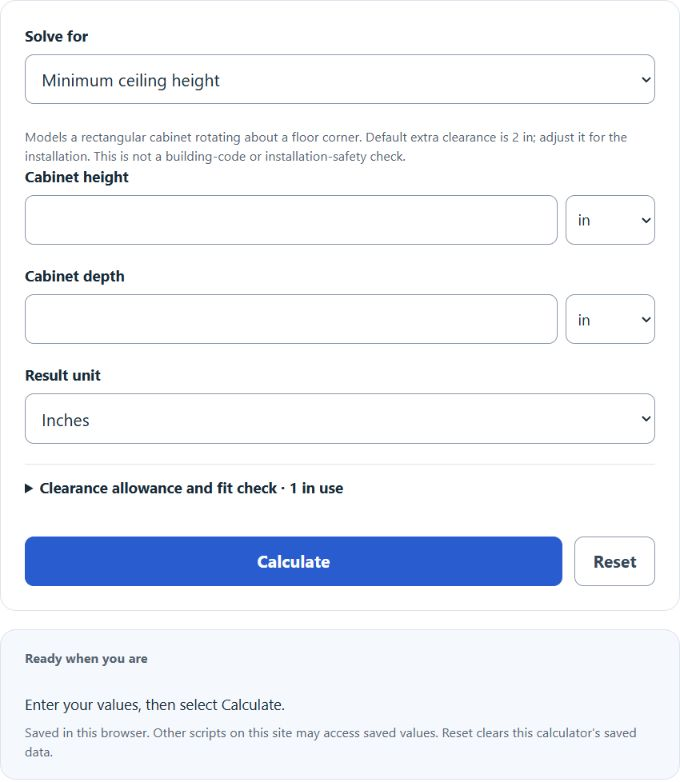
Calculate minimum ceiling height from cabinet height and depth, or solve for maximum cabinet dimensions, with unit conversions and a safety margin.
- All Construction Calculators
- False Ceiling (POP Ceiling) Cost Calculator
- Gross Floor Area Calculator
- Ceiling Slope Calculator
Ceiling Height Clearance Formula
The following equation gives the idealized tilt diagonal before extra clearance is added. The calculator adds an adjustable allowance, initially 2 inches.
- Where CH is the minimum ceiling height (ft)
- L is the length/height of the cabinet/dresser (ft)
- D is the depth of the cabinet/dresser (ft)
This formula follows the Pythagorean theorem for a rigid rectangular cabinet rotating about a floor corner. The peak height of that model is its height–depth diagonal. Required ceiling height equals that diagonal plus the chosen extra allowance. Real feet, handles, toe kicks, obstructions and pivot paths can change the required space.
What is Ceiling Height Clearance?
Ceiling height clearance is the vertical distance between the floor and the lowest point of the ceiling (or any overhead obstruction such as a beam, duct, or soffit) in a given space. In the context of furniture installation, it refers specifically to the minimum ceiling height needed to tilt a tall object, like a cabinet, bookcase, or armoire, from a lying-down position into its upright orientation without the piece colliding with the ceiling.
This measurement matters far beyond furniture. Building codes, workplace safety regulations, and accessibility standards all set specific ceiling clearance minimums depending on the type of space and its intended use. A residential hallway, a commercial stairwell, an industrial warehouse, and an operating room each have different clearance requirements governed by different regulatory bodies.
Why the Diagonal Matters When Tilting Furniture
Many people assume that if a cabinet is 7 feet tall and the ceiling is 8 feet high, there is plenty of room. That assumption ignores the tilting process. A cabinet that is 7 feet tall and 2 feet deep has a diagonal of approximately 7.28 feet. That means you need at least 7 feet 3.4 inches of ceiling height to tilt it upright, not 7 feet. The deeper the furniture, the more ceiling height you lose to the diagonal.
An extra working allowance is added to the diagonal when finding required ceiling height. For an inverse solve, subtract the allowance from available ceiling height before applying the Pythagorean theorem. The calculator retains 2 inches as an adjustable example; no universal allowance guarantees a safe installation. Toe-kick geometry is not modeled.
Standard Ceiling Heights by Building Type and Region
Ceiling heights are not universal. They vary by era of construction, building type, climate, and local building codes. Understanding the standard heights for your space helps you determine whether clearance will be an issue before you ever measure a piece of furniture.
Residential Ceiling Heights
In the United States, most homes built after 1990 have 8-foot (96-inch) ceilings on the first floor and sometimes 9-foot (108-inch) ceilings in newer construction. Homes built in the 1950s through 1970s often have ceilings as low as 7 feet 6 inches in basements and 8 feet on main floors. Older Victorian-era homes (pre-1920) commonly feature 9- to 12-foot ceilings, while mid-century ranch homes typically sit at exactly 8 feet.
Ceiling dimensions vary by country, jurisdiction, building age and use. A customary or advertised ceiling height is not necessarily a regulatory minimum. Measure the actual room and consult locally adopted requirements.
Commercial and Industrial Ceiling Heights
Commercial and industrial clear heights depend on the building, occupancy and equipment. Suspended ceilings, services and overhead structures can reduce usable clearance. Use measured clearance at the installation location rather than a market average.
Building Code Ceiling Height Minimums
Regulatory minimums for ceiling height exist to protect safety, ensure adequate ventilation, and maintain livability. The specific requirements depend on the type of space, the governing code, and local amendments.
IRC (International Residential Code)
Under the 2021 IRC, Sections R305 and R311.7.2, habitable spaces, hallways and basement areas containing these spaces generally require 7 feet of ceiling height. Bathrooms, toilet rooms, laundry rooms and non-habitable basement areas generally require 6 feet 8 inches. Specific exceptions apply to sloped ceilings, beams and basement obstructions. Stairway headroom is generally 6 feet 8 inches above the line connecting tread nosings. Check the locally adopted edition and amendments.
IBC (International Building Code) for Commercial Spaces
The 2024 IBC, Sections 1003.2, 1003.3.1 and 1011.3, generally requires a 7-foot-6-inch ceiling height for means of egress, subject to specific exceptions. Permitted projections generally must maintain 80 inches over circulation paths; certain door hardware may extend to 78 inches. Stairways generally require 80 inches above the line connecting tread nosings, with separate exceptions. Apply the locally adopted code and occupancy requirements.
OSHA Workplace Requirements
OSHA requirements depend on the workplace and equipment. Exit-route ceilings generally require 7 feet 6 inches, with projections no lower than 6 feet 8 inches. For specified electrical working spaces at 600 volts or less, minimum headroom is 6 feet 3 inches for installations built before August 13, 2007, and 6 feet 6 inches for installations built on or after that date; taller equipment requires at least its own height. Where energized parts above 600 volts are exposed, minimum working-space height is 6 feet 6 inches. Marine terminals must prominently post insufficient vehicle or equipment clearance heights.
ADA Accessibility Standards
Where the ADA Standards, Section 307.4, apply, vertical clearance is generally at least 80 inches. Areas with lower clearance require a guardrail or other physical barrier whose leading edge is no more than 27 inches above the floor or ground. A detectable warning alone does not satisfy this barrier requirement. Door closers and door stops have a 78-inch minimum exception.
Ceiling Clearance Requirements by Installation Type
Beyond furniture, many common household and commercial installations have their own clearance rules that affect how much usable vertical space remains in a room.
Ceiling Fans
Ceiling fans require the clearances specified by the manufacturer and applicable installation requirements. Check blade-to-floor, blade-to-wall and blade-to-ceiling distances for the selected fan. Flush-mount and downrod models have different mounting and airflow characteristics; do not assume a universal airflow reduction.
Fire Sprinklers
Where adopted, IFC Section 315.3.1 generally requires storage at least 2 feet below ceilings in nonsprinklered areas and 18 inches below sprinkler deflectors in sprinklered areas. Its wall-storage exceptions have stated conditions, including a compliant automatic sprinkler system for the 18-inch exception. Confirm the applicable code and sprinkler design; this furniture-tilt calculation does not establish storage compliance.
Lighting Fixtures
Pendant lights over kitchen islands are typically hung 30 to 36 inches above the countertop, which translates to roughly 66 to 72 inches above the floor for a standard 36-inch counter. Over dining tables, the recommended hanging height is 30 to 34 inches above the table surface. Recessed lighting requires 6 to 8 inches of clearance above the ceiling plane for the housing, which can matter when planning insulation or when working with shallow joist bays.
Garage and Carport Clearance
Garage clearance must account for the door opening, tracks, opener, overhead storage and vehicle. Automotive lift requirements depend on the exact lift, vehicle and raised position. Follow the manufacturer’s installation requirements and measure the complete operating envelope.
Maximum Cabinet Height for Common Ceiling Heights
The table below uses maximum cabinet height = √((ceiling height − 2 in)² − cabinet depth²), rounded to one decimal inch. The 2-inch example allowance is subtracted from ceiling height first. These are geometric model limits, not guarantees that a particular cabinet can be installed.
| Ceiling Height | Cabinet Depth: 12 in | Cabinet Depth: 18 in | Cabinet Depth: 24 in | Cabinet Depth: 30 in |
|---|---|---|---|---|
| 7 ft 6 in (90 in) | 87.2 in (7 ft 3.2 in) | 86.1 in (7 ft 2.1 in) | 84.7 in (7 ft 0.7 in) | 82.7 in (6 ft 10.7 in) |
| 8 ft 0 in (96 in) | 93.2 in (7 ft 9.2 in) | 92.3 in (7 ft 8.3 in) | 90.9 in (7 ft 6.9 in) | 89.1 in (7 ft 5.1 in) |
| 8 ft 6 in (102 in) | 99.3 in (8 ft 3.3 in) | 98.4 in (8 ft 2.4 in) | 97.1 in (8 ft 1.1 in) | 95.4 in (7 ft 11.4 in) |
| 9 ft 0 in (108 in) | 105.3 in (8 ft 9.3 in) | 104.5 in (8 ft 8.5 in) | 103.2 in (8 ft 7.2 in) | 101.7 in (8 ft 5.7 in) |
| 10 ft 0 in (120 in) | 117.4 in (9 ft 9.4 in) | 116.6 in (9 ft 8.6 in) | 115.5 in (9 ft 7.5 in) | 114.1 in (9 ft 6.1 in) |
A recessed toe kick may change the actual pivot path. This calculator does not model that geometry or grant extra height for it. Check the cabinet manufacturer’s installation instructions and assess the actual path and obstructions.
Practical Tips for Tilting Tall Furniture
Always measure the actual ceiling height at the specific location where the furniture will be tilted, not just the room’s general ceiling height. Ceilings are rarely perfectly level, and variations of half an inch to an inch are common, especially in older homes. Crown molding, ceiling-mounted light fixtures, smoke detectors, and HVAC vents can all reduce effective clearance by 2 to 6 inches.
When tilting a piece, the back-bottom corner stays on the floor as the pivot point. Placing a furniture slider or a piece of cardboard under this corner prevents floor damage and makes the rotation smoother. Two people should coordinate the tilt: one controlling the pivot at the base and the other guiding the top edge as it swings upward. Tilting against a wall rather than in the center of a room gives you a stable backstop and prevents the piece from overshooting vertical.
If the diagonal exceeds the ceiling height by a small margin (under 2 inches), there are workarounds. Removing adjustable feet or leveling legs from the bottom of the cabinet temporarily shortens it. Some cabinet installers build the unit in two pieces and join them after standing each piece individually. For built-in cabinetry, constructing the face frame separately and attaching it after the cabinet box is in position avoids the tilt problem entirely.