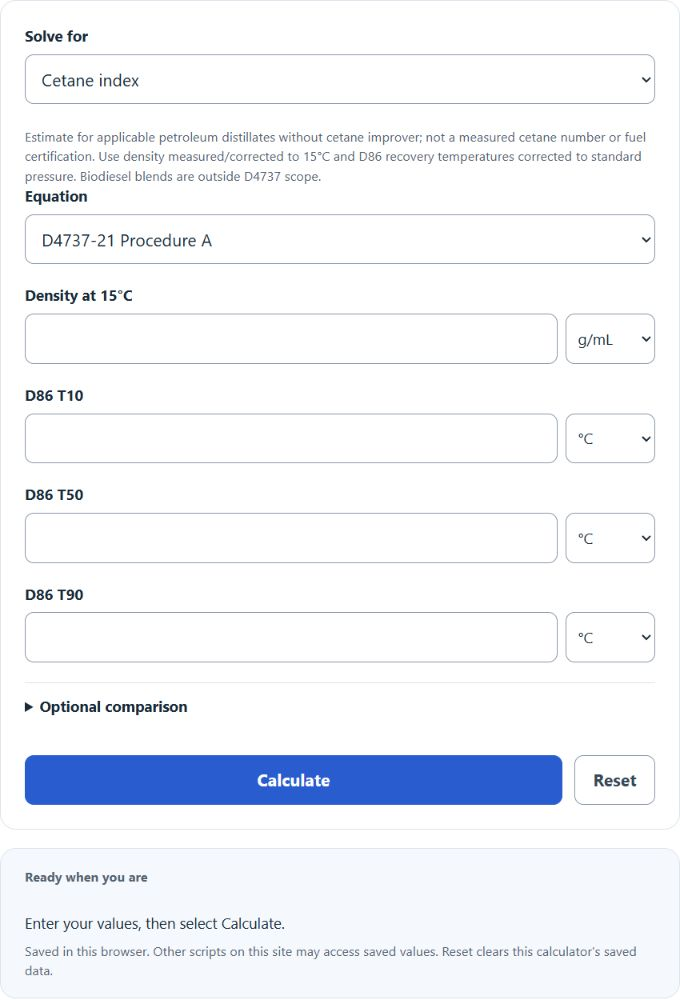
Calculate diesel cetane index from density at 15 °C and D86 T10/T50/T90 recovery temperatures using ASTM D4737 Procedure A or B or the D976 equation.
- All Automotive Calculators
- Specific Gravity To Volume Calculator
- Bulk Specific Gravity (GSB) Calculator
Cetane Index Formula
Use density D in g/mL at 15°C and ASTM D86 recovery temperatures T10, T50 and T90 in °C, corrected to standard barometric pressure. This calculator implements D4737-21 A/B and the D976 two-variable equation; it does not use aniline point or Diesel Index.
For Procedure A, define B = exp[−3.5(D − 0.85)] − 1, X = T10 − 215, Y = T50 − 260 and Z = T90 − 310.
CI = 45.2 + 0.0892X + (0.131 + 0.901B)Y + (0.0523 − 0.420B)Z + 0.00049(X² − Z²) + 107B + 60B².
Procedure B: CI = −399.90D + 0.1113T10 + 0.1212T50 + 0.0627T90 + 309.33.
D976: CI = 454.74 − 1641.416D + 774.74D² − 0.554T50 + 97.803(log10 T50)².
Diesel Index Formula
The diesel index is an estimate of ignition quality for petroleum diesel. It uses the fuel’s aniline point and API gravity at 60 °F.
Diesel index = aniline point (°F) × API gravity ÷ 100.
The aniline point is the lowest temperature at which equal volumes of the fuel and aniline mix into a single liquid phase. To convert an aniline point from °C to °F, multiply by 1.8 and add 32 before using the formula.
Diesel index, calculated cetane index (ASTM D4737 or D976), and measured cetane number (ASTM D613) use different methods and can give different values.
What is a Cetane Index?
A cetane index estimates ignition quality from fuel properties; it is not a measured D613 cetane number. D4737 excludes biodiesel blends and does not measure the effect of cetane improver. Procedure A includes No. 2-D S15; Procedure B applies to No. 2-D S500. Verify the applicable standard and grade.
How to Calculate Cetane Index?
Select the equation and solve mode, then enter the visible required properties. SG or API gravity at 60°F is not an exact substitute for density at 15°C. Use laboratory density or a suitable temperature correction.
Inverse calculations return all mathematical candidates within density 0.70–1.05 g/mL or T50 120–400°C; A/B also require T10 ≤ T50 ≤ T90. These search bounds do not establish method validity or a blending recommendation. Optional thresholds are numeric comparisons only; a measured-minus-calculated difference does not establish additive treatment.
Example: D = 0.850 g/mL, T10 = 215°C, T50 = 260°C and T90 = 310°C give CI = 45.2 by Procedure A and about 44.29 by Procedure B. Holding temperatures fixed and solving the A equation for target 45.2 gives D = 0.850 g/mL.