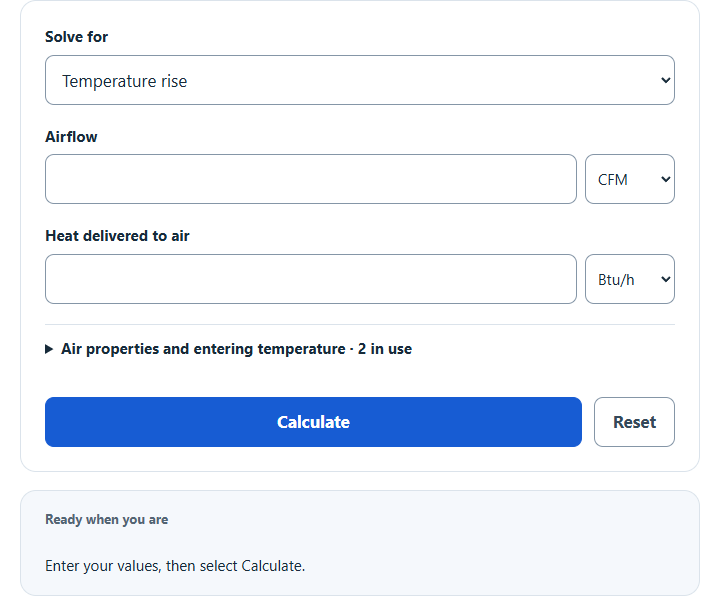
Calculate air temperature rise from CFM and Btu/h, or find the CFM needed for a heat load and the Btu/h from airflow, using standard air you can adjust.
Calculator Functions
| Function | What it does | What it requires |
|---|---|---|
| Temperature rise | Finds how much a heat input warms an airflow | Requires the airflow and the heat delivered to the air |
| Required airflow (Btu/h to CFM) | Finds the airflow that carries a heat load at a chosen temperature rise | Requires the heat delivered to the air and the temperature rise |
| Sensible heat (CFM to Btu/h) | Finds the heat an airflow carries for a temperature rise | Requires the airflow and the temperature rise |
Airflow can be entered in CFM, m³/h or L/s, heat in Btu/h, kW or W, and temperature rise in Δ°F or Δ°C. Optional settings change the air density, prefilled with 0.075 lb/ft³, and the specific heat, prefilled with 0.24 Btu/(lb·°F). An entering-air temperature adds the leaving-air temperature to the result.
CFM Temperature Rise Formulas
| ΔT | Temperature rise (°F) |
| Q | Sensible heat delivered to the air (Btu/h) |
| CFM | Airflow (cubic feet per minute) |
| 1.08 | Air factor: 60 × 0.075 × 0.24 |
This is the heat balance for an air stream, heat = mass flow × specific heat × temperature change, written for CFM, °F and Btu/h. The 1.08 constant holds the unit conversions and the density of air at sea level, so above sea level it is multiplied by the ratio of actual to standard air density [1]. The density setting does the same job: the calculator works out the air factor as 60 × density × specific heat.
Temperature rise
10,000 Btu/h delivered to 500 CFM raises the air by 10,000 ÷ (1.08 × 500) = 18.52 °F, which is 10.29 °C. A 5 kW heater is 17,061 Btu/h [2], and across 400 CFM it gives 17,061 ÷ (1.08 × 400) = 39.49 °F. With thinner air at 0.06 lb/ft³ the air factor falls to 0.864 and the first case becomes 23.15 °F.
Required airflow (Btu/h to CFM)
Carrying 60,000 Btu/h with a 50 °F rise takes 60,000 ÷ (1.08 × 50) = 1,111 CFM.
Sensible heat (CFM to Btu/h)
1,000 CFM warmed by 20 °F carries 1.08 × 1,000 × 20 = 21,600 Btu/h, or 6.33 kW.
Limits of This Estimate
- The formulas cover sensible heat only, the part that changes air temperature. They leave out moisture added to or removed from the air, so they do not describe a cooling coil that also dehumidifies.
- Q is the heat that reaches the air. For a furnace that is its output, not the fuel input on the rating plate.
- The 1.08 factor fits air at sea-level density [1]. Enter the actual density for hot air or high altitude.
- A temperature rise on its own does not show that equipment is efficient or correctly sized.
Sources
- National Renewable Energy Laboratory, Refrigeration Playbook: Heat Reclaim (NREL/TP-5500-63786): air-side heat equation with the 1.08 constant and its density correction
- NIST, Special Publication 811, Appendix B.8: Btu per hour, cubic foot per minute and specific heat conversions