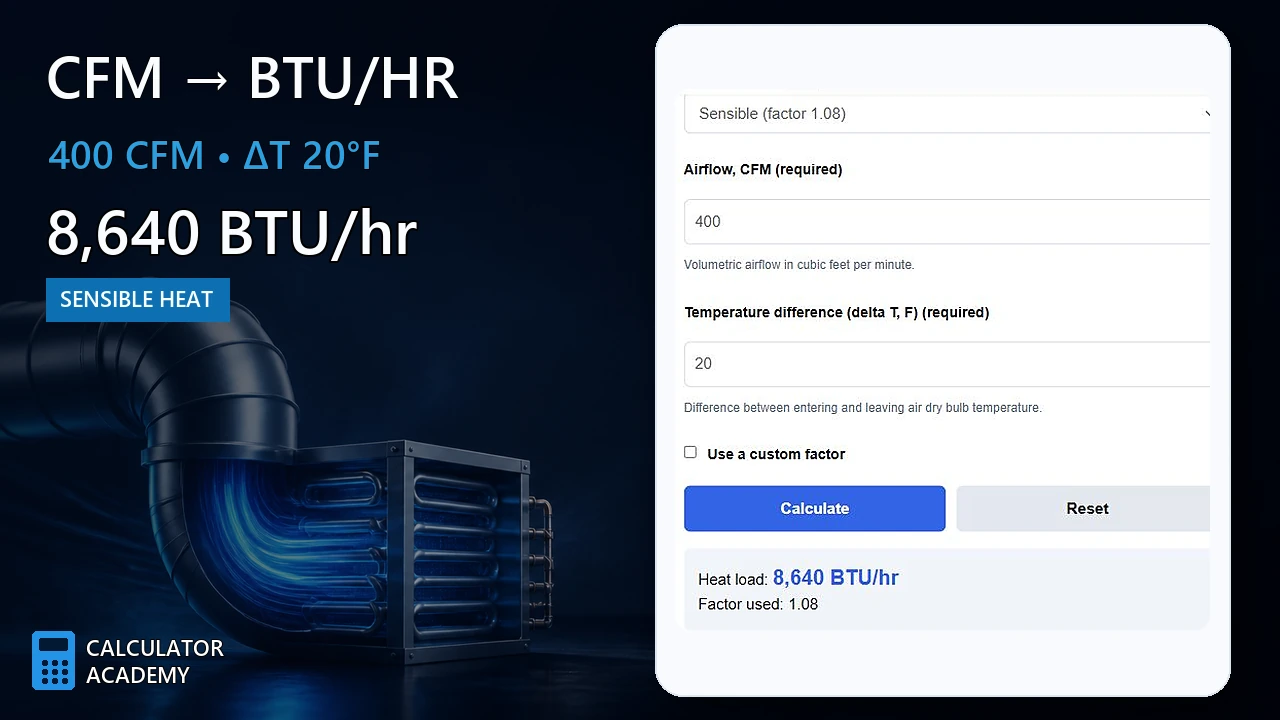
Calculate sensible heat BTU/hr from CFM and temperature difference, or find required airflow from BTU/hr for heating and cooling loads.
Quick overview: Convert airflow in CFM to sensible heating or cooling capacity in BTU/hr using the standard HVAC relationship BTU/hr = 1.08 × CFM × ΔT.
- 500 CFM at 20°F ≈ 10,800 BTU/hr
- 400 CFM at 20°F ≈ 8,640 BTU/hr
- 1,000 CFM at 20°F ≈ 21,600 BTU/hr
- 500 CFM at 30°F ≈ 16,200 BTU/hr
The 1.08 factor is based on standard indoor air conditions and combines air density, specific heat, and minutes-to-hours conversion.
- cfm to m3/sec Converter
- Furnace AFUE Savings Calculator
- Gas Pressure To Btu Calculator
- Temperature Decrease Calculator
- Gpm To Kw Calculator
- All Unit Converters
This page converts airflow in cubic feet per minute (CFM) to a sensible heat rate in British thermal units per hour (BTU/hr). HVAC technicians, mechanical engineers, and building contractors use this conversion to size ductwork, verify equipment capacity, and diagnose system performance. The relationship between air volume and thermal energy depends on air density, specific heat, and the temperature differential across the air stream.
CFM to BTU Formula
The standard sensible heat equation for air at sea-level, near-room-temperature conditions is:
Where:
- CFM is the volumetric airflow rate
- ΔT is the temperature difference in °F
- BTU/hr is the sensible heating or cooling capacity
The inverse form is CFM = BTU/hr / (1.08 × ΔT).
Where the 1.08 Factor Comes From
The number 1.08 is not a universal constant. It is the product of three properties of dry air at standard conditions, typically sea level and near 70°F:
ρ is the air density, approximately 0.075 lb/ft³ at standard conditions. Cp is the specific heat of air, approximately 0.24 BTU per pound per degree Fahrenheit. The factor of 60 converts minutes to hours. When these conditions change, the 1.08 factor changes as well, which is why altitude and temperature corrections matter for accurate HVAC calculations.
CFM to BTU/hr Reference Table
The table below shows BTU/hr output for common CFM values across several temperature differentials, all using the standard 1.08 factor.
| CFM | ΔT 10°F | ΔT 15°F | ΔT 20°F | ΔT 25°F | ΔT 30°F | ΔT 40°F |
|---|---|---|---|---|---|---|
| 100 | 1,080 | 1,620 | 2,160 | 2,700 | 3,240 | 4,320 |
| 200 | 2,160 | 3,240 | 4,320 | 5,400 | 6,480 | 8,640 |
| 400 | 4,320 | 6,480 | 8,640 | 10,800 | 12,960 | 17,280 |
| 500 | 5,400 | 8,100 | 10,800 | 13,500 | 16,200 | 21,600 |
| 600 | 6,480 | 9,720 | 12,960 | 16,200 | 19,440 | 25,920 |
| 800 | 8,640 | 12,960 | 17,280 | 21,600 | 25,920 | 34,560 |
| 1,000 | 10,800 | 16,200 | 21,600 | 27,000 | 32,400 | 43,200 |
| 1,500 | 16,200 | 24,300 | 32,400 | 40,500 | 48,600 | 64,800 |
| 2,000 | 21,600 | 32,400 | 43,200 | 54,000 | 64,800 | 86,400 |
| 3,000 | 32,400 | 48,600 | 64,800 | 81,000 | 97,200 | 129,600 |
Note that 400 CFM at ΔT 30°F equals 12,960 BTU/hr, which is close to 1 ton of cooling capacity at 12,000 BTU/hr. This aligns with the industry rule of thumb of approximately 400 CFM per ton of air conditioning capacity.
Altitude Correction for the 1.08 Factor
At higher elevations, air is less dense, so the 1.08 factor decreases. For installations above roughly 2,000 feet, using the sea-level factor will overestimate the BTU/hr output. The corrected relationship becomes BTU/hr = (corrected factor) × CFM × ΔT.
| Elevation (ft) | Air Density (lb/ft³) | Correction Multiplier | Adjusted Factor |
|---|---|---|---|
| Sea level | 0.075 | 1.00 | 1.08 |
| 1,000 ft | 0.072 | 0.96 | 1.04 |
| 2,000 ft | 0.069 | 0.92 | 0.99 |
| 3,000 ft | 0.066 | 0.88 | 0.95 |
| 4,000 ft | 0.064 | 0.85 | 0.92 |
| 5,000 ft | 0.062 | 0.83 | 0.90 |
| 7,000 ft | 0.058 | 0.77 | 0.83 |
| 10,000 ft | 0.052 | 0.69 | 0.75 |
For example, a system delivering 800 CFM with a 20°F temperature rise in Denver at roughly 5,280 feet would produce about 800 × 0.90 × 20 = 14,400 BTU/hr instead of the 17,280 BTU/hr predicted by the sea-level formula. That is about a 17% reduction in actual sensible capacity.
Temperature Effects on Air Density
Air density also varies with temperature. The standard 0.075 lb/ft³ applies near 70°F. At higher or lower temperatures, the density shifts, changing how much heat energy each cubic foot of air can carry. This matters in industrial applications such as process heating, furnace flue gas analysis, and cold-storage ventilation.
| Air Temp (°F) | Density (lb/ft³) | Adjusted Factor |
|---|---|---|
| 0°F | 0.086 | 1.24 |
| 32°F | 0.081 | 1.17 |
| 70°F (std) | 0.075 | 1.08 |
| 100°F | 0.071 | 1.02 |
| 150°F | 0.065 | 0.94 |
| 200°F | 0.060 | 0.86 |
| 300°F | 0.052 | 0.75 |
| 400°F | 0.043 | 0.62 |
At 0°F the factor rises to 1.24, meaning cold air carries about 15% more heat energy per cubic foot than room-temperature air. At 400°F it drops to 0.62, nearly half. For most residential and light commercial HVAC applications between about 55°F and 100°F, the standard 1.08 factor usually introduces less than 6% error.
Sensible Heat vs. Total Heat vs. Latent Heat
The equation BTU/hr = 1.08 × CFM × ΔT calculates sensible heat only, meaning the energy associated with a temperature change in air. In cooling applications, removing moisture from air also requires energy, called latent heat. The three common HVAC heat formulas are shown below.
| Heat Type | Formula | What It Measures |
|---|---|---|
| Sensible | 1.08 × CFM × ΔT | Temperature change only |
| Latent | 0.68 × CFM × ΔW (grains) | Moisture removal only |
| Total | 4.5 × CFM × Δh (BTU/lb) | Temperature plus moisture change |
In a typical residential cooling scenario, about 70% of the total load may be sensible and 30% latent, though this varies by climate and equipment design. The CFM-to-BTU relationship on this page addresses the sensible component, which is the dominant factor in most heating applications and an important sizing variable for duct airflow.
CFM per Ton of Cooling
A widely used HVAC benchmark is 400 CFM per ton of cooling capacity, where 1 ton = 12,000 BTU/hr.
| System Size | Tons | Total BTU/hr | Typical CFM | Sensible BTU/hr at ΔT 20°F |
|---|---|---|---|---|
| Small room unit | 1.5 | 18,000 | 600 | 12,960 |
| Small residential | 2.0 | 24,000 | 800 | 17,280 |
| Average home | 3.0 | 36,000 | 1,200 | 25,920 |
| Large home | 4.0 | 48,000 | 1,600 | 34,560 |
| Large residential | 5.0 | 60,000 | 2,000 | 43,200 |
The 400 CFM per ton figure is an average. Systems designed for humid climates sometimes use closer to 350 CFM per ton to allow the evaporator coil to remove more moisture, while dry-climate systems may run closer to 450 CFM per ton. Adjusting airflow per ton affects both sensible and latent capacity, which is why proper airflow measurement is a key step in HVAC commissioning.
When the Standard Formula Is Not Enough
The equation 1.08 × CFM × ΔT works well for standard residential and commercial HVAC at low to moderate elevations. Certain situations require the more general form BTU/hr = ρ × Cp × 60 × CFM × ΔT, where the actual air density for the operating conditions is used. This includes flue gas heat recovery above 200°F, cold storage and freezer ventilation below 32°F, high-altitude installations above 3,000 feet, and process air systems containing significant moisture or other gases. For cooling-load calculations that must include both temperature and humidity changes, the total heat formula using enthalpy 4.5 × CFM × Δh gives a more complete picture.