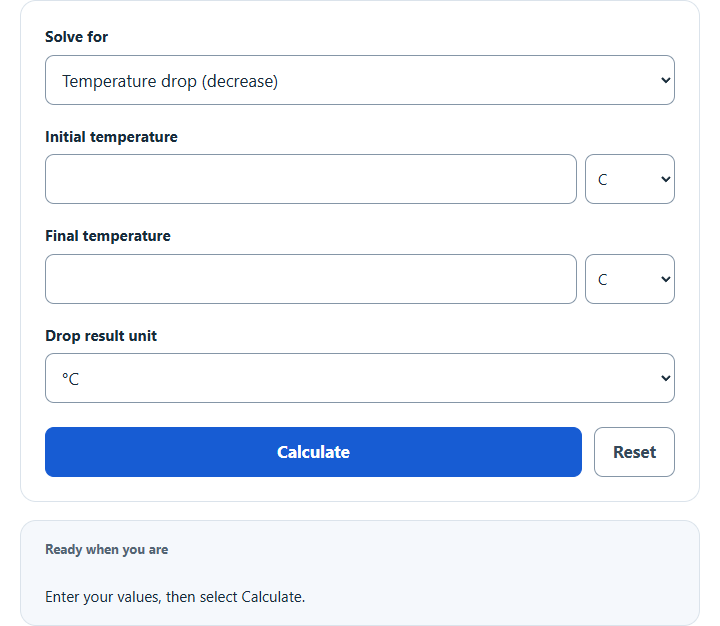
Calculate a temperature drop from initial and final readings, the temperature after a drop, or the average drop per hour or minute, in °C, °F or K.
Calculator Functions
| Function | What it does | What it requires |
|---|---|---|
| Temperature drop (decrease) | Finds how many degrees a temperature fell | Requires the initial and final temperatures |
| Initial temperature before a drop | Finds the starting temperature | Requires the final temperature and the size of the drop |
| Final temperature after a drop | Finds the temperature reached after a drop | Requires the initial temperature and the size of the drop |
| Drop per hour (cooling rate) | Finds the average rate of cooling between two readings | Requires the initial and final temperatures and the elapsed time |
| Drop per hour from a known drop | Finds the average rate of cooling from a drop already known in degrees | Requires the size of the drop and the elapsed time |
| Initial temperature from rate | Finds the starting temperature from a steady cooling rate | Requires the final temperature, the cooling rate and the elapsed time |
| Final temperature from rate | Finds the temperature reached at a steady cooling rate | Requires the initial temperature, the cooling rate and the elapsed time |
| Elapsed time from rate | Finds how long a drop takes at a steady cooling rate | Requires the initial and final temperatures and the cooling rate |
| Check an entered decrease | Tests whether a stated drop matches two readings | Requires the initial and final temperatures and the stated drop |
| Check an entered cooling rate | Tests whether a stated cooling rate matches two readings and a time | Requires the initial and final temperatures, the elapsed time and the stated rate |
Temperatures and drops can be entered in °C, °F or K, time in hours, minutes or seconds, and rates in degrees per hour, minute or second. Every result also shows the drop in all three scales. A negative drop or rate means the temperature rose.
Temperature Decrease Formulas
| ΔT | Temperature drop (°C, °F or K) |
| T1 | Initial temperature |
| T2 | Final temperature |
Readings on different scales are first converted with °C = (°F − 32) ÷ 1.8 [1] and °C = K − 273.15 [2]. A drop is an interval, so it converts without the 32 or 273.15 offset: one Fahrenheit degree of drop is 5/9 of a Celsius degree [1], and a drop in °C is the same number in kelvins [2].
Temperature drop (decrease)
From 25 °C to 15 °C the drop is 10 °C, which is also 18 °F and 10 K.
Initial temperature before a drop
A final reading of 15 °C after a 10 °C drop started at 25 °C.
Final temperature after a drop
From a temperature of 15°, a drop of 21° results in −6°.
Drop per hour (cooling rate)
t is the elapsed time. Cooling from 25 °C to 15 °C over 2 hours averages 5 °C per hour.
Drop per hour from a known drop
A drop of 50.16 °C in 5.7 hours averages 50.16 ÷ 5.7 = 8.8 °C per hour.
Initial temperature from rate
Ending at 15 °C after 2 hours of cooling at 5 °C per hour means a start of 25 °C.
Final temperature from rate
Starting at 25 °C and cooling at 5 °C per hour for 2 hours ends at 15 °C.
Elapsed time from rate
Falling from 25 °C to 15 °C at 5 °C per hour takes 2 hours. The rate and the change must point the same way, or no positive time exists.
Check an entered decrease
The drop is recalculated from the two readings and compared with the stated one. 25 °C to 15 °C against a stated 10 °C agrees; against 12 °C it does not.
Check an entered cooling rate
The average rate is recalculated from the readings and the time and compared with the stated rate. 25 °C to 15 °C in 2 hours agrees with 5 °C per hour.
Limits of This Estimate
- Rates are averages over the whole interval. Real objects cool quickly at first and more slowly as they near the surrounding temperature, so the three rate projections are straight-line estimates and not Newton’s law of cooling.
- Readings below absolute zero (−273.15 °C, −459.67 °F or 0 K) are rejected.
- The two check functions accept a match only within rounding of about one part in ten billion, so a stated value rounded to fewer digits can be reported as not agreeing.
Sources
- National Institute of Standards and Technology, Guide for the Use of the International System of Units (SP 811), Appendix B.8: Fahrenheit to Celsius conversion for temperatures and for temperature intervals
- National Institute of Standards and Technology, Guide for the Use of the International System of Units (SP 811), Section 8.5: Celsius and kelvin temperature differences having the same value, and the 273.15 offset