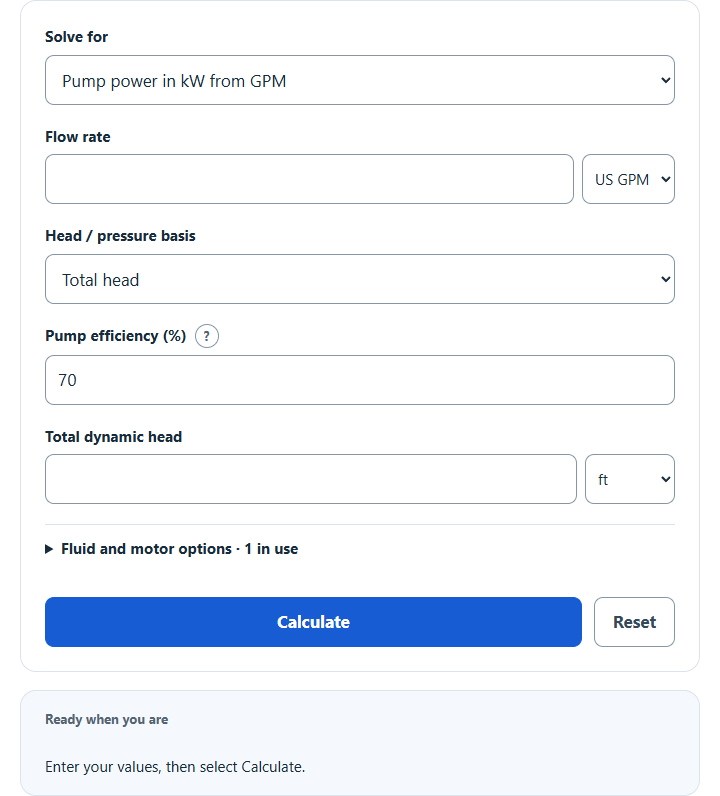
Convert GPM to kW of pump power from flow, head and pump efficiency (70% typical), or reverse kW to GPM, with results in kW, hp, L/s and m³/h.
- All Unit Converters
- Thermodynamics and Fluid Unit Converters
- GPM To Tons Calculator
- CC/REV to GPM Calculator
Calculator Functions
| Function | What it does | What it requires |
|---|---|---|
| Pump power in kW from GPM | Finds the shaft power a pump needs to move a flow against a head or pressure rise | Requires the flow rate, the total head or pressure rise, and the pump efficiency |
| Flow in GPM from kW | Finds the flow a pump delivers for a shaft power | Requires the shaft power, the total head or pressure rise, and the pump efficiency |
| Head / pressure rise | Finds the total head or pressure rise a pump can produce | Requires the flow rate, the shaft power and the pump efficiency |
| Pump efficiency | Finds pump efficiency from measured flow, head and power | Requires the flow rate, the shaft power, and the total head or pressure rise |
Flow is accepted in US GPM, L/s, L/min or m³/h, power in kW, hp or W, head in ft or m, and pressure rise in psi, bar or kPa. Pump efficiency is prefilled at 70%, a planning figure to replace with the efficiency at the real operating point. Optional settings are the fluid specific gravity, prefilled at 1 for water and used only with head, and a motor efficiency, which adds the electrical input power. Every result also lists hydraulic power, shaft power, flow and pressure rise in several units.
GPM to kW Formulas
| P | Pump shaft input power (kW) |
| Q | Flow rate (US GPM) |
| H | Total dynamic head (ft) |
| SG | Specific gravity of the fluid, 1 for water |
| k | 0.000188580819, the unit factor for GPM, feet and kW |
| η | Pump efficiency as a decimal (0.70 for 70%) |
GPM does not convert to kW on its own, because flow is not power. The power depends on how hard the pump has to push, which is the head or pressure rise, and on how efficient the pump is. The fluid power a system uses is the product of head and flow, and in US units it is H × Q × SG ÷ 3,960 in horsepower [1]. The factor k is the same relationship taken straight to kilowatts: it combines the US gallon and foot [2], standard gravity of 9.80665 m/s² [3] and a water density of 1,000 kg/m³.
Pump power in kW from GPM
The main formula applies directly. Pump efficiency is fluid power divided by pump shaft power [1], so dividing the fluid power by η gives the shaft power. A pump moving 50 GPM of water against 100 ft of head at 70% efficiency needs 50 × 100 × 1 × 0.000188580819 ÷ 0.70 = 1.347 kW at the shaft. At that head and efficiency, each 10 GPM adds 0.269 kW.
With Pressure rise selected, Δp is the pressure rise across the pump in pascals, Q is in m³/s and P is in watts. No specific gravity is needed, because pressure already includes the fluid density: Δp = ρ × g × H. For 100 GPM (0.006309 m³/s) and 50 psi (344,738 Pa) at 70%, P = 0.006309 × 344,738 ÷ 0.70 = 3,107 W, or 3.107 kW.
When a motor efficiency is entered, electrical input = shaft power ÷ motor efficiency. Motor power is higher than fluid power because of both pump and motor losses [1]. A 2.694 kW shaft load on a 90% efficient motor draws 2.993 kW.
Flow in GPM from kW
This is the main formula solved for flow. A 5 kW shaft input at 70% efficiency against 100 ft of head moves 5 × 0.70 ÷ (100 × 1 × 0.000188580819) = 185.6 GPM of water. The same power moves less water against a higher head.
Head / pressure rise
With 3 kW at the shaft, 70% efficiency and 100 GPM of water, H = 3 × 0.70 ÷ (100 × 0.000188580819) = 111.4 ft. With Pressure rise selected the result is Δp = P × η ÷ Q instead, which for the same inputs is 48.28 psi.
Pump efficiency
Efficiency is the fluid power divided by the shaft power [1]. A pump delivering 100 GPM of water at 100 ft while drawing 3 kW at the shaft is 100 × 100 × 0.000188580819 ÷ 3 = 0.6286, or 62.86% efficient. A result above 100% means a measurement or the head and pressure choice is wrong, and the calculator rejects it.
Limits of This Estimate
- The formulas describe steady flow of a liquid that does not compress. Total dynamic head has to include the lift and the friction losses in the piping, not the lift alone.
- Pump efficiency changes with flow. Each centrifugal pump has a best efficiency point, and running away from it lowers efficiency [1], so 70% is only a starting figure.
- Shaft power, electrical input and motor nameplate size are three different numbers. Motor selection also depends on the pump’s power curve across its operating range.
Sources
- U.S. Department of Energy, Improving Pumping System Performance: A Sourcebook for Industry, Second Edition: fluid power as head times flow, pump efficiency as fluid power over shaft power, motor losses and the best efficiency point
- NIST Special Publication 811, Guide for the Use of the SI, Appendix B.9: conversion factors for the US gallon, foot, psi and horsepower
- NIST, CODATA Value: standard acceleration of gravity: 9.80665 m/s²