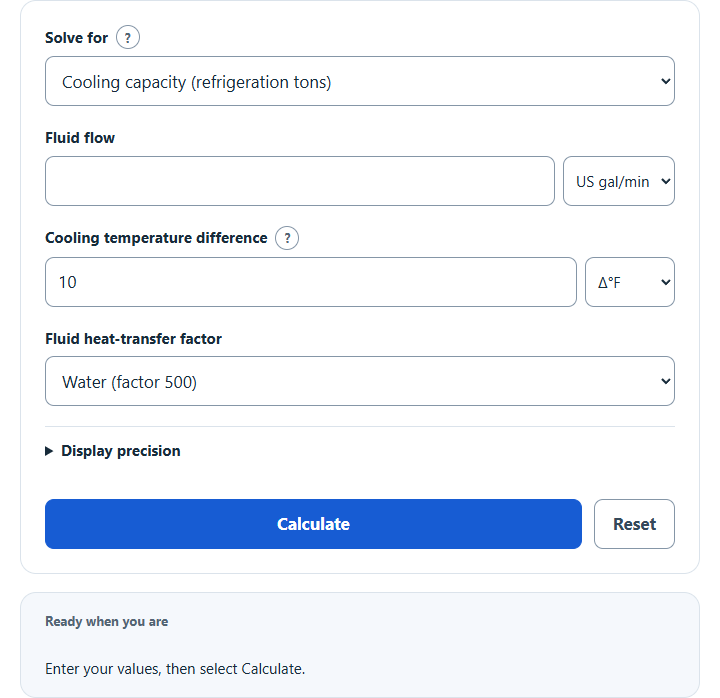
Convert GPM to tons of refrigeration (TR) from water flow and temperature difference, or TR to GPM, plus fluid mass flow in tons per hour.
- All Unit Converters
- Thermodynamics and Fluid Unit Converters
- GPM to Pipe Size Calculator
- Gallons to Tons Calculator
Calculator Functions
| Function | What it does | What it requires |
|---|---|---|
| Cooling capacity (refrigeration tons) | Converts a water flow and temperature difference to tons of refrigeration | Requires fluid flow, cooling temperature difference and fluid heat-transfer factor |
| Cooling flow from capacity | Converts tons of refrigeration to the flow in GPM that carries it | Requires cooling capacity, cooling temperature difference and fluid heat-transfer factor |
| Cooling temperature difference | Finds the temperature change of the fluid across the load | Requires fluid flow, cooling capacity and fluid heat-transfer factor |
| Fluid mass (tons per hour or total) | Converts a flow in GPM to tons of fluid moved | Requires fluid flow, fluid specific gravity, elapsed flow time and mass answer unit |
Flow can be entered in US gallons per minute, liters per minute or cubic meters per hour, temperature difference in °F or °C, and capacity in refrigeration tons, Btu/h or kW. The temperature difference starts at 10 °F. The fluid factor is 500 for water, or a custom value for other fluids. The mass function starts at a specific gravity of 1 and one hour, and its reference water density of 8.34 lb per gallon can be changed.
GPM to Tons Formulas
| TR | Cooling capacity in tons of refrigeration, each 12,000 Btu/h [1] |
| C | Fluid heat-transfer factor, 500 for water |
| GPM | Flow (US gallons per minute) |
| ΔT | Return temperature minus supply temperature (°F) |
For water this reduces to TR = GPM × ΔT ÷ 24. The factor C is 60 minutes per hour times the fluid’s weight per gallon times its specific heat. A US gallon is 3.785412 liters [1], and at a density of 1.000 g/cm³ [2] it holds 8.345 lb of water with a specific heat of 1 Btu per pound per °F, which makes C about 500.7, rounded to 500.
Cooling capacity (refrigeration tons)
The main formula applies directly. 240 GPM of water with a 10 °F temperature difference carries 500 × 240 × 10 ÷ 12,000 = 100 tons, which is 1,200,000 Btu/h or 351.7 kW. 100 GPM at 12 °F is 50 tons.
Cooling flow from capacity
(C × ΔT)
One ton of refrigeration needs 2.4 GPM of water at a 10 °F temperature difference, and 100 tons at 16 °F needs 150 GPM. The flow for each ton depends only on the temperature difference, as the table shows for water.
| Temperature difference (°F) | GPM per ton |
|---|---|
| 5 | 4.8 |
| 8 | 3 |
| 10 | 2.4 |
| 12 | 2 |
| 14 | 1.71 |
| 15 | 1.6 |
| 16 | 1.5 |
| 18 | 1.33 |
| 20 | 1.2 |
Cooling temperature difference
(C × GPM)
100 tons carried by 300 GPM of water means a temperature difference of 100 × 12,000 ÷ (500 × 300) = 8 °F.
Fluid mass (tons per hour or total)
8.34 ÷ 2,000
M is the fluid moved in US short tons, t is the time in hours and SG is the specific gravity. This is weight of fluid, not cooling. 100 GPM of water for one hour is 6,000 gallons, or 25.02 short tons, so each GPM of water is 0.2502 short tons per hour or 0.2270 metric tonnes per hour. 50 GPM of a fluid with a specific gravity of 1.2 moves 108.95 metric tonnes in 8 hours.
Limits of This Estimate
- The factor of 500 is a rounded value for plain water near room temperature. These estimates are based on the best available data and estimations.
- Glycol mixes and other fluids carry less heat per gallon. They need a custom factor of 60 × density in lb per gallon × specific heat at the operating temperature.
- A ton of refrigeration is a rate of heat removal and a ton of fluid is a weight. The first three functions and the mass function answer different questions and cannot be converted into each other.
Sources
- NIST, Guide to the SI, Appendix B.8: ton of refrigeration as 12,000 Btu/h, and the gallon, pound and short ton factors
- NIST, X-Ray Mass Attenuation Coefficients, Table 2: density of liquid water