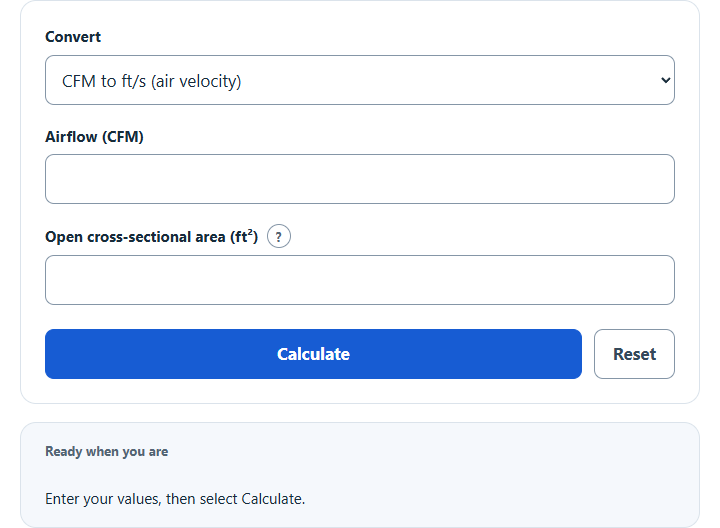
Convert CFM to ft/s air velocity from airflow and duct area, with feet per minute shown too, or work back from ft/s or fpm to CFM.
- Ccf To Scf Calculator
- Lbs To kPa Calculator
- Air Pressure To Water Pressure Calculator
- Weight to Density Calculator
- All Unit Converters
CFM to ft/s Formula
The following formula is used to calculate the air velocity in feet per second from airflow in cubic feet per minute and duct area.
Variables:
- FTS is the cross-sectional average air velocity in feet per second
- CFM is the airflow in cubic feet per minute
- A is the open duct cross-sectional area in square feet
To calculate feet per second, first divide the airflow in CFM by 60 to convert it to cubic feet per second, then divide by the duct area in square feet.
What is CFM to ft/s Conversion?
CFM measures volumetric airflow. Dividing actual flow by the matching open cross-sectional area gives average velocity. Local airspeed may differ across the duct; standard-volume flow must be converted to actual flow conditions before using this relationship.
How to Calculate CFM to ft/s?
The following steps outline how to calculate feet per second from CFM.
- First, determine the airflow in cubic feet per minute (CFM).
- Next, determine the duct cross-sectional area in square feet (A).
- Convert CFM to cubic feet per second by dividing by 60.
- Finally, divide that result by the duct area to calculate the air velocity in feet per second.
- After inserting the values and calculating the result, check your answer with the calculator above.
Example Problem:
Use the following variables as an example problem to test your knowledge.
Airflow (CFM) = 300
Duct Area (A) = 1.0 ft²
Feet Per Second (FTS) = (300 / 60) / 1.0 = 5 ft/s
CFM to ft/s Conversion Table
The table below shows a few common airflow and duct area combinations using the formula above.
| Airflow (CFM) | Duct Area (ft²) | Velocity (ft/s) |
|---|---|---|
| 60 | 1.0 | 1 |
| 120 | 1.0 | 2 |
| 300 | 1.0 | 5 |
| 600 | 1.0 | 10 |
| 300 | 0.5 | 10 |
| 300 | 2.0 | 2.5 |
| 900 | 1.5 | 10 |
In HVAC design and troubleshooting, airflow is often rated in CFM while airspeed is discussed in ft/s or ft/min. Understanding how to convert between these values makes it easier to evaluate duct sizing, compare airflow targets, and check whether a system is operating as expected.