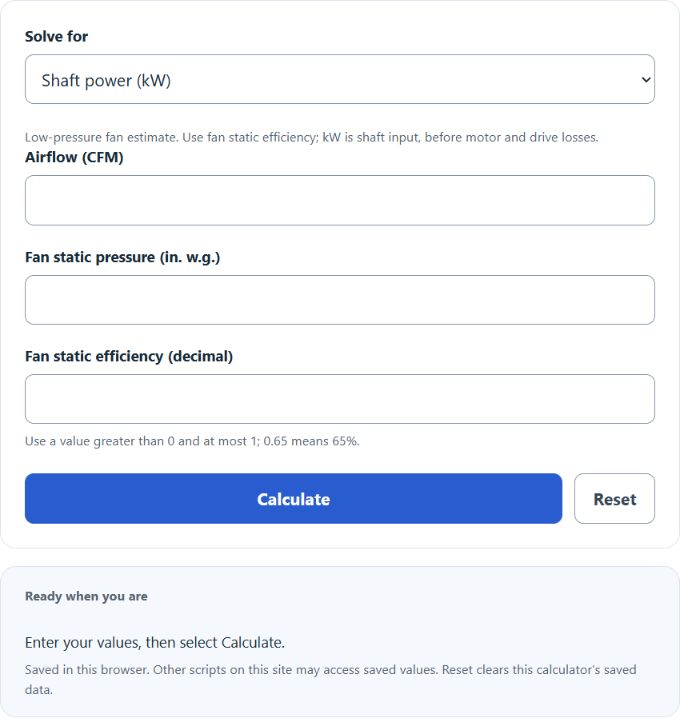
Estimate fan shaft input power, airflow, static pressure, or fan static efficiency from the other three values. Use the same operating point for all inputs; this is a low-pressure fan estimate.
- All Unit Converters
- Thermodynamics and Fluid Unit Converters
- CFM To Tons Calculator
- CFM To LPM Calculator
- CFM to Static Pressure Calculator
CFM to kW Formula
The following rounded formula estimates fan shaft input power from airflow, fan static pressure, and fan static efficiency:
kW = 0.0001175 × CFM × P ÷ n
Variables:
- kW is fan shaft input power in kilowatts, before motor and drive losses
- CFM is the air flow in cubic feet per minute
- P is the static pressure in inches of water gauge (in. w.g.)
- n is fan static efficiency as a decimal, greater than 0 and at most 1
The retained rounded constant 0.0001175 converts CFM times inches of water to kW. NIST gives 1 CFM = 0.0004719474432 m³/s and 1 conventional inch of water approximately 249.08891 Pa. Their product is approximately 0.117557 W, or 0.000117557 kW. Airflow times static pressure is static air power; dividing by fan static efficiency gives required shaft input power. Electrical input also includes motor and drive losses.
| Air Flow (CFM) | Power (kW) |
|---|---|
| 100 | 0.036 |
| 150 | 0.054 |
| 200 | 0.072 |
| 250 | 0.090 |
| 300 | 0.108 |
| 400 | 0.145 |
| 500 | 0.181 |
| 600 | 0.217 |
| 750 | 0.271 |
| 900 | 0.325 |
| 1000 | 0.362 |
| 1200 | 0.434 |
| 1500 | 0.542 |
| 2000 | 0.723 |
| 2500 | 0.904 |
| 3000 | 1.085 |
| 3500 | 1.265 |
| 4000 | 1.446 |
| 5000 | 1.808 |
| 6000 | 2.169 |
| Rounded to 3 decimals. Formula: kW = 0.0001175 x CFM x ΔP / η. Assumes ΔP = 2.0 in. w.g. and efficiency η = 0.65. | |
Fan Power vs. Air Compressor Power
This low-pressure fan approximation is not a high-pressure compressor power model. Compressor input depends on absolute pressure ratio, inlet flow conditions, thermodynamic process, and efficiency. Converting PSI to inches of water alone does not make this fan model suitable for compressor sizing.
| System Type | Pressure Unit | Power Formula | Typical Operating Pressure |
|---|---|---|---|
| Fan / Blower | in. w.g. | kW = 0.0001175 x CFM x ΔP / η | 0.05 to 10 in. w.g. |
| Air Compressor | PSI | Requires a compression model and inlet conditions | 80 to 200 PSI |
| 1 PSI is approximately 27.68 conventional inches of water. Ideal isothermal compression work depends on the logarithm of the absolute pressure ratio; no universal linear CFM-to-PSI power conversion is provided here. | |||
Fan Affinity Law: How Airflow Changes Affect Power
For the same fan geometry and air density at corresponding operating points, with approximately unchanged efficiency, airflow scales with speed, pressure with speed squared, and shaft power with speed cubed. Under those assumptions, a 20% airflow reduction corresponds to about 48.8% less shaft power. Arbitrary airflow changes or damper adjustments do not guarantee this relationship.
| CFM Ratio | Power Multiplier | Power Change | Example (Base: 2,000 CFM, 1.0 kW) |
|---|---|---|---|
| 50% | 0.125x | -87.5% | 0.125 kW |
| 60% | 0.216x | -78.4% | 0.216 kW |
| 70% | 0.343x | -65.7% | 0.343 kW |
| 80% | 0.512x | -48.8% | 0.512 kW |
| 90% | 0.729x | -27.1% | 0.729 kW |
| 100% (base) | 1.000x | baseline | 1.000 kW |
| 110% | 1.331x | +33.1% | 1.331 kW |
| 120% | 1.728x | +72.8% | 1.728 kW |
| 150% | 3.375x | +237.5% | 3.375 kW |
| 200% | 8.000x | +700% | 8.000 kW |
| Power ratio ≈ (CFM ratio)^3 at corresponding operating points for the same fan, fixed geometry and density, and approximately constant efficiency. Under those assumptions: 80% speed ≈ 80% CFM ≈ 51.2% shaft power. | |||
Fan Efficiency by Type
At fixed airflow and pressure, shaft power is inversely proportional to fan static efficiency. Use measured or manufacturer-rated static efficiency at the operating point. The following illustrative ranges are not defaults or guaranteed ratings.
| Fan Type | Static Efficiency Range | Peak Static Efficiency | Common Applications |
|---|---|---|---|
| Propeller / Axial | 40 to 65% | ~65% | Cooling towers, low-resistance exhaust |
| Vane Axial | 65 to 80% | ~80% | Duct systems, medium-pressure supply |
| Centrifugal Forward-Curved | 55 to 70% | ~70% | Low-pressure residential HVAC, quiet operation |
| Centrifugal Backward-Curved | 70 to 85% | ~85% | Commercial AHUs, industrial exhaust |
| Centrifugal Airfoil Blade | 75 to 90% | ~90% | Premium HVAC, clean-air systems, data centers |
| Mixed Flow | 60 to 78% | ~78% | Variable flow, moderate pressure applications |
| Illustrative ranges only; confirm actual static efficiency from manufacturer data at the operating point. Motor and drive losses reduce overall electrical-to-air efficiency below fan shaft efficiency. | |||
Typical Static Pressures by Application
Static pressure is determined by duct layout, filter type and loading, coil resistance, and damper positions. The values below are illustrative references, not equipment ratings or design targets; verify the actual system pressure losses at the required airflow.
| Application | Typical ΔP (in. w.g.) | Dominant Pressure Loss Source |
|---|---|---|
| Residential HVAC (AHU) | 0.5 to 1.0 | Filter + coil + ductwork |
| Commercial AHU | 1.0 to 3.0 | Longer duct runs, VAV boxes, MERV 13+ filters |
| Kitchen exhaust hood | 0.5 to 1.5 | Grease filters, duct length |
| Industrial process exhaust | 1.0 to 4.0 | Dust collectors, long duct runs |
| Cleanroom supply (ISO 5-6) | 2.0 to 5.0 | HEPA filtration dominates |
| Cooling tower fan | 0.05 to 0.3 | Fill resistance only, very low |
| Data center CRAC/CRAH | 0.3 to 0.8 | Raised floor, perforated tiles |
| Filter loading changes the system resistance and operating point. Its effect on airflow and motor load depends on the fan curve and controls; measure or obtain system-specific data. | ||