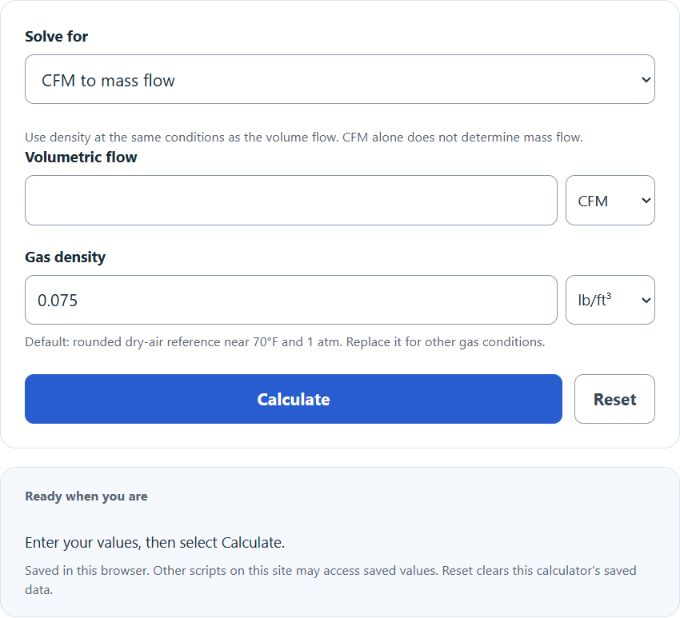
Convert CFM to lb/min, or lb/min to CFM, using the typical air density of 0.075 lb/ft³, your own gas density, or actual air temperature and pressure.
- cfm to m3/h Converter
- lb/hr to kg/hr Calculator
- Pressure to Density Calculator
- Specific Humidity Calculator
- All Unit Converters
Calculator Functions
| Function | What it does | What it requires |
|---|---|---|
| CFM to mass flow | Converts a volumetric flow to a mass flow in lb/min at an entered gas density | Requires the volumetric flow and the gas density |
| Mass flow to CFM | Converts a mass flow to a volumetric flow in CFM at an entered gas density | Requires the mass flow and the gas density |
| Actual-condition dry-air mass flow | Finds the mass flow of dry air from its density at a measured temperature and absolute pressure | Requires the volumetric flow, the dry-air temperature and the absolute pressure |
Volumetric flow goes in as CFM, m³/min, m³/h or L/s, mass flow as lb/min, lb/h, kg/s or kg/min, and density as lb/ft³ or kg/m³. Gas density starts at 0.075 lb/ft³, the density of dry standard air [2]. Every result also lists the density used, the mass flow in kg/s and lb/h, and the volumetric flow in m³/min.
CFM to lb/min Formulas
| ṁ | Mass flow (lb/min) |
| Q | Volumetric flow (CFM) |
| ρ | Gas density (lb/ft³) |
Mass flow is density times velocity times flow area [1], and velocity times area is the volumetric flow. CFM has no fixed lb/min value: the answer depends on the density of the gas being moved.
CFM to mass flow
At 0.075 lb/ft³, 100 CFM carries 100 × 0.075 = 7.5 lb/min, so 1 CFM of standard air is 0.075 lb/min.
Mass flow to CFM
At 0.075 lb/ft³, 7.5 lb/min is 100 CFM, and 1 lb/min is 13.33 CFM.
Actual-condition dry-air mass flow
P is absolute pressure in psia and T is absolute temperature in °R, which is °F + 459.67. This is the ideal gas law for dry air [3], with 144 converting psi to lb/ft² and 53.35 ft·lbf/(lb·°R) as the gas constant. The density then goes into ṁ = Q × ρ. At 70 °F and 14.696 psia the density is 0.07489 lb/ft³, so 100 CFM carries 7.489 lb/min. At 200 °F it drops to 0.06013 lb/ft³ and 6.013 lb/min.
Limits of This Estimate
- 0.075 lb/ft³ belongs to dry air at 68 °F and 29.92 inHg [2]. Other gases, temperatures, pressures and altitudes need their own density.
- Volumetric flow and density must describe the same conditions. A flow stated in SCFM pairs with the density at its standard conditions, not with the density in the duct.
- Actual-condition dry-air mass flow treats air as a dry ideal gas, so humidity and real-gas effects are left out. The pressure must be absolute, not gauge.
- The gas constant of 53.35 is about 0.4% above the rounded figure NASA lists for air [3]. These estimates are based on the best available data and estimations.
Sources
- NASA Glenn Research Center, Mass Flow Rate: mass flow as density times volume flow
- OSHA Technical Manual, Section III, Chapter 3, Ventilation Investigation: 0.075 lb/ft³ for dry standard air
- NASA Glenn Research Center, Equation of State: ideal gas law and the gas constant for air