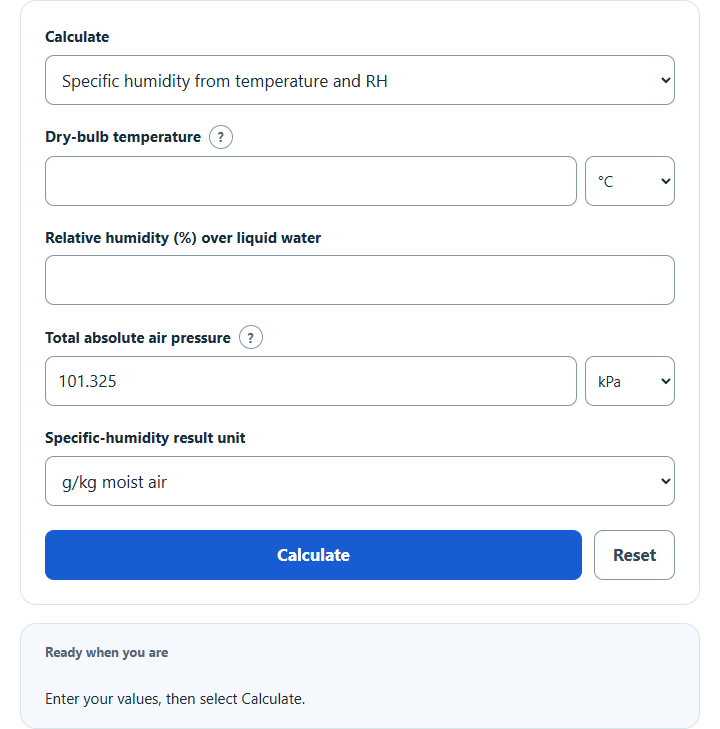
Calculate specific humidity from temperature and relative humidity or from vapor pressure, or convert specific humidity back to relative humidity.
Related Calculators
- Apparent Temperature Calculator
- m3/h to cfm Converter
- Watts To Btu Calculator
- Pounds Per Minute Calculator
- All Unit Converters
Specific Humidity Formula
The following equation can be used to calculate specific humidity from the water-vapor partial pressure and the total pressure.
- Where SH is the specific humidity (% by mass; i.e., 100 × kg/kg)
- P is the total pressure (same units as Pw)
- Pw is the partial pressure of water vapor
To calculate specific humidity, multiply 0.622 by the partial pressure of water vapor, divide by P − 0.378·Pw, and (if you want percent) multiply the result by 100.
Specific Humidity Definition
Specific humidity is the mass of water vapor divided by the total mass of moist air (a dimensionless mass fraction, often reported in kg/kg or g/kg).
Specific Humidity Example
How to calculate specific humidity?
- First, determine the total pressure.
Measure the total pressure of the air.
- Next, determine the water vapor pressure.
Measure or calculate the partial pressure of water vapor.
- Finally, calculate the specific humidity.
Using the equation above, calculate the specific humidity.
FAQ
Specific humidity is the mass of water vapor per unit mass of moist air (a dimensionless mass fraction, often given in kg/kg or g/kg).
The partial pressure of water vapor is the pressure that the water vapor contributes to the overall pressure of the air.