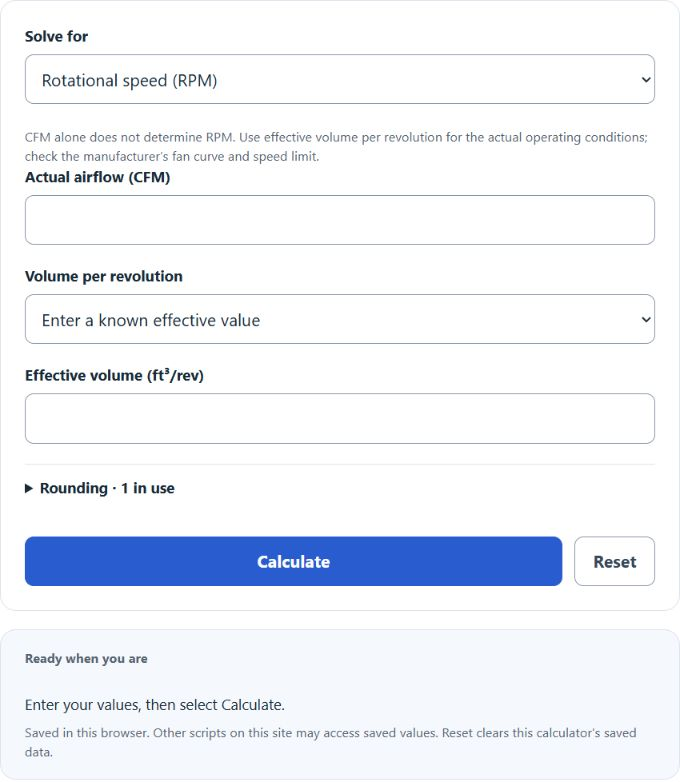
Relate actual CFM, RPM and a known effective volume per revolution. CFM alone does not determine fan speed: use manufacturer performance data for the actual system resistance and gas conditions.
- CFM To Voltage Calculator
- m3/h to cfm Converter
- mph to rpm Converter
- Flow to Velocity Calculator
- All Unit Converters
CFM to RPM Formula
The following formula is used to convert airflow in cubic feet per minute into rotational speed in revolutions per minute when the volume moved per revolution is known.
RPM = CFM ÷ Vrev, using effective volume in ft³/rev at the actual operating conditions.
Equivalent relationships include:
- CFM = RPM × Vrev
- RPM = CFM ÷ Vrev
- Vrev = CFM ÷ RPM
Variables:
- RPM is the rotational speed in revolutions per minute
- CFM is the airflow in cubic feet per minute
- Vrev is the volume of air moved per revolution in cubic feet per revolution
To calculate RPM, divide the airflow in CFM by the fan or blower’s effective volume per revolution.
What is CFM to RPM?
CFM to RPM conversion relates an airflow rate to the rotational speed needed to produce that airflow. CFM measures how much air moves through a system each minute, while RPM measures how many times a shaft, fan, or blower turns in that same minute. To convert between them, you must know how much air is moved during one revolution.
If a device moves more air per revolution, fewer RPM are needed to reach a target airflow. If it moves less air per revolution, more RPM are required. This makes the volume per revolution a key value when comparing different fans, blowers, and pumps.
For example, a device moving 1.00 ft³/rev would require 500 RPM to deliver 500 CFM. A device moving only 0.10 ft³/rev would require 5,000 RPM to deliver that same airflow.
How to Calculate CFM to RPM?
The following steps outline how to calculate RPM from CFM.
- First, determine the airflow in cubic feet per minute (CFM).
- Next, determine the volume of air moved per revolution, Vrev, in cubic feet per revolution.
- Then divide the airflow by the volume per revolution using the formula RPM = CFM ÷ Vrev.
- After calculating the result, verify your answer with the calculator above.
Example Problem:
Use the following values as an example problem to test your understanding.
Airflow (CFM) = 500
Volume per Revolution (Vrev) = 0.10 ft³/rev
RPM = 500 ÷ 0.10 = 5,000 RPM
CFM to RPM Conversion Table
The table shows arithmetic examples for 500 CFM at stated effective volumes per revolution. These values are illustrations, not typical ratings for fan or blower types. Diameter times pitch is an ideal swept-cylinder model and does not establish real fan airflow.
| Illustrative effective volume | Volume per Revolution (ft³/rev) | 500 CFM in RPM |
|---|---|---|
| Example 0.02 ft³/rev | 0.02 | 25,000 RPM |
| Example 0.05 ft³/rev | 0.05 | 10,000 RPM |
| Example 0.10 ft³/rev | 0.10 | 5,000 RPM |
| Example 0.50 ft³/rev | 0.50 | 1,000 RPM |
| Example 1.00 ft³/rev | 1.00 | 500 RPM |
In real systems, the effective volume per revolution can vary with blade shape, system resistance, and operating conditions. Even so, the relationship RPM = CFM ÷ Vrev provides a useful way to estimate speed requirements and compare different devices.