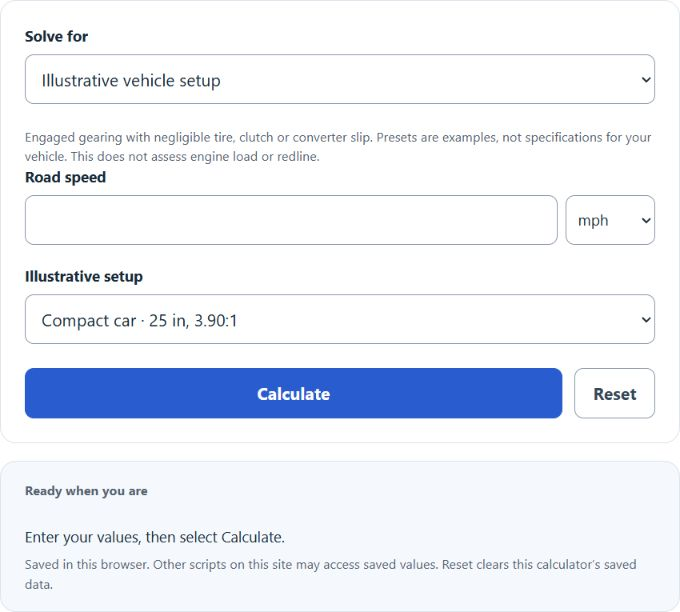
Convert MPH to RPM for your vehicle by tire diameter and gear ratio, with illustrative car, truck, SUV or motorcycle setups or custom values. Presets are not vehicle specifications.
- Length To Frequency Calculator
- Events Per Second Calculator
- Inches Per Hour Calculator
- Film Feet To Minutes Calculator
- All Unit Converters
MPH to RPM Formula
The following formula is used to estimate engine RPM from vehicle speed, tire diameter, and overall gear ratio.
Variables:
- RPM is the engine speed in revolutions per minute
- MPH is the vehicle speed in miles per hour
- OR is the overall engine-to-wheel reduction: selected gear × final drive × any primary reduction
- TD is the effective rolling tire diameter in inches
To estimate engine RPM, multiply road speed by overall reduction and 336, then divide by rolling tire diameter in inches. The conventional 336 is rounded from 1056/π ≈ 336.13524, about 0.0402% lower. This assumes engaged gearing and negligible tire, clutch or converter slip.
What is MPH to RPM?
MPH to RPM describes the relationship between a vehicle’s road speed and the speed at which the engine is turning. At a given MPH, the engine RPM depends primarily on two things: the tire diameter and the overall gear ratio. Smaller tires or numerically larger gears cause the engine to spin faster at the same road speed, while larger tires or taller gearing reduce engine RPM.
This type of calculation is commonly used when comparing axle ratios, estimating cruise RPM on the highway, checking drivetrain combinations, or verifying that a tachometer reading is reasonable for a given speed.
How to Calculate MPH to RPM?
The following steps outline how to calculate engine RPM from MPH.
- First, determine the vehicle speed in miles per hour (MPH).
- Next, determine the tire diameter in inches.
- Then, multiply all reduction stages between the engine and wheel, including the selected gear, final drive and any primary reduction.
- Finally, calculate RPM using the formula RPM = (MPH × OR × 336) / TD.
- After calculating the result, compare your answer with the converter above.
Example Problem:
Use the following values as an example problem to test your knowledge.
Speed (MPH) = 60
Overall Gear Ratio (OR) = 3.90
Tire Diameter (TD) = 25 inches
RPM = (60 × 3.90 × 336) / 25 = 3,144.96 ≈ 3,145 RPM
MPH to RPM Example Table
The table below shows approximate engine RPM at 60 MPH for illustrative tire and overall-reduction combinations using the rounded constant 336; these are not specifications for all vehicles in each class.
| Setup | Tire Diameter (in) | Overall Ratio | RPM at 60 MPH |
|---|---|---|---|
| Compact car | 25 | 3.90:1 | ≈ 3,145 RPM |
| Midsize car | 26 | 3.50:1 | ≈ 2,714 RPM |
| Highway cruiser | 27 | 3.00:1 | ≈ 2,240 RPM |
| Pickup truck | 31 | 4.10:1 | ≈ 2,666 RPM |
| Off-road SUV | 33 | 4.56:1 | ≈ 2,786 RPM |
| Sport motorcycle | 24 | 5.50:1 | ≈ 4,620 RPM |
| Heavy truck | 40 | 3.55:1 | ≈ 1,789 RPM |
Actual RPM may differ because of tire, clutch or torque-converter slip, effective rolling diameter and tire growth. Power losses alone do not alter a fixed mechanical speed ratio. Presets are illustrative; consult vehicle-specific gearing and RPM limits. Engine load or proximity to redline cannot be inferred from RPM alone.