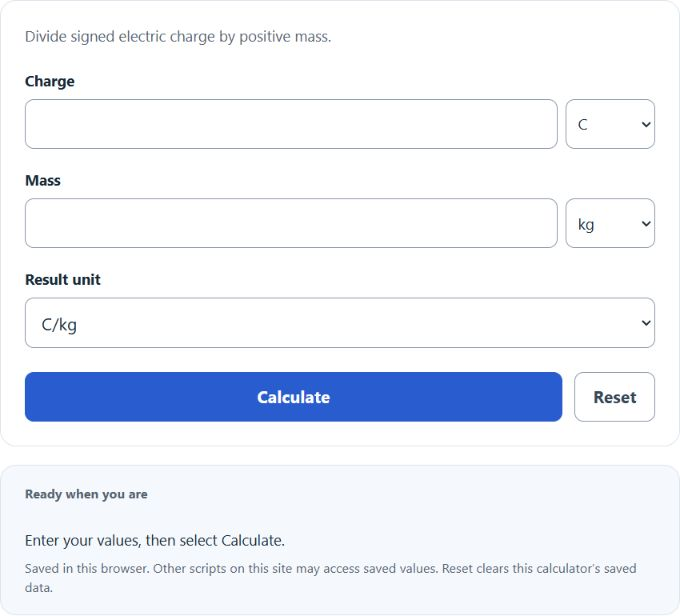
Calculate the charge to mass ratio from charge and mass inputs in C, mC, μC, nC, kg, g, lb, or mg and view the result in selected units.
Charge to Mass Ratio Formula
The charge to mass ratio is the electric charge of an object or particle divided by its mass. The calculator first converts charge to coulombs and mass to kilograms, then calculates the ratio in coulombs per kilogram.
- R = charge to mass ratio, usually in C/kg
- Q = electric charge in coulombs, C
- m = mass in kilograms, kg
The calculator uses these input conversions before applying the formula:
- Charge conversion: converts C, mC, μC, or nC to coulombs.
- Mass conversion: converts kg, g, lb, or mg to kilograms.
- Ratio calculation: divides converted charge by positive mass, then converts C/kg to your selected result unit. One C/kg equals 1 mC/g, 1,000 μC/g, 1,000,000 nC/g, 0.001 C/g, or 0.45359237 C/lb.
Charge and Mass Unit Conversions
Use these factors to check how the calculator converts your entries before calculating the ratio.
| Quantity | Unit | Conversion to base unit |
|---|---|---|
| Charge | C | 1 C = 1 C |
| Charge | mC | 1 mC = 0.001 C |
| Charge | μC | 1 μC = 0.000001 C |
| Charge | nC | 1 nC = 0.000000001 C |
| Mass | kg | 1 kg = 1 kg |
| Mass | g | 1 g = 0.001 kg |
| Mass | mg | 1 mg = 0.000001 kg |
| Mass | lb | 1 lb = 0.45359237 kg |
Typical Charge to Mass Ratios
| Particle | Charge to mass ratio | Notes |
|---|---|---|
| Electron | -1.759 × 10¹¹ C/kg | Negative because an electron has negative charge |
| Proton | 9.579 × 10⁷ C/kg | Positive because a proton has positive charge |
| Alpha particle | 4.822 × 10⁷ C/kg | Has twice the proton charge but much more mass |
Example Calculations
Example 1: Charge in microcoulombs and mass in grams
Suppose the charge is 5 μC and the mass is 2 g.
Convert each value to base units:
5 μC = 0.000005 C
2 g = 0.002 kg
The charge to mass ratio is 0.002500 C/kg.
Example 2: Charge in millicoulombs and mass in kilograms
Suppose the charge is 3 mC and the mass is 0.5 kg.
Convert the charge to coulombs:
3 mC = 0.003 C
The charge to mass ratio is 0.006000 C/kg.
FAQ
What does charge to mass ratio mean?
Charge to mass ratio tells you how much electric charge an object or particle has compared with its mass. A larger magnitude means the charge is large relative to the mass. This value is important in electromagnetism because charged particles with high charge to mass ratios are more strongly affected by electric and magnetic fields.
Can the charge to mass ratio be negative?
Yes. If the charge is negative, the charge to mass ratio is also negative because mass is positive. For example, an electron has a negative charge, so its charge to mass ratio is negative.
Why can mass not be zero?
The formula divides charge by mass. Division by zero is undefined, so a mass value of zero cannot produce a valid charge to mass ratio. Enter a positive mass value in kg, g, lb, or mg.