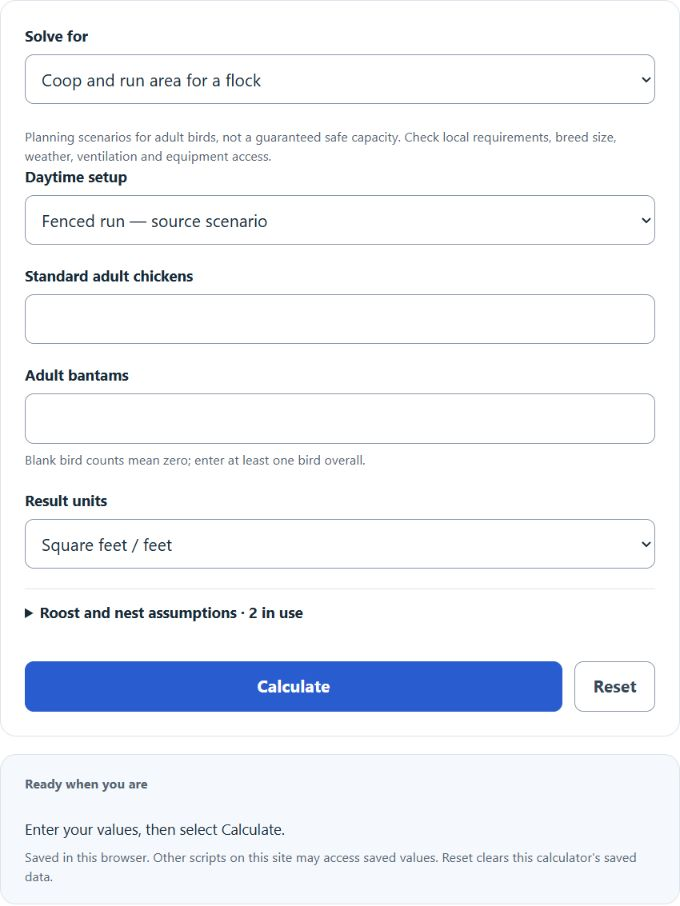
Estimate coop and run areas under the stated adult-bird planning scenarios, or calculate a floor-area-only bird capacity. These figures do not establish a universally safe or legal stocking level.
Chicken Coop Size Formula
The calculator works in two directions. To size a coop and run for a known flock, it multiplies the number of birds by the space each bird needs:
Coop = N * A
 Run = N * R
To find how many birds an existing coop holds, it divides the coop floor area by the space per bird and rounds down:
Max Birds = floor(Coop Area / A)
Variables:
- Coop is the usable floor area under the selected planning scenario
- Run is the outdoor area in the retained source scenario
- N is the number of birds
- A is the coop floor space per bird, which is 4 sq ft for a standard bird with run access, 10 sq ft if confined full-time, and 3 sq ft if free-ranging
- R is the run space per bird, about 10 sq ft for a standard bird and 5 sq ft for a bantam
- Max Birds is the whole-bird floor-area quotient, before checking equipment, outdoor access, climate, flock behavior or local requirements
Pick what you want to find at the top of the calculator. In “Coop and run size for my flock” mode you enter how many standard chickens and bantams you keep, and the tool returns the coop area, run area, and the fittings that go inside. In “How many chickens fit my coop” mode you enter the coop area or its length and width, and the tool returns the maximum flock plus the run and fittings to match. The daytime setting changes A, since birds locked in all day need far more floor space than birds that only sleep inside.
The fittings below retain the source planning arithmetic. Nest boxes and illustrative egg totals assume every entered bird is a mature laying hen. The ventilation opening estimate does not determine airflow, and waterer count does not determine water capacity or refill frequency:
Boxes = roundup(Hens / 4)
 Roost = N * 8 in
 Vent = Coop Area / 10
You can raise the roost allowance to 10 or 12 inches per bird and tighten the box ratio to one per three hens in the advanced options.
Space Per Bird By Setup
The floor space a bird needs depends mostly on where it spends the day. These are the per-bird figures the calculator uses.
| Daytime setup | Coop per standard bird | Coop per bantam |
|---|---|---|
| In a fenced run | 4 sq ft | 2 sq ft |
| Confined full-time | 10 sq ft | 4 sq ft |
| Free-ranging the yard | 3 sq ft | 1 sq ft |
Breed size and housing conditions affect actual space needs. The following source examples are illustrative rather than validated breed-specific standards; the calculator uses the setup table above and has no extra-area input.
| Breed class | Examples | Coop per bird (run access) | Run per bird |
|---|---|---|---|
| Bantam | Silkie, Sebright, Serama | 2 sq ft | 5 sq ft |
| Light | Leghorn, Ancona, Fayoumi | 3 sq ft | 8 sq ft |
| Standard dual-purpose | Rhode Island Red, Australorp, Sussex | 4 sq ft | 10 sq ft |
| Heavy or large | Orpington, Brahma, Jersey Giant | 6 sq ft | 15 sq ft |
Example Problems
Example 1: Size a coop and run for a flock.
You keep 6 standard hens that use a fenced run during the day. The coop needs 6 times 4 sq ft, which is 24 sq ft, equivalent to a 4 ft by 6 ft usable rectangle before checking other housing needs. The run needs 6 times 10 sq ft, which is 60 sq ft. You round 6 hens up to 2 nesting boxes, and the roost bar needs 6 times 8 inches, which is 48 inches, or 4 feet.
Example 2: Find how many birds a coop holds.
You have a 4 ft by 4 ft coop, which is 16 sq ft, and your birds use a run. Divide 16 sq ft by 4 sq ft per bird to get 4 standard hens. That flock wants about 40 sq ft of run, one nesting box, and a 32-inch roost bar.
Frequently Asked Questions
How much space does one chicken need in a coop?
The retained standard/bantam scenario allowances are 4/2 sq ft with a fenced run, 10/4 sq ft under full confinement, and 3/1 sq ft with free range. They are not universal minimums. University of Minnesota Extension describes 3–5 sq ft of indoor space per layer; local guidance and actual flock conditions can require a different plan.
How big should the run be?
The source scenario uses 10 sq ft per standard bird and 5 sq ft per bantam. More space can help, but no area threshold guarantees that behavior problems will be rare. Ground condition, shelter, access and flock management also matter.
How many chickens can I keep in a 4 by 8 coop?
A 4 ft by 8 ft coop is 32 sq ft. With a run for daytime use at 4 sq ft per bird, that holds 8 standard hens. If the birds stay inside full-time at 10 sq ft each, the same coop holds only 3. Switch the calculator to “How many chickens fit my coop” to run these numbers for any size you have in mind.