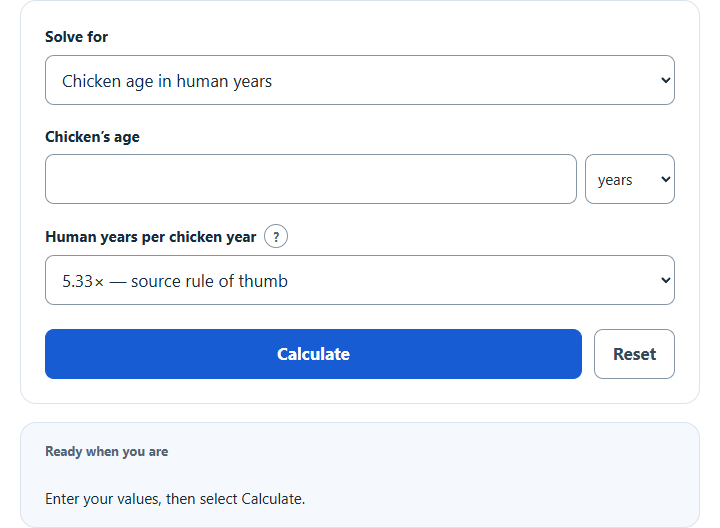
Convert chicken years to human years by entering your chicken’s age in years, months or days, using the 5.33× rule of thumb or your own multiplier.
Related Calculators
- Bird to Human Years Calculator
- Chicken Coop Size Calculator
- Goat Years Calculator
- Horse to Human Years Calculator
- Bird Age Calculator
- Chicken Hatch Date Calculator
- All Biology Calculators
Calculator Functions
| Function | What it does | What it requires |
|---|---|---|
| Chicken age in human years | Converts a chicken’s age into an equivalent human age | Requires the chicken’s age in years, months or days and a multiplier |
| Human years to chicken age | Converts a human age into the chicken age that matches it | Requires an age in human years, months or days and a multiplier |
The multiplier is the number of human years counted for each chicken year: 5.33, 8 or a custom value. Ages entered in months or days are converted with 12 months and 365.2425 days per year. Each result also lists the age in years, months and days, a life-stage label, a laying-age note and the same age at a lower and a higher multiplier.
Chicken Years to Human Years Formulas
| H | Human-equivalent age (years) |
| C | Chicken’s age (years) |
| k | Human years per chicken year: 5.33 by default |
Chicken age in human years
The formula applies directly. At 5.33 human years per chicken year, a 2-year-old chicken is 2 × 5.33 = 10.66 in human years, a 6-month-old chicken is 2.665 and a 10-year-old chicken is 53.3. At the 8× setting the 2-year-old chicken is 16.
Human years to chicken age
This runs the conversion backward. One human year is 1 ÷ 5.33 = 0.1876 chicken years, or about 68.5 days. A human age of 40 corresponds to a chicken of 40 ÷ 5.33 = 7.5 years.
How the Estimate Works
Chicken years are ordinary calendar years. The human-year figure is a rule of thumb in the same spirit as dog years, and the 5.33 and 8 multipliers are not scientific constants. A single multiplier treats aging as a straight line, while real chickens mature far faster early in life: hens begin laying at around six months [1], an age the 5.33 multiplier would call under 3 human years.
The life-stage label uses the chicken’s actual age: chick under 8 weeks, juvenile to 6 months, young adult to 2 years, mature adult from 2 through 5 years and senior beyond that. The laying note follows the same ages. Hens can keep laying for five to 10 years, with peak production in the first two years [1].
Limits of This Estimate
- No study sets a human-year multiplier for chickens. These estimates are based on the best available data and estimations.
- Breed, health and care affect how a chicken ages far more than the multiplier does, so the life-stage labels are broad guides.
- The lower and higher multipliers shown with each result illustrate how much the answer moves. They are not a confidence range.
Sources
- University of Minnesota Extension, Raising chickens for eggs: age when hens begin laying and the years of peak egg production