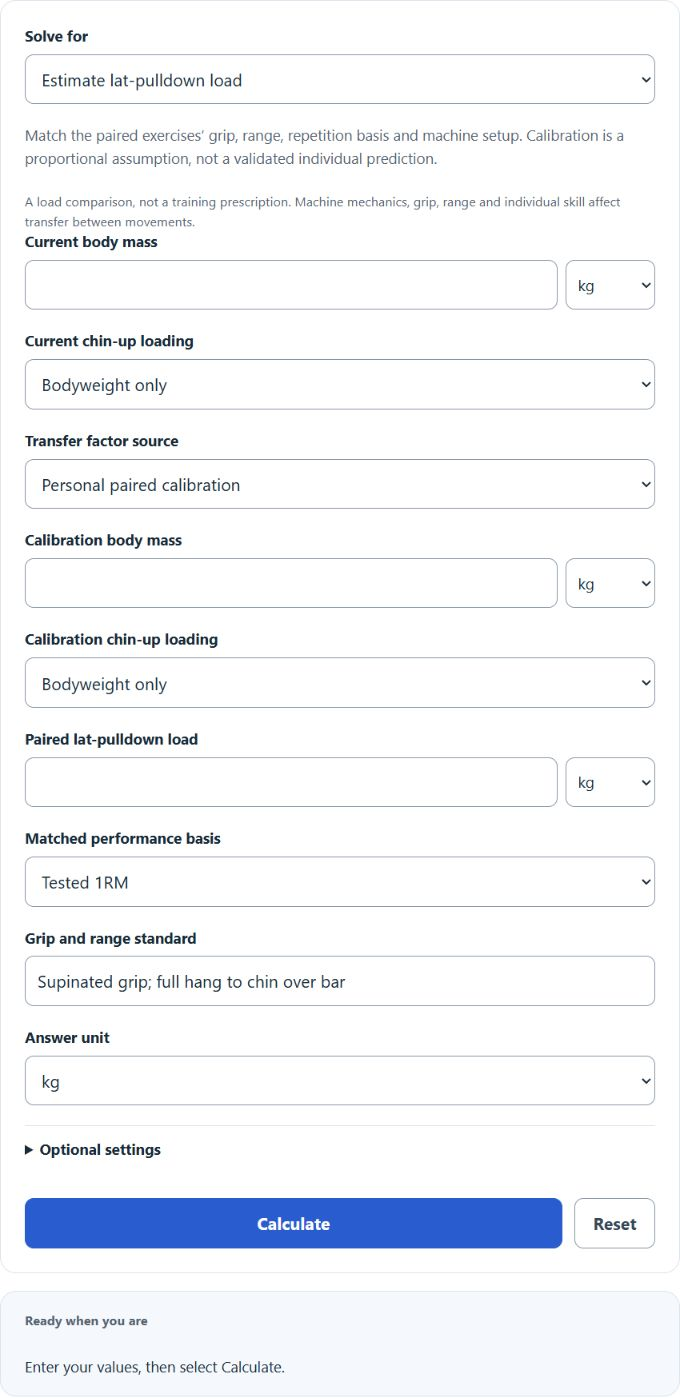
Convert chin-up system load to a lat-pulldown estimate, or solve the added load or assistance implied by a pulldown target.
How the Chin-Up To Lat Pulldown Calculator Works
The calculator first converts bodyweight-only, weighted, or assisted chin-ups into total system load. Personal mode then compares that system load with a paired lat-pulldown performance.
The optional published proxy is the ratio of group-mean pull-up and lat-pulldown 1RM values. It is not a validated individual supinated chin-up conversion. It is restricted to tested 1RM and must be deliberately selected. Added weight and assistance are mutually exclusive.
Chin-Up System-Load Formula
Formula: system load = body mass + added load - assistance; factor = paired lat pulldown / paired system load; lat pulldown = system load x factor
Reverse mode divides the pulldown target by the factor, subtracts body mass, and translates a positive net value to added load or a negative value to positive assistance.
Choosing Comparable Inputs
Enter body mass and select exactly one loading mode. For personal calibration, use the same grip, range, and performance basis. Study mode uses reported group-mean factors and does not accept same-rep sets.
| Case | Body mass | Added load | Assistance | System-load equation | System load |
|---|---|---|---|---|---|
| Bodyweight only | 80 kg | 0 | 0 | 80 + 0 - 0 | 80 kg |
| Weighted | 80 kg | 10 kg | 0 | 80 + 10 - 0 | 90 kg |
| Assisted | 60 kg | 0 | 15 kg | 60 + 0 - 15 | 45 kg |
Understanding Your Results
The calculated loading estimate appears first. System load, nonnegative added load and assistance, factor, method, basis, grip standard, calibration pair, optional range, and steps follow.
A machine stack should be compared with total chin-up system load, not with added weight alone. Personal calibration uses your paired measurements and assumes a fixed proportional factor. Grip, machine, body path and individual pulling skill differ, so it does not establish exact equivalence or prescribe a safe training load.
Worked Example
At 80 kg body mass with 30 kg added, system load is 110 kg. A personal pair of 100 kg system load and 75 kg lat pulldown gives 0.7500, estimating 82.5 kg.
Common Mistakes
Do not enter added weight as total system load, combine assistance with added weight, call the study proxy chin-up-specific, or use the proxy for a same-rep maximum.
Assumptions and Limitations
The cited study reports pull-up and lat-pulldown 1RM values. The calculator uses descriptive ratios of the normalized group means, not an individual prediction equation. The women's individual correlation was not significant, even though the group means permit a descriptive proxy. Neither proxy replaces personal calibration.
Browse the complete Exercise Strength Conversions calculator collection or return to the Sports & Fitness Calculators hub.
Sources
Doug Johnson and colleagues, Relationship of Lat-Pull Repetitions and Pull-Ups to Maximal Lat-Pull and Pull-Up Strength in Men and Women, Journal of Strength and Conditioning Research, 2009. Normalized group means: men 0.93/1.16; women 0.55/0.73. Optional factor ranges are user-defined comparisons, not confidence intervals. Rounded assistance that reaches body mass is rejected as infeasible.