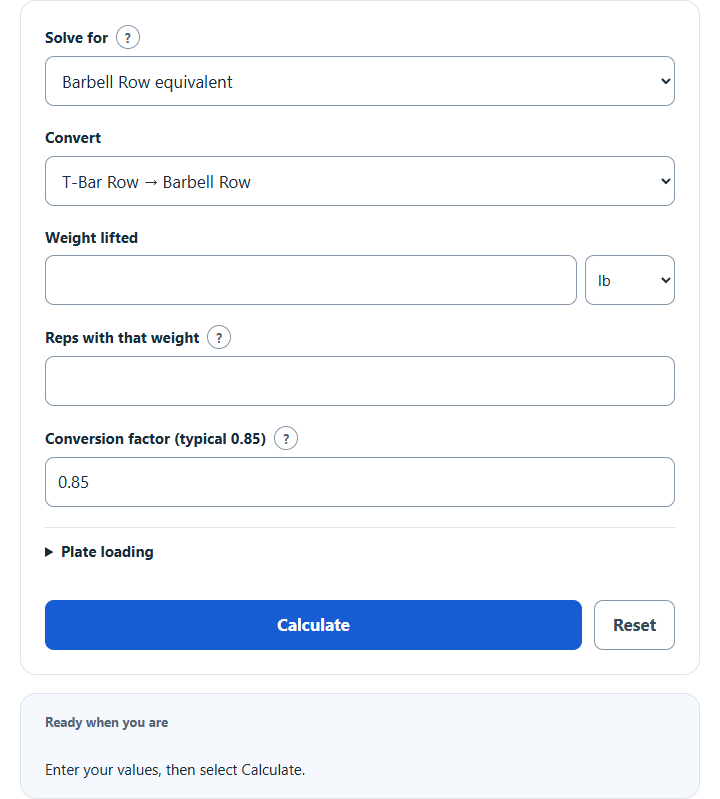
Convert a T-Bar Row weight to a Barbell Row equivalent or back, and check T-Bar Row strength standards, your strength level and working sets and reps.
Calculator Functions
| Function | What it does | What it requires |
|---|---|---|
| Barbell Row equivalent | Converts a T-Bar Row weight to an estimated Barbell Row weight, or a Barbell Row weight to a T-Bar Row weight | Requires the direction, the weight lifted and the conversion factor, which starts at 0.85. Reps and the bar or handle weight are optional |
| Strength standards and level | Lists Beginner to Elite one-rep-max standards for the T-Bar Row or Bent-Over Barbell Row and places a lift among them | Requires sex and exercise. Row weight, reps, bodyweight and age are optional |
| Sets, reps and working weight | Sets a working weight for a hypertrophy, strength, volume or endurance session | Requires sex and training goal. Row weight and reps are optional |
| Personal conversion factor | Finds the ratio between a lifter’s own Barbell Row and T-Bar Row | Requires a T-Bar Row weight and a Barbell Row weight lifted for the same reps |
Weights can be entered in pounds or kilograms, with 1 kg taken as 2.2046226218 lb. Reps can be 1 to 30. A blank or 1 uses the weight as entered, and a higher count is first turned into an estimated one-rep max.
T-Bar Row to Barbell Row Formulas
| BR | Estimated Barbell Row weight |
| TBR | T-Bar Row weight |
| CF | Conversion factor, 0.85 unless changed (any value up to 2) |
This is the Epley equation, with W the weight lifted and R the reps completed [1]. It is applied before any other step whenever the reps are above 1.
Barbell Row equivalent
A 120 lb T-Bar Row converts to 120 × 0.85 = 102 lb on the Barbell Row. The other direction divides: a 102 lb Barbell Row is 102 ÷ 0.85 = 120 lb on the T-Bar Row. With reps, 100 lb for 8 becomes a 126.7 lb one-rep max, and 126.7 × 0.85 = 107.7 lb.
Entering the bar or handle weight adds a plate breakdown. For a Barbell Row result it is (result − bar) ÷ 2 per side, and for a T-Bar Row result it is the result minus the handle on the loaded end. Plates used are 45, 35, 25, 10, 5 and 2.5 lb, or 25, 20, 15, 10, 5, 2.5 and 1.25 kg.
Strength standards and level
With no bodyweight entered, the one-rep-max standards are:
| Level | T-Bar Row, male | T-Bar Row, female | Barbell Row, male | Barbell Row, female |
|---|---|---|---|---|
| Beginner | 81 lb | 36 lb | 90.4 lb | 33.1 lb |
| Novice | 130 lb | 65 lb | 132.3 lb | 57.3 lb |
| Intermediate | 196 lb | 105 lb | 187.4 lb | 90.4 lb |
| Advanced | 274 lb | 154 lb | 253.5 lb | 130.1 lb |
| Elite | 361 lb | 209 lb | 324.1 lb | 174.2 lb |
A bodyweight replaces these with values interpolated from a bodyweight table that runs from 110 to 310 lb for men and 90 to 260 lb for women. An age scales every standard: the factor is 1.00 from 25 to 40, 0.85 at 15, 0.88 at 50, 0.745 at 60 and 0.607 at 70, with straight-line steps between the listed ages.
The five levels are treated as the 5th, 20th, 50th, 80th and 95th percentiles of lifters, and a lift between two levels is placed on a straight line between them. A man rowing 200 lb on the T-Bar sits between Intermediate (196 lb) and Advanced (274 lb), which works out as stronger than about 52% of lifters.
Sets, reps and working weight
1RM × goal %
The goals are Hypertrophy at 3 × 10 with 70%, Strength at 5 × 5 with 82%, Volume at 4 × 8 with 72% and Endurance at 3 × 12 with 62%. A 200 lb one-rep max on the Strength goal gives 5 sets of 5 at 164 lb. With no weight entered, the Intermediate T-Bar Row standard is used as the one-rep max: 196 lb for men and 105 lb for women.
Personal conversion factor
A lifter who rows 170 lb with a barbell and 200 lb on the T-Bar for the same reps has a factor of 170 ÷ 200 = 0.85. That number can then replace the default in the Barbell Row equivalent function.
Limits of This Estimate
- The 0.85 factor is a typical figure, not a measured constant. Grip, torso angle, chest support and the handle used all move it, which is why a personal factor is offered. These estimates are based on the best available data and estimations.
- The strength standards and percentiles are approximate guides to how other lifters perform. They are not test results or medical advice.
- The one-rep-max equation is linear. The study cited here tested the bench press and leg press, not rows, and found linear equations should not be used above 10 reps [1]. Estimates from 11 to 30 reps are looser.
Sources
- Reynolds, Gordon and Robergs (2006), Journal of Strength and Conditioning Research 20(3):584-592: the Epley one-rep-max equation and the 10-rep limit for linear equations