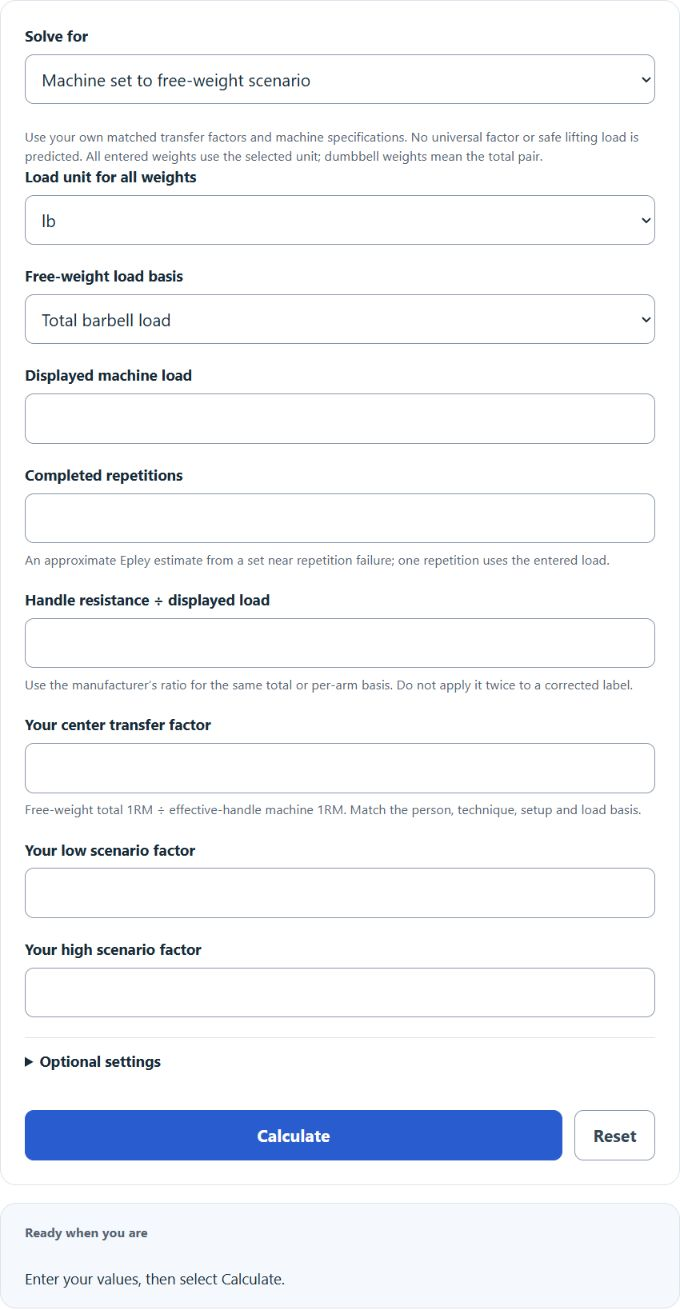
Estimate machine shoulder press to barbell or dumbbell 1RM with reps, pulley ratio, transfer range, reverse sizing, and personal calibration.
Machine to Free Weight Shoulder Press Estimation Formula
The formula applies a personal transfer factor to a machine shoulder-press load on a matching basis. No universal machine-to-free-weight factor is assumed. The calculator can correct displayed load by an entered handle-resistance ratio and starting resistance, estimate machine 1RM from 2–10 repetitions with the approximate Epley formula, and apply your factors. One repetition uses the handle load directly. Combining these steps is an unvalidated extrapolation, not a safe lifting prescription.
Where:
- FW is the Free Weight Shoulder Press weight
- MS is the Machine Shoulder Press weight
- CF is your matched free-weight total 1RM divided by effective-handle machine 1RM; the low and high factors are user-defined scenarios, not a statistical confidence interval
Multiply the machine weight by your chosen CF to estimate the free-weight value. To reverse the calculation, divide the free-weight value by CF.
| Machine Weight (kg) | Free Weight (kg) |
|---|---|
| 10 | 8.00 |
| 15 | 12.00 |
| 20 | 16.00 |
| 25 | 20.00 |
| 30 | 24.00 |
| 35 | 28.00 |
| 40 | 32.00 |
| 45 | 36.00 |
| 50 | 40.00 |
| 55 | 44.00 |
| 60 | 48.00 |
| 65 | 52.00 |
| 70 | 56.00 |
| 75 | 60.00 |
| 80 | 64.00 |
| 85 | 68.00 |
| 90 | 72.00 |
| 95 | 76.00 |
| 100 | 80.00 |
| 105 | 84.00 |
| *Static hypothetical example only, rounded. This table assumes factor 0.80; it does not update with calculator inputs. | |
Why Machine and Free Weight Numbers Differ
Machine and free-weight results depend on the person, equipment, technique and load convention. These differences do not establish a universal conversion factor.
Stabilizer muscle demand. Free-weight pressing requires control of the load path, while a machine constrains some movement. Muscles can contribute to both movement and stabilization; EMG findings do not show that a fixed amount of neural drive is reassigned or establish a load conversion.
Fixed movement path vs. free-weight control. A machine constrains its handle trajectory. Saeterbakken and Fimland (2013) compared seated and standing barbell and dumbbell presses in 15 men, not machine presses. Their anterior-deltoid differences compared barbell with dumbbells within seated or standing conditions; these results do not validate a machine transfer factor.
Mechanical advantage from cam and lever systems. Lever geometry and cam profiles can change handle resistance across the movement. The calculator’s fixed resistance ratio and offset are approximations; use the manufacturer’s specifications and a consistent total or per-arm basis.
Friction and counterbalance. Friction, starting resistance and counterbalance can affect resistance at the handles. Their magnitudes and direction depend on the equipment and movement; no generic pound offset or 0.60–0.90 transfer range is assumed.
How Machine Type Affects Your Conversion Factor
Machine categories alone do not determine a transfer factor. Record the exact machine, seat position, range of motion, handle basis and technique when using paired personal measurements.
Selectorized (pin-loaded) vertical press. Check the manufacturer’s displayed-load and handle-resistance convention, pulley ratio and starting resistance. Stack labels do not supply a personal free-weight factor.
Plate-loaded lever press. Check lever geometry and starting resistance for the exact model. The loaded plates and resistance at the hands need not share the same numerical value.
Converging path machines. Independent or converging handles change the movement path, but this feature does not establish a numerical free-weight conversion.
Smith machine overhead press. Check actual bar starting resistance and counterbalance for the model. Guided-bar performance does not establish an individual free-barbell or dumbbell load.
Population-Level Strength Data: Machine vs. Free Weight
Tracking-platform averages from different groups are not paired measurements of the same lifters on the same equipment. Dividing such averages does not establish an individual conversion factor.
The same limitation applies to comparisons grouped by sex: unpaired averages cannot establish a personal ratio or explain its cause.
Experience categories and training duration alone cannot establish the ratio between two exercises. Use comparable personal measurements and keep their equipment and technique documented.
Overhead Press Strength Benchmarks by Body Weight
No body-weight or training-age benchmark is established by this conversion. The calculator cannot determine where an individual’s overhead press should fall or how common a particular strength level is.
A ratio-based machine scenario is not a measured barbell strict-press result and should not be used to assign a strength standard.
Muscle Activation Differences: What the Research Shows
Coratella and colleagues (2022) measured acute muscle excitation across front and back barbell and machine overhead presses in eight competitive bodybuilders. Differences depended on the muscle, phase and exercise. The study does not establish a universal conversion factor, long-term hypertrophy equivalence or an injury-risk ranking.
Saeterbakken and Fimland (2013) found greater deltoid activity and lower 1RM with the standing dumbbell condition in their comparison. That study compared barbell and dumbbell modalities, not a machine-to-free-weight transfer. Acute EMG differences do not by themselves establish long-term growth or safe load equivalence.
Shoulder Health and Injury Considerations
Overhead pressing places demands on the shoulder complex. This conversion calculator does not diagnose pain, determine its cause or estimate injury risk. Pain or an existing injury requires individualized assessment.
Grip, range of motion and equipment fit should be selected for the individual. No single grip-width threshold or machine geometry here guarantees reduced injury risk or suitability for rehabilitation.
A guided path does not guarantee safe technique or make training to failure appropriate. Equipment choice and loading should account for individual ability and symptoms, with qualified supervision when needed.
If you are currently dealing with a rotator cuff issue or recovering from shoulder surgery, avoid any overhead pressing with load until cleared by a medical professional. When reintroducing the movement, a machine press is typically the first variation to return because the fixed path reduces the stabilization demand on the recovering tissues.
Practical Guide: Transitioning from Machine to Free Weight Pressing
When moving from a machine to free weights, do not use the calculator output or a fixed percentage reduction as a prescribed starting load. Learn the movement with conservative loading and qualified coaching.
Progression depends on technique, tolerance, training history and the equipment. This calculator cannot establish a weekly load increase or a time by which free-weight performance should match its scenario.
You do not need to abandon machine pressing entirely during this transition. A practical programming approach is to perform the free weight press first in your session (when you are freshest and can focus on stabilization and technique), then follow it with machine pressing for additional volume. This allows you to develop the stabilization skill with the barbell while still accumulating the total training volume your shoulders need to grow.