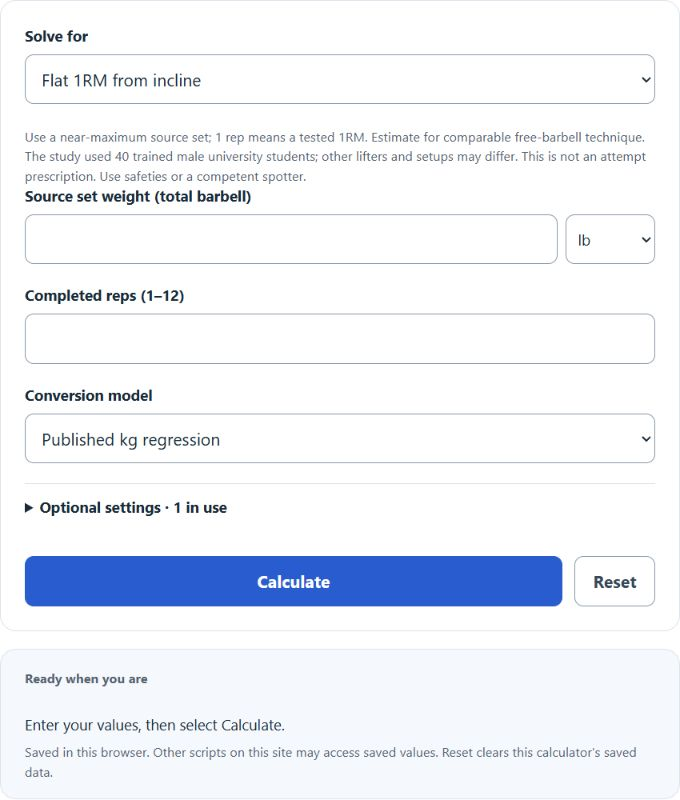
Estimate flat bench press 1RM from an incline barbell set, or convert flat to incline, using published regression, rep-max formulas, kilograms, or pounds.
Safety note: This calculator provides an estimate, not a lifting prescription. Incline-to-flat differences vary with bench angle, equipment, technique, and rep range. A fixed percentage below an estimate does not establish a safe attempt. Start conservatively and use a spotter and/or safety arms. If you have pain, a prior injury, or health concerns, consult a qualified professional before lifting heavy.
Incline Bench Press to Flat Bench Press Conversion Formula
The default model estimates a source one-repetition maximum (1RM), then applies a published free-barbell regression. Its intercept requires kilograms. The custom model instead uses your chosen incline-to-flat 1RM ratio.
Variables:
- FBP is the flat free-barbell 1RM in kilograms for the published regression.
- IBP is the incline free-barbell 1RM in kilograms for the published regression.
- For the custom model, p = incline 1RM / flat 1RM. Enter 100 × p as the incline-to-flat percentage.
For incline-to-flat estimation, the calculator algebraically reverses the published equation: flat 1RM kg = (incline 1RM kg + 6.648) / 0.827. This inversion is not a separately fitted reverse regression. The custom model uses flat 1RM = incline 1RM / p, or incline 1RM = flat 1RM × p. Pound inputs are converted to kilograms before the regression and converted back for display.
| Model | Relationship |
|---|---|
| Published model: flat to incline | Incline 1RM kg = −6.648 + 0.827 × flat 1RM kg |
| Algebraic inverse: incline to flat | Flat 1RM kg = (incline 1RM kg + 6.648) / 0.827 |
| Custom personal ratio | p = incline 1RM / flat 1RM; flat = incline / p; incline = flat × p |
| The published equation is a sample-based free-barbell 1RM estimate. Bench angle alone does not determine a conversion coefficient. | |
| Method | Calculation |
|---|---|
| One completed repetition | Use the entered weight as the source 1RM. |
| Epley | Estimated 1RM = weight × (1 + reps / 30). |
| Brzycki | Estimated 1RM = weight × 36 / (37 − reps). |
| Average option | Arithmetic mean of the Epley and Brzycki estimates. |
| The calculator accepts 1–12 completed reps. Rep-based estimates assume a near-maximum set for that repetition count and add uncertainty before conversion. The arithmetic average is not a separately validated prediction model. | |
Incline vs Flat Bench Press: Strength Differential
Lim (2006) measured flat and incline free-barbell 1RM in 40 male university students skilled in both exercises. The study fitted incline 1RM from flat 1RM using the equation above. This sample-based relationship does not establish a universal ratio across people, bench angles, or equipment. See the primary study abstract.
Use the custom percentage when you have comparable measured incline and flat results. Divide incline 1RM by flat 1RM and multiply by 100. Keep the same equipment, incline angle, grip, pause, and range of motion when reusing that ratio. Neither a sample regression nor a personal ratio establishes a safe training load. The displayed 75% and 85% values are arithmetic references, not attempt recommendations.
Muscle Activation by Bench Angle
Rodríguez-Ridao et al. (2020) measured acute muscle excitation in 30 trained adults performing free-barbell presses at five bench angles and 60% of angle-specific 1RM. Upper-pectoral excitation was highest at 30°, and anterior-deltoid excitation was highest at 60° in that protocol. These observations do not provide a strength-conversion equation, a muscle-imbalance diagnosis, or a universally best angle for long-term growth. See the primary EMG study.
Compare Your Incline / Flat Ratio
Divide incline 1RM by flat 1RM and multiply by 100 to obtain the custom percentage. The result describes those two performances under their recorded conditions. It does not isolate individual muscle strength or diagnose an imbalance.
| Check | Keep consistent |
|---|---|
| Performance basis | Compare tested 1RMs, or identify which source 1RM was estimated from reps. |
| Incline setup | Record the bench angle; measure a new personal ratio when the setup changes. |
| Equipment and technique | Use free barbells throughout with matched grip, pause, and range of motion. |
| Units and interpretation | Use the same weight unit in the ratio. Record the ratio without diagnostic thresholds. |
| A personal ratio applies to the measured conditions. No ratio threshold in this table diagnoses weakness or prescribes training. | |