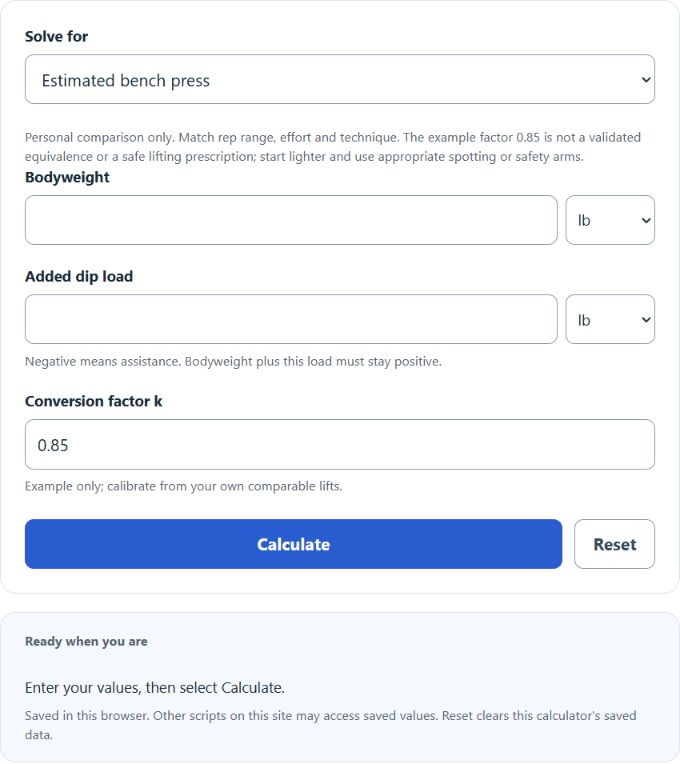
Estimate bench press weight from bodyweight and weighted dip load, reverse-solve added dip weight, or calibrate a personal conversion factor in pounds or kilograms.
Dip Strength to Bench Press Conversion Formula
The following formulas provide a rough estimate of barbell bench press weight from a weighted dip by accounting for bodyweight:
Variables:
- BP is the Bench Press weight (bar weight)
- BW is bodyweight
- AD is the added dip load (use a negative number for assistance)
- k is an adjustable conversion factor (there is no single universally correct value)
To estimate your bench press weight, add your bodyweight to your added dip load, then multiply by k. Conversely, divide your bench press weight by k, then subtract your bodyweight to estimate the added dip load.
| Total Dip Load (BW + AD) | Estimated Bench Press (BP) |
|---|---|
| 20 | 17.00 |
| 25 | 21.25 |
| 30 | 25.50 |
| 35 | 29.75 |
| 40 | 34.00 |
| 45 | 38.25 |
| 50 | 42.50 |
| 55 | 46.75 |
| 60 | 51.00 |
| 65 | 55.25 |
| 70 | 59.50 |
| 75 | 63.75 |
| 80 | 68.00 |
| 90 | 76.50 |
| 100 | 85.00 |
| 110 | 93.50 |
| 120 | 102.00 |
| 130 | 110.50 |
| 140 | 119.00 |
| 150 | 127.50 |
| * Rounded to 2 decimals. Example only: BP ≈ 0.85 × (BW + AD). Change k in the calculator to fit your own results. | |
What is the Dip Strength to Bench Press Conversion?
This conversion is a heuristic that helps you compare performance between weighted dips and the barbell bench press. Since dips include bodyweight and the stabilization/mechanics differ (depth, torso angle, grip width, ROM, and equipment), there is no single conversion factor that applies to everyone. The most reliable approach is to adjust the factor k using your own tested numbers.
How to Calculate the Bench Press Equivalent?
Follow these steps to perform the conversion:
- Record your bodyweight (BW) in the same units you will use for the other values.
- Record either your added dip load (AD) or your bench press weight (BP) for a comparable effort/rep range (e.g., tested 1RM vs tested 1RM, or a hard set of 5 vs a hard set of 5).
- Choose a conversion factor k (and adjust it later based on your own tested relationship between the two lifts).
- If AD is known, compute BP using BP ≈ (BW + AD) × k.
- If BP is known, compute AD using AD ≈ (BP / k) − BW.
- Compute the estimate with the calculator above, then validate cautiously in training by starting lighter and progressing gradually.
Example Problem:
Suppose your bodyweight is 180 pounds and your added dip load is 100 pounds. Using k = 0.85, your total dip load is 180 + 100 = 280 pounds, so your estimated bench press weight is:
BP ≈ 280 × 0.85 = 238 pounds