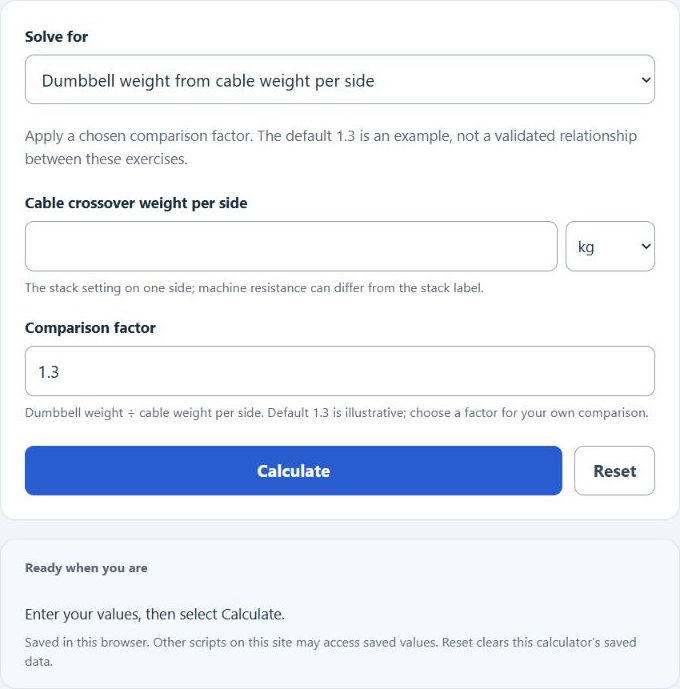
Compare cable crossover and dumbbell bench press loads using a factor you choose. The result is hypothetical arithmetic, not a validated prediction of lifting ability.
Cable Crossover to Dumbbell Bench Press Conversion Formula
The following formula is used to estimate the dumbbell bench press weight from the cable crossover machine weight. The illustrative default factor of 1.3 is not a standardized exercise conversion.
Variables:
- DB is the Dumbbell Bench Press Weight (per dumbbell)
- CCW is the Cable Crossover Weight (per side / per stack). If you only know the total for both sides, divide by 2.
- CF is a user-chosen conversion factor used for a rough estimate (for example, 1.3). Actual equivalence can vary widely by machine pulley ratio, cable angle, and setup.
To estimate the dumbbell bench press weight per dumbbell, multiply the cable crossover weight per side by the conversion factor.
| Cable Crossover (kg, per side) | Dumbbell Bench Press (kg, per dumbbell) |
|---|---|
| 5 | 6.5 |
| 10 | 13 |
| 15 | 19.5 |
| 20 | 26 |
| 25 | 32.5 |
| 30 | 39 |
| 35 | 45.5 |
| 40 | 52 |
| 45 | 58.5 |
| 50 | 65 |
| 55 | 71.5 |
| 60 | 78 |
| 65 | 84.5 |
| 70 | 91 |
| 75 | 97.5 |
| 80 | 104 |
| 85 | 110.5 |
| 90 | 117 |
| 95 | 123.5 |
| 100 | 130 |
| Example only: assumes DB (per dumbbell) ≈ 1.3 × cable crossover (per side). Values rounded to the nearest 0.1 kg. These are illustrative calculations, not recommended training loads. | |
What is the Cable Crossover to Dumbbell Bench Press Conversion?
This conversion provides a rough estimate of a dumbbell bench press weight based on the weight selected on a cable crossover station. Cable force direction, machine pulley ratio, friction, technique and stabilization demands differ from dumbbell bench pressing. The selected stack value is not necessarily the resistance at the handle.
How to Calculate the Dumbbell Equivalent?
Follow these steps to calculate the dumbbell bench press equivalent:
- Determine the cable crossover weight in your chosen unit and confirm whether it is per side (per stack) or total (both sides combined).
- Choose a conversion factor (CF) to use as an estimate (for example, 1.3). If you only know total cable weight for both sides, divide by 2 to get a per-side value.
- Estimate dumbbell bench press weight per dumbbell using: DB ≈ CCW × CF (where CCW is cable weight per side).
- If you know your dumbbell bench press weight per dumbbell, divide by CF to estimate cable weight per side (then multiply by 2 if you want a total-both-sides number).
- Select the task, enter the known weight and chosen comparison factor, then select Calculate. The result is an illustrative comparison, not a strength prediction or a safe lifting prescription.
Example Problem:
If the cable crossover machine weight is 30 pounds per side, and you use an example conversion factor of 1.3, the estimated dumbbell bench press weight per dumbbell would be:
DB ≈ 30 × 1.3 = 39 pounds per dumbbell