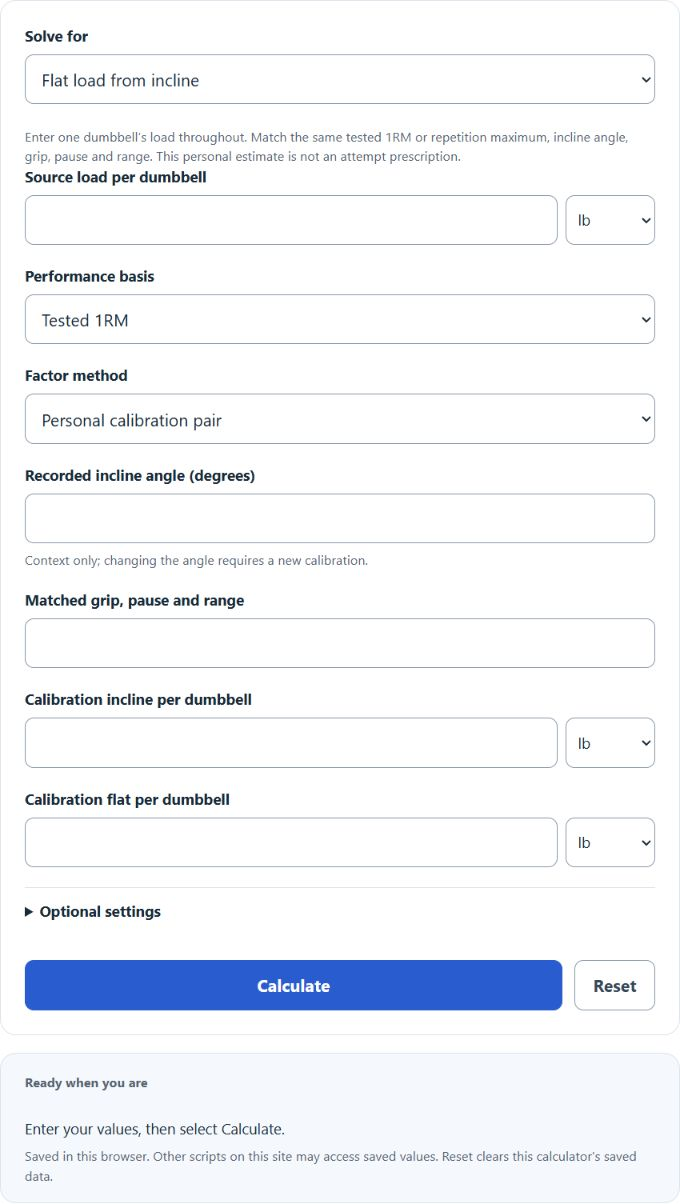
Convert between incline and flat dumbbell bench loads with an angle-specific personal calibration and unambiguous per-hand totals.
How the Incline Dumbbell To Flat Dumbbell Bench Calculator Works
The calculator uses per-dumbbell loads throughout. It derives flat-per-hand divided by incline-per-hand from an angle-matched pair, then applies or reverses that factor.
Incline angle, grip, pause or touch standard, and range define the calibration. The angle selector records context only; it never looks up an unshown coefficient.
Incline-to-Flat Dumbbell Formula
Formula: factor = paired flat load per hand / paired incline load per hand; flat per hand = incline per hand x factor; pair total = 2 x per-hand load
Reverse mode divides the flat target by the same factor. Optional interval endpoints create user-defined per-hand scenarios, not statistical confidence intervals. Pair totals are twice the corresponding per-hand result. Nearest-increment rounding is arithmetic and does not establish a safe attempt.
Choosing Comparable Inputs
Enter the weight of one dumbbell, not the sum of both. Use a tested 1RM or a shared 2-to-10-rep maximum and preserve incline angle, bench, grip, pause, and range.
| Incline angle | Incline per hand | Flat per hand | Calculated factor | Date and setup note |
|---|---|---|---|---|
| 15 degrees | Record result | Record flat result | Flat / incline | Keep this angle only |
| 30 degrees | 42 lb | 50 lb | 1.1905 | Same grip and range |
| 45 degrees | Record result | Record flat result | Flat / incline | Do not borrow the 30-degree factor |
Understanding Your Results
The primary result is per dumbbell. The total pair load, personal factor, method, performance basis, exact incline angle, setup standard, optional range, and steps follow.
The pair total helps with volume accounting, but the per-hand number remains the conversion basis. Recalibrate at a different bench angle rather than assuming a smooth angle table.
Worked Example
An angle-matched 42 lb incline and 50 lb flat pair yields 1.190476. A 40 lb incline performance then estimates 47.62 lb per dumbbell, or 95.24 lb across the pair.
Common Mistakes
Do not enter the pair total into a per-dumbbell field, infer a factor from angle alone, or reuse a factor when grip, pause, range, or bench angle changes.
Assumptions and Limitations
The cited barbell studies describe load-velocity behavior and regional excitation; they do not validate a dumbbell conversion coefficient. This tool uses your personal factor rather than a universal paired dumbbell equation.
Browse the complete Exercise Strength Conversions calculator collection or return to the Sports & Fitness Calculators hub.
Sources
Diogo Luis Marques and colleagues, Load-Velocity Relationship in the Free-Weight Horizontal and Incline Bench Press, Scientific Reports, 2025.
Helio V. Cabral and colleagues, Non-Uniform Excitation of the Pectoralis Major Muscle During Flat and Inclined Bench Press Exercises, Scandinavian Journal of Medicine and Science in Sports, 2022.