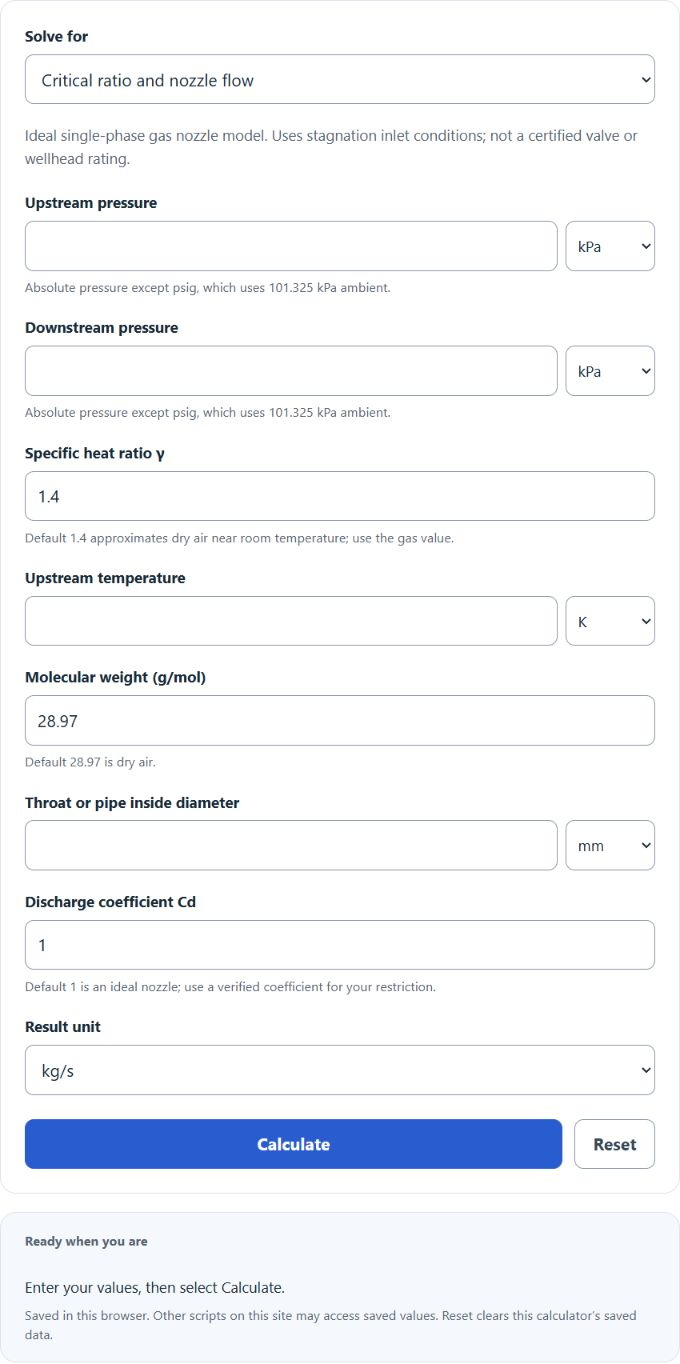
Calculate critical pressure ratio, choked gas flow, and valve Cv from pressure, temperature, diameter, flow, and gas properties in piping systems.
Related Calculators
- CO2 Flow Rate Calculator
- Formation Pressure Calculator
- Haaland Equation Calculator
- Theoretical Velocity Calculator
- All Physics Calculators
Choke Coefficient Formula
There is no single universal “choke coefficient” that can be calculated as a simple ratio like flow divided by pressure drop. In practice, different coefficients are used depending on the correlation and regime. The critical-ratio mode calculates the ideal nozzle coefficient xcrit = 1 − r*, where r* is the critical downstream-to-stagnation-pressure ratio. Straight-pipe Fanno and simplified gas/liquid valve Cv modes use different models.
Variables:
- r* is the ideal nozzle critical downstream-to-upstream stagnation-pressure ratio
- xcrit is the dimensionless ideal nozzle pressure-drop ratio at choking
- γ is the gas specific heat ratio; Cd is a supplied dimensionless mass-flow correction
- P1 is the upstream absolute stagnation pressure for nozzle and pipe modes
- d is the throat or pipe inside diameter; select m, mm, in or ft
Nozzle flow uses ideal-gas compressible equations, Cd and the entered geometry. Pipe flow solves the adiabatic straight-pipe Fanno equations with Darcy friction; generic fitting K presets are not a validated compressible-junction model and are excluded. Valve gas flow uses the supplied manufacturer xT, with Z and piping factor assumed 1; liquid flow assumes nonchoked incompressible conditions.
What is a Choke Coefficient?
“Choke coefficient” is a general term used for a parameter that relates flow rate to upstream conditions and choke size for a particular choke model or correlation. Depending on the application, this may refer to:
- a discharge coefficient (Cd) used with orifice/nozzle flow equations (dimensionless), and/or
- a critical pressure-drop ratio for an ideal nozzle, or a manufacturer-specific valve factor xT. These are not interchangeable.
Because the definition depends on the chosen model and units, it’s important to use the coefficient in the same way it was defined or calibrated.
How to Calculate Choke Coefficient?
The following steps apply to Critical ratio and nozzle flow. Select a separate pipe or valve solve for those tasks.
- Determine the upstream absolute pressure P1 (for example, psia).
- Enter downstream static pressure, gas specific heat ratio, stagnation temperature and molecular weight.
- Enter throat diameter and a verified discharge coefficient Cd; the default 1 represents an ideal nozzle.
- Choose a mass-flow result unit. Gauge conversions use 101.325 kPa ambient; the equations use absolute pressure.
- Select Calculate. Compare the actual downstream/upstream ratio with r*; flow is choked when the actual ratio is no greater than r*.
Example Problem :
Use the following variables as an example problem to test your knowledge.
Upstream stagnation pressure = 500 kPa absolute; downstream pressure = 100 kPa absolute
Throat diameter = 10 mm; stagnation temperature = 300 K; molecular weight = 28.97 g/mol; γ = 1.4
Discharge coefficient (Cd) = 1 (ideal nozzle)
Actual pressure ratio = 0.2; critical ratio r* ≈ 0.528282; flow is choked
Compute the ideal nozzle choke coefficient and mass flow:
xcrit = 1 − r* ≈ 0.471718; ideal choked mass flow ≈ 0.09163823 kg/s