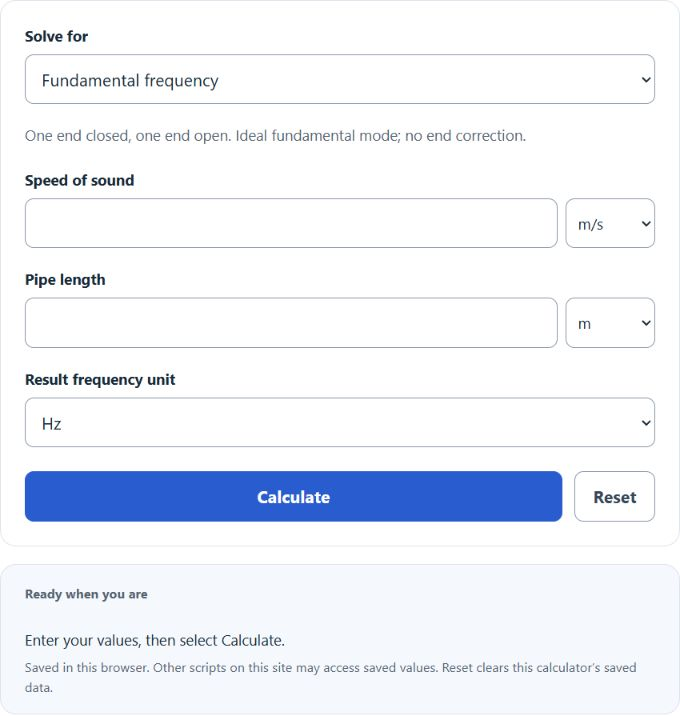
Calculate closed pipe resonance frequency, speed of sound, or pipe length from any two values using the fundamental resonance formula.
Related Calculators
- Port Length Calculator
- Speaker Delay Calculator
- Angular Frequency Calculator
- DB Gain Calculator
- All Physics Calculators
Closed Pipe Resonance Formula
For the ideal fundamental of a tube closed at one end and open at the other, use:
- f = fundamental frequency in hertz
- v = sound speed in meters per second
- L = pipe length in meters
The inverse equations are v = 4Lf and L = v / (4f). Choose the quantity to solve for and enter the other two, using positive values and the corresponding units. The result and conversion steps appear below the controls.
Closed Pipe Resonance Examples
At a sound speed of 340 m/s, a 0.5 m pipe has a fundamental of 340 / (4 × 0.5) = 170 Hz. Conversely, 170 Hz and 0.5 m imply 340 m/s; 340 m/s and 170 Hz imply 0.5 m.
Model Limits
This model omits end corrections. Higher ideal resonances occur at odd multiples of the fundamental. A tube open at both ends uses a different equation. Use the sound speed appropriate to the medium and conditions.