Calculate port length for a vented box from vent diameter, number of ports, box volume and tuning frequency, with all unit options.
- All Physics Calculators
- Sound Pressure Level Calculator
- dB to Percentage Calculator
- dB to Watts Calculator
- Aero Port Area Calculator
Port Length Formula
The port length calculator estimates the physical cut length of a round vent for a ported speaker or subwoofer enclosure. In a bass-reflex design, the enclosure volume and the air mass inside the port form a tuned system. If the port is too short, the box tunes too high. If the port is too long, the box tunes too low.
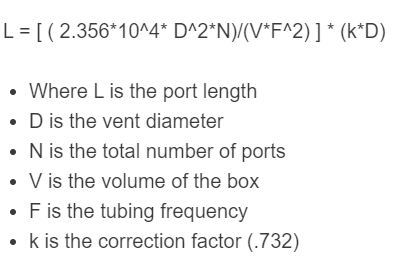
- L = physical port length
- D = vent diameter
- N = total number of ports
- V = net box volume
- F = tuning frequency
- k = end-correction coefficient
This form of the equation is commonly used with D in inches, V in cubic feet, and F in hertz. The diameter should be the internal diameter of each round port. The calculator uses sound speed 1125.33 ft/s (about 20 °C), C = c²/(192π) ≈ 2099.4653 and k = 0.732, approximating one flanged and one free end. The rounded coefficient above is illustrative. Flare style, nearby walls and port termination change the effective length.
What Port Length Means
Port length is the distance the air column travels inside the vent tube. That air column acts like a moving mass. Together with the air spring inside the box, it sets the enclosure tuning. Increasing port length lowers tuning frequency, while shortening the port raises it. Port diameter matters at the same time: a larger diameter reduces air velocity and noise, but it also requires a longer tube to reach the same tuning.
How to Use the Calculator
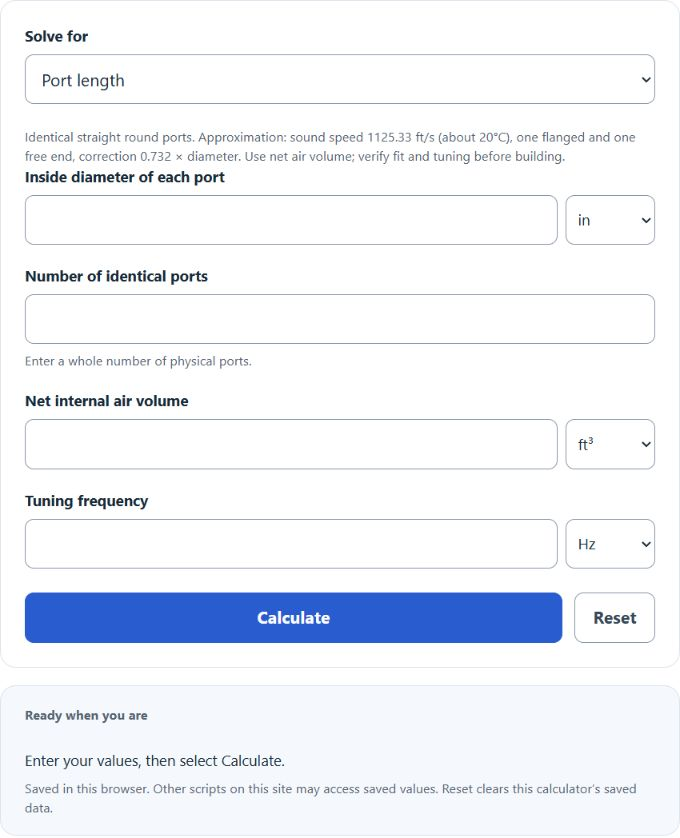
- Enter the inside diameter of one round port.
- Enter the total number of identical ports.
- Use the net internal box volume rather than the gross cabinet size.
- Enter the target tuning frequency.
- Calculate the required port length and confirm that it physically fits inside the enclosure.
Net volume is important because the woofer basket, bracing, amplifier plate, and the port itself all occupy space. Ignoring those displacements changes the effective air volume and shifts the final tuning.
Example
For one 4 in port, a 2 ft3 net enclosure, and a 32 Hz tuning target, the estimated port length is about 13.47 in when k = 0.732.
Design Notes
- Use net volume: subtract the displacement of the driver, bracing, terminal cup, and port.
- Use inside diameter: the tuning depends on the air column inside the vent, not the outer tube size.
- Multiple ports change length: adding ports increases total vent area and changes the required length through the N term.
- Larger ports are quieter: lower air speed helps reduce chuffing, but larger ports usually need more length.
- Smaller ports are easier to fit: they shorten required length, but air velocity can become too high at strong output levels.
- Allow end clearance: keep the inner end of the port away from the cabinet wall so airflow is not restricted.
- Flared ports can behave differently: if you are using aero or flared ports, the effective length may differ slightly from a straight unflared tube.
- Round-port equation: this calculator is best suited to round vents; slot ports are usually designed from equivalent vent area and geometry.
Common Questions
Does a longer port always mean better bass?
A longer port lowers the tuning frequency, but the best tuning depends on the driver, enclosure size, and the response you want. Lower tuning is not automatically better if it reduces output in the range you care about most.
What if the port length is too long to fit inside the box?
You can redesign the enclosure, use bends in the port path, change the number of ports, or adjust diameter and tuning. Any geometry change should be recalculated before building.
What does a very short or negative result suggest?
It means the assumed acoustic length is no greater than the end correction. Lower frequency, reduce net volume, or increase diameter or port count, then reassess fit and the acoustic assumptions.
Why can two boxes with the same woofer need different port lengths?
Because port length depends on enclosure volume, tuning target, vent diameter, and the number of ports. Changing any one of those inputs changes the required length.