Calculate power or signal dB to percentage and linear ratio, with equivalent power, voltage, or field levels at the same impedance.
- All Unit Converters
- DB to Watts Calculator
- Decibel Calculator
- Sound Pressure Level Calculator
- dB Per Inch Calculator
dB to Percentage Formula
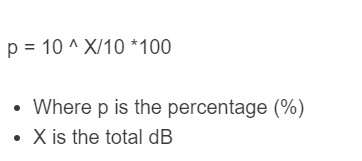
The calculator converts decibels to a linear ratio, then multiplies by 100 to express that ratio as a percentage of the original level. Two formulas are used depending on whether the quantity is a power or a field quantity such as voltage, current, or sound pressure.
Power mode:
Signal mode (voltage, current, sound pressure):
- Percent: the resulting level as a percentage of the original
- dB: the decibel value (positive for gain, negative for loss)
- Ratio: the linear ratio, equal to Percent / 100
Assumptions: dB is a logarithmic ratio between two values of the same quantity. Use the power formula (factor 10) when comparing watts, milliwatts, or any energy or power quantity. Use the signal formula (factor 20) when comparing voltages, currents, or sound pressures at the same impedance. The 20 factor follows the squared amplitude-to-power relationship under the stated conditions. A 100% decrease or zero remaining has no finite dB value and is rejected.
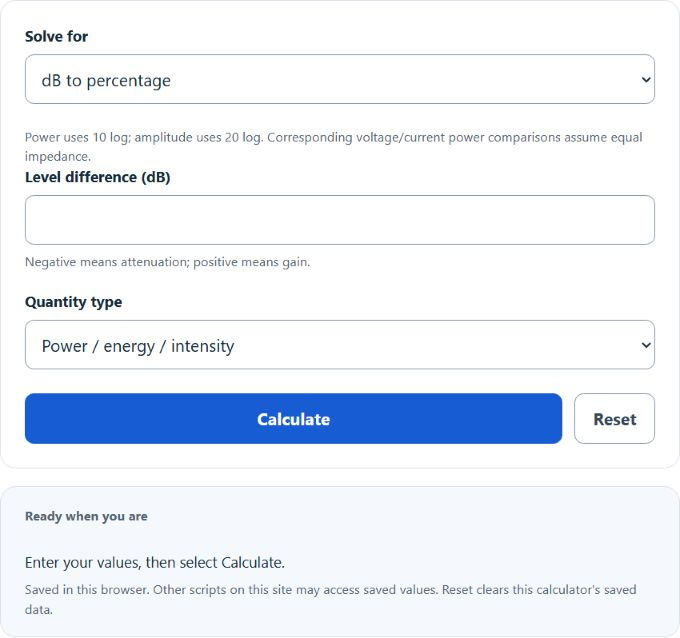
Choose dB to percentage or Percentage to dB, then choose Power or Amplitude. For percentage input, specify percent remaining, increase or decrease. Forward results show both domains at the same dB; inverse results compare treating the entered percentage as power or amplitude. Linear ratio and calculation steps are in Calculation details.
Reference Tables
Common dB values and their equivalent percentages and ratios:
| dB | Power % | Signal % | Power ratio | Signal ratio |
|---|---|---|---|---|
| +20 | 10000% | 1000% | 100× | 10× |
| +10 | 1000% | 316.2% | 10× | 3.162× |
| +6 | 398.1% | 199.5% | 3.981× | 1.995× |
| +3 | 199.5% | 141.3% | 1.995× | 1.413× |
| +1 | 125.9% | 112.2% | 1.259× | 1.122× |
| 0 | 100% | 100% | 1× | 1× |
| -1 | 79.4% | 89.1% | 0.794× | 0.891× |
| -3 | 50.1% | 70.8% | 0.501× | 0.708× |
| -6 | 25.1% | 50.1% | 0.251× | 0.501× |
| -10 | 10% | 31.6% | 0.1× | 0.316× |
| -20 | 1% | 10% | 0.01× | 0.1× |
| -30 | 0.1% | 3.16% | 0.001× | 0.0316× |
Which formula to use for common quantities:
| Quantity | Mode | Factor |
|---|---|---|
| Electrical power (W, mW; relative dBm differences) | Power | 10 |
| RF signal power | Power | 10 |
| Acoustic intensity | Power | 10 |
| Voltage (audio level, dBV, dBu) | Signal | 20 |
| Current | Signal | 20 |
| Sound pressure (dB SPL) | Signal | 20 |
| Electric or magnetic field strength | Signal | 20 |
Worked Examples and FAQ
Example 1: -3 dB power loss. Using the power formula, 10^(-3/10) = 0.501. The output is 50.1% of the original power. This is why -3 dB is called the half-power point.
Example 2: -6 dB voltage attenuation. Using the signal formula, 10^(-6/20) = 0.501. The output voltage is 50.1% of the input. The same -6 dB expressed as power is 25.1% of original power, because power scales as voltage squared.
Example 3: +10 dB amplifier gain. Using the power formula, 10^(10/10) = 10. The output power is 1000% of the input, or ten times the original.
Why is -3 dB sometimes 50% and sometimes 70.7%? It depends on what the dB value describes. -3 dB of power is 50.1% of the original power. -3 dB of voltage is 70.8% of the original voltage, because voltage uses the factor of 20.
Can the percentage be over 100%? Yes. Any positive dB value gives a result above 100%, which means the level is larger than the reference. +20 dB power equals 10000% of the original.
Can dB be negative? Yes. Negative dB means the value is smaller than the reference, so the percentage is less than 100%.
What does 0 dB mean? 0 dB is a ratio of 1, or 100% of the reference. The two values being compared are equal.
How do dBm and dBW convert to a percentage? dBm and dBW are absolute units referenced to 1 mW and 1 W. To get a percentage you need a reference level. Subtract the reference dBm from the measured dBm to get a relative dB value, then use the power formula here.