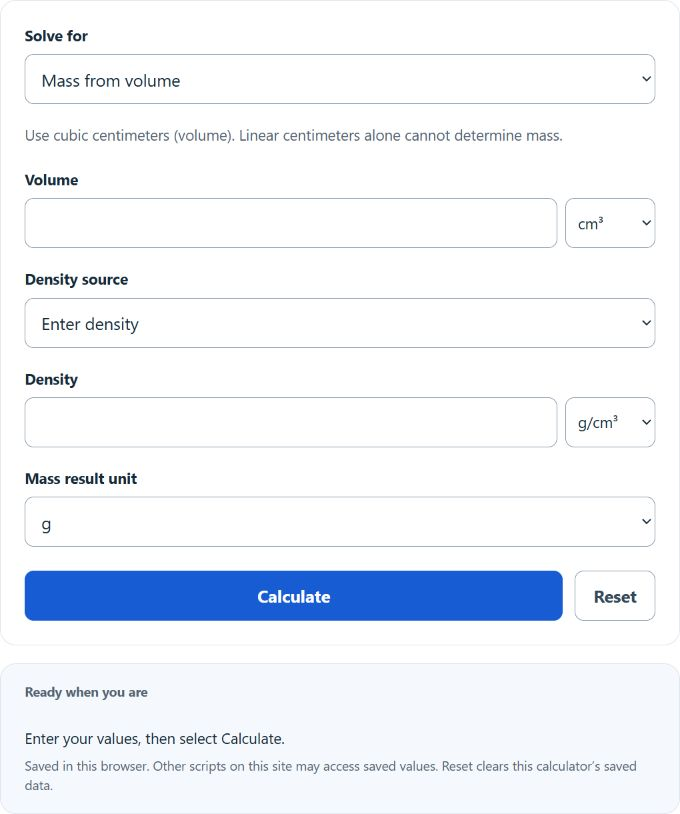
Convert cubic centimeters to grams, grams to cubic centimeters, or find density from mass and volume. Select the solve mode and units. Use a known density or a qualified approximate preset; flour and sugar require a bulk density appropriate to your measurement and packing method.
| Volume to Mass (Water) | Mass to Volume (Water) |
|---|---|
| 1 mL (1 cm³) = 1 g | 1 g = 1 mL (1 cm³) |
| 5 mL (5 cm³) = 5 g | 5 g = 5 mL (5 cm³) |
| 10 mL (10 cm³) = 10 g | 10 g = 10 mL (10 cm³) |
| 15 mL (15 cm³) = 15 g | 15 g = 15 mL (15 cm³) |
| 30 mL (30 cm³) = 30 g | 30 g = 30 mL (30 cm³) |
| 50 mL (50 cm³) = 50 g | 50 g = 50 mL (50 cm³) |
| 100 mL (100 cm³) = 100 g | 100 g = 100 mL (100 cm³) |
| 125 mL (125 cm³) = 125 g | 113.398 g (4 oz) = 113.398 mL |
| 150 mL (150 cm³) = 150 g | 125 g = 125 mL (125 cm³) |
| 200 mL (200 cm³) = 200 g | 200 g = 200 mL (200 cm³) |
| 236.588 mL (1 US cup) = 236.588 g | 226.796 g (8 oz) = 226.796 mL |
| 240 mL = 240 g | 250 g = 250 mL (250 cm³) |
| 250 mL = 250 g | 453.592 g (1 lb) = 453.592 mL |
| ≈355 mL (12 US fl oz) = ≈355 g | 500 g = 500 mL (500 cm³) |
| 473.176 mL (1 US pint) = 473.176 g | 750 g = 750 mL (750 cm³) |
| 500 mL = 500 g | 907.185 g (2 lb) = 907.185 mL |
| 750 mL = 750 g | 1000 g = 1000 mL (1 L) |
| 946.353 mL (1 US qt) = 946.353 g | 2000 g = 2000 mL (2 L) |
| 1000 mL (1 L) = 1000 g | 5000 g = 5000 mL (5 L) |
| 3785.412 mL (1 US gal) = 3785.412 g | 10000 g = 10000 mL (10 L) |
| Formulas: m = V × ρ and V = m ÷ ρ. This table uses the approximate water density ρ = 1.000 g/cm³, so 1 mL (1 cm³) corresponds to 1 g in this model. Actual water density varies with temperature; named US volume and avoirdupois mass conversions are rounded. | |
Related Calculators
- Grams To mm Calculator
- Centimeter to Cubic Feet Conversion Calculator
- mm To cc Calculator
- Grams of Sugar to Tsp Conversion Calculator
- All Unit Converters
cm³ To Grams Formula
The following formula is used to calculate the mass, volume, or density when two of the three variables are known.
Variables:
- M is the mass in grams
- V is the volume in cubic centimeters (cm³)
- D is the density in grams per cubic centimeter (g/cm³)
To calculate the mass, multiply the volume by the density. To find the volume, divide the mass by the density. To determine the density, divide the mass by the volume.
What is cm³ To Grams?
The cm³ To Grams calculator is a tool used to convert between mass, volume, and density. This is particularly useful in various scientific and engineering applications where understanding the relationship between these variables is crucial. For instance, in material science, knowing the density and volume of a material can help determine its mass, which is essential for various calculations and practical applications.
How to Calculate cm³ To Grams?
The following steps outline how to calculate the mass, volume, or density using the cm³ To Grams formula.
- First, determine the two known variables (mass, volume, or density).
- Next, use the formula M = V * D to calculate the missing variable.
- If calculating mass, multiply the volume by the density.
- If calculating volume, divide the mass by the density.
- If calculating density, divide the mass by the volume.
- After inserting the values and calculating the result, check your answer with the calculator above.
Example Problem :
Use the following variables as an example problem to test your knowledge.
Mass (M) = 50 grams
Volume (V) = 25 cm³
Density (D) = 2 g/cm³