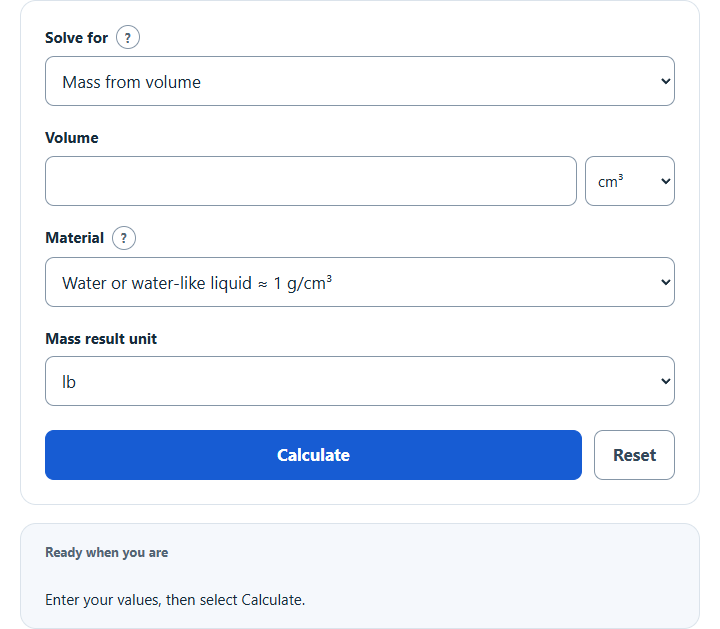
Convert cm to lbs from cubic centimeters using water or your own density, or from length in cm and weight per length. Also converts lbs back to cm.
cm to lbs Conversion Formula
Linear centimeters alone do not determine pounds. Use length with linear mass density, or cubic centimeters with volume density:
Formula source: National Institute of Standards and Technology (NIST) Special Publication 811, Appendix B – Conversion Factors (2008)
Variables:
- mass (lb) is the avoirdupois mass in pounds
- length is measured in cm; volume is measured in cm³, which is a different quantity
Multiply length by the object’s linear mass density, or volume by the material’s volume density, then convert grams to pounds. A density or linear density is required; there is no universal cm-to-lb conversion factor.
| Cubic Centimeters (cm³) | Pounds (lb) |
|---|---|
| 1 | 0.002 |
| 5 | 0.011 |
| 10 | 0.022 |
| 25 | 0.055 |
| 50 | 0.110 |
| 75 | 0.165 |
| 100 | 0.220 |
| 125 | 0.276 |
| 150 | 0.331 |
| 200 | 0.441 |
| 250 | 0.551 |
| 300 | 0.661 |
| 350 | 0.772 |
| 400 | 0.882 |
| 450 | 0.992 |
| 500 | 1.102 |
| 750 | 1.653 |
| 1000 | 2.205 |
| 1500 | 3.307 |
| 2000 | 4.409 |
| * Rounded to 3 decimals. Assumes water (ρ = 1.00 g/mL). 1 cm³ water ≈ 1 g; 1 cm³ ≈ 0.002205 lb (1 lb = 453.59237 g). | |
What is the cm to lbs Conversion?
Length in cm needs a known linear mass density to determine mass in pounds. Volume in cm³ needs a known volume density. The water table uses the approximate density 1 g/cm³, so 1 cm³ corresponds to approximately 0.00220462 lb in that model. Actual water density depends on temperature. The calculator defaults to water and lets you enter another density.
How to Convert cm to lbs?
The following steps calculate mass from length and linear mass density:
- First, measure the length in centimeters (cm) and determine the object’s linear mass density.
- Next, multiply length (cm) by linear density (g/cm), then divide by 453.59237 to obtain pounds.
- Finally, calculate the mass in pounds (lb). For volume, select Mass from volume and enter cm³ with volume density instead.
- Check the chosen solve mode and units against your measurements, then compare your answer with the calculator above.
Example Problem:
Use the following variable as an example problem to test your knowledge.
Length = 50 cm; linear mass density = 0.02 kg/cm. Mass = 50 × 0.02 = 1 kg = approximately 2.20462262 lb.